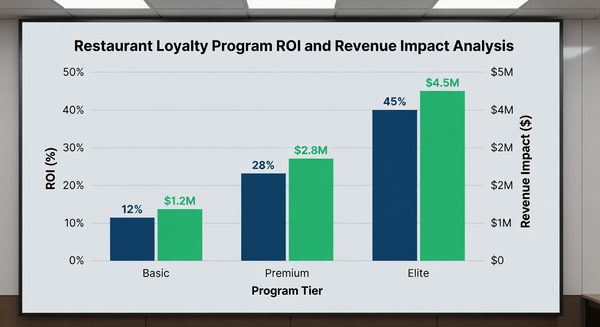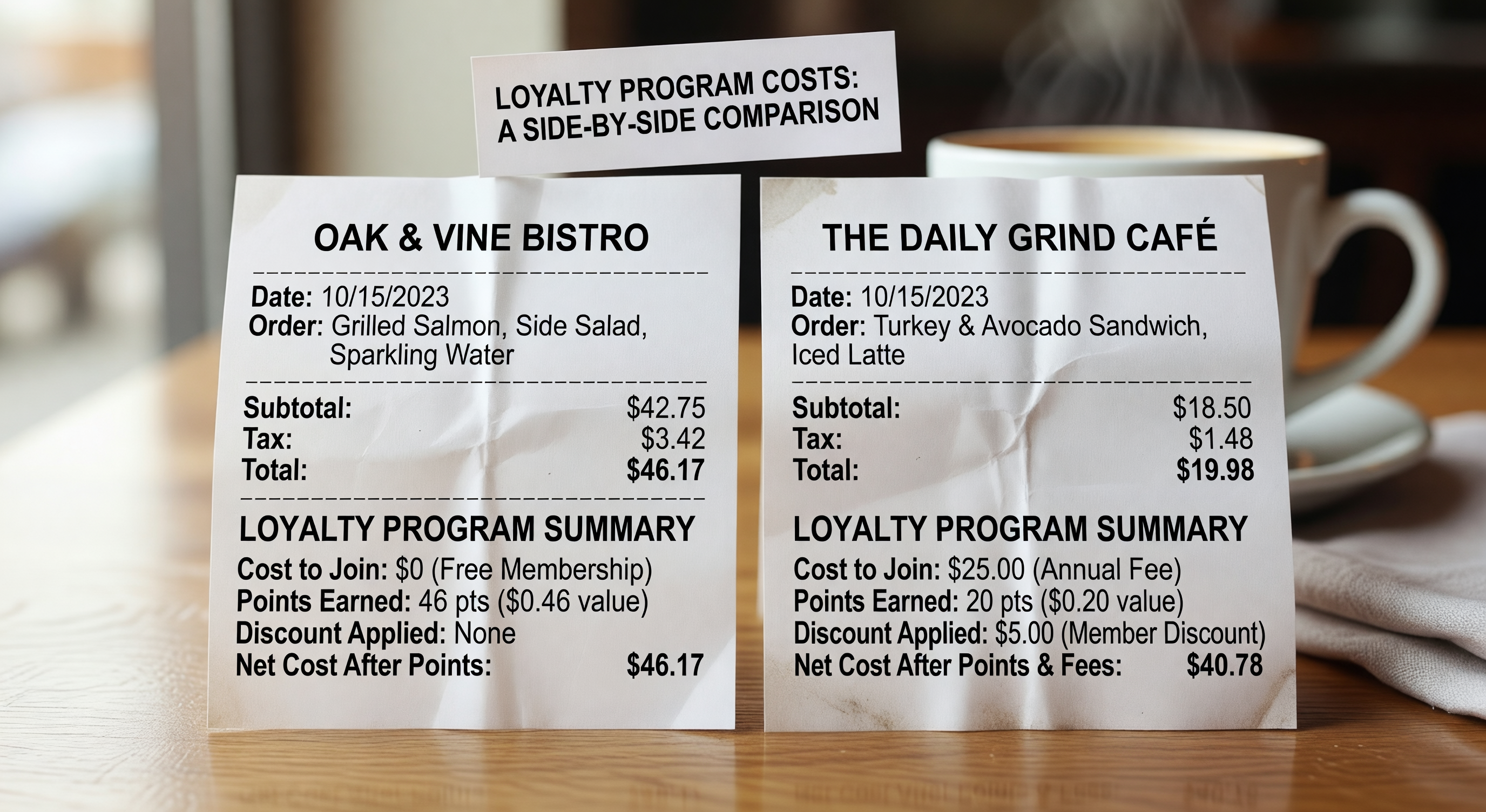
The investor pitch for restaurant loyalty programs is seductive: invest in a platform, build a member base, and watch average check and visit frequency rise. What the pitch rarely includes is the complete cost picture — the platform licensing fees, the unredeemed point liability on the balance sheet, the operational overhead, and the breakage math that determines whether the unit economics actually work.
This is the version of the conversation your loyalty vendor isn’t having with you.
Platform Licensing: What Operators Actually Pay
The restaurant loyalty technology landscape includes a range of vendors operating across different price tiers. Published pricing is not standard — most enterprise solutions are negotiated — but published entry points and publicly available pricing tiers provide a working baseline.
At the low end of the market, white-label loyalty platforms built for smaller chains and independent restaurants start at approximately $100–300 per month for basic point-tracking and redemption functionality. These solutions typically lack sophisticated segmentation, predictive analytics, or deep POS integration. They work for simple earn-and-redeem programs but don’t provide the data infrastructure that makes loyalty programs genuinely valuable.
Mid-market platforms — the tier appropriate for regional chains with 25–200 locations — typically price in the range of $500–2,500 per month for base licensing, with additional fees for POS integration, SMS marketing, advanced analytics, and loyalty-linked gift card functionality. Vendors in this space include Paytronix, Thanx, and Punchh (now part of PAX Technology). Pricing at this tier is heavily negotiated based on location count and contracted feature set.
Enterprise solutions for national chains involve custom contracts and typically bundle the loyalty platform with broader CRM and marketing automation infrastructure. These contracts can run from $50,000 to $500,000+ annually, not including the implementation costs that can match or exceed the first-year licensing fee.
The hidden cost in platform licensing is integration. Connecting a loyalty platform to existing POS systems, kitchen display systems, and delivery platform integrations requires development work that vendors sometimes underestimate in their sales process. IT and integration costs at a multi-unit chain can add 30–50% to the first-year cost of a loyalty program implementation.
Point Liability: The Balance Sheet Problem Most Operators Ignore
Every time a loyalty member earns a point, you’ve issued a liability. The consumer has a valid claim — denominated in program currency — on future goods or services. Under standard accounting treatment, loyalty program liabilities must be recognized in a way that reflects the portion of points expected to eventually be redeemed.
For large public companies, this creates a material line item. Starbucks, as the most prominent example, has historically carried hundreds of millions of dollars in deferred revenue associated with its loyalty program — primarily from gift cards and stored-value balances, but also from outstanding Stars (as of recent fiscal years; consult current SEC filings for the latest figure). The company discloses this figure in its financial statements and must estimate both the redemption timeline and the expected breakage rate.
For a mid-size restaurant group, the math is smaller but structurally identical. A chain with 50 locations, averaging 200 loyalty-earning transactions per day per location, issuing 10 points per dollar on a $12 average check: that’s 200 × 50 × 120 = 1,200,000 points per day, or roughly 438 million points per year. If a free entrée costs 1,250 points and is priced at $9, the theoretical maximum liability from one year of points is (438,000,000 ÷ 1,250) × $9 = approximately $3.15 million.
Of course, not all those points will be redeemed — breakage reduces the actual liability. But the gross figure is the starting point, and it belongs on the balance sheet. Many smaller operators don’t account for this properly until an audit requires them to.
Breakage Calculation: The Revenue You’re Counting On
Breakage — the percentage of issued points that consumers never redeem — is both an accounting variable and a business model component. Operators with healthy loyalty programs rely on breakage to make the program economics work.
Industry data on restaurant loyalty breakage rates varies significantly by program design. Well-designed programs with low redemption thresholds and broad offer clarity tend to see redemption rates of 40–60%, implying breakage of 40–60%. Poorly designed programs with high thresholds and confusing terms see redemption rates below 25%, with breakage above 75%.
The tension is obvious: high breakage improves the operator’s economics but signals a program that isn’t delivering value to consumers. The programs with the highest breakage rates are, by definition, the ones providing the least consumer benefit — and over time, consumer perception of those programs tends to deteriorate.
The breakage calculation for a mid-size chain looks like this: if you issue $3.15 million in theoretical point liability annually and your historical redemption rate is 35%, your expected redemption cost is approximately $1.1 million — and your expected breakage benefit is approximately $2.05 million. That breakage benefit directly offsets program costs in the P&L. The accuracy of the estimate matters: overestimating breakage understates liability; underestimating it overstates it.
Operational Overhead: The Costs That Don’t Show Up in Vendor Proposals
Beyond platform licensing and point liability, loyalty programs impose operational costs that rarely appear in vendor proposals or industry benchmarks.
Staff training is ongoing, not one-time. Every new hire at a loyalty-enabled location needs to understand how to process loyalty transactions, handle enrollment, troubleshoot common errors (expired points, missing credits, duplicate accounts), and explain the program to customers. At a chain with meaningful staff turnover — and restaurant turnover rates run among the highest of any industry — this training cost is persistent. For a 50-location chain with significant turnover, the annual training cost associated with loyalty operations can represent tens of thousands of dollars when counted honestly.
Customer service overhead from loyalty program issues is often undercounted. Missing points, disputed redemptions, and account problems generate contacts to customer service channels. These contacts cost money — either in call center time or in the management overhead of resolving complaints. Programs with opaque earn mechanics or easily triggered expiration policies generate disproportionately high service volume.
Promotional cannibalization is a cost that requires careful measurement. Loyalty members who receive targeted promotional offers — which is the primary mechanism through which loyalty programs claim to drive incremental visits — would have visited anyway in some percentage of cases. The discount given to a member who would have visited regardless is a pure margin hit. Separating true incremental visits from visits that would have occurred without the incentive requires test-and-control methodology that most operators don’t run rigorously.
Unit Economics Model: A Mid-Size Casual Dining Chain
The following model is illustrative — a framework for structuring the analysis, not a guarantee of specific outcomes. The assumptions should be replaced with your actual program data when available.
Assumptions:
- 75 locations, averaging $1.2M in annual restaurant-level revenue per location
- 18% of transactions from loyalty members (industry median for early-stage programs)
- Average loyalty member check: $14 (vs. $11 for non-members)
- Points earn rate: 10 points per dollar
- Free entrée reward cost: 1,250 points (value: $9)
- Effective program discount rate: 7.2% on loyalty transactions
- Historical redemption rate: 38%
- Platform licensing: $1,800/month ($21,600/year)
- Implementation and integration (year 1): $45,000
- Annual staff training overhead: $30,000
- Customer service overhead: $18,000/year
Revenue picture:
- Total chain revenue: $90M
- Loyalty member revenue (18%): $16.2M
- Check size uplift from loyalty members: $3 per transaction × estimated 1.16M loyalty transactions = ~$3.48M in incremental revenue attributable to the check uplift effect
Cost picture:
- Platform licensing: $21,600
- Training overhead: $30,000
- Customer service: $18,000
- Point redemption cost (38% of 7.2% of $16.2M): ~$444,000
- Promotional offer cost (estimated at 2% of loyalty revenue): ~$324,000
- Total annual program cost: approximately $837,600 (year 2+, excluding implementation)
Net calculation:
- Incremental revenue from check uplift: ~$3.48M
- Less: program costs: ~$837,600
- Estimated net program contribution: ~$2.64M
This is a simplified model, and the check uplift assumption is the most sensitive input. If loyalty members would have spent $14 regardless of the program — meaning the difference versus non-members reflects self-selection rather than program influence — the model changes dramatically. Rigorous programs test this with matched control groups; most programs don’t.
When to Launch, Upgrade, or Kill a Program
The build-vs-buy decision for a loyalty program is not binary, and the “right time to launch” question deserves a direct answer rather than a framework platitude.
Launch when: you have stable POS infrastructure, a defined customer base with sufficient frequency to reach redemption thresholds within 60–90 days of enrollment, and the staff bandwidth to train and support the program at launch. Launching a loyalty program during an operational pivot or a major IT project is a reliable way to create a program nobody uses well.
Upgrade when: your current platform can’t segment your member base by behavior — if you’re sending the same offer to a customer who visits twice a week and a customer who’s lapsed for four months, your platform is a point ledger, not a loyalty tool. The upgrade threshold is when the data you’re collecting stops informing meaningful marketing decisions.
Kill it when: your redemption rate drops below 20% despite promotional investment, your platform costs are exceeding your estimated breakage benefit, and your member base is shrinking rather than growing. A failing loyalty program is not neutral — it actively damages brand perception for members who enrolled with genuine interest and found the program didn’t deliver.
Loyalty programs are not inherently profitable. They are profitable when designed with honest accounting, realistic redemption assumptions, and the operational infrastructure to execute them well. The chains that succeed with loyalty tend to be the ones that treat it as a long-term customer relationship investment, not a marketing tactic with a 90-day payback window.
Frequently Asked Questions
What does it typically cost to launch a restaurant loyalty platform?
Platform licensing for mid-market restaurant chains (25–200 locations) typically runs $500–2,500 per month, depending on features and location count. First-year implementation and POS integration costs can add $30,000–80,000 for a multi-unit chain. Enterprise solutions for national brands involve custom contracts that can run $50,000–500,000+ annually before implementation. These figures reflect publicly available pricing tiers and typical negotiated ranges — specific costs depend heavily on vendor and program scope.
How do you account for unredeemed loyalty points on the balance sheet?
Under GAAP, loyalty point liabilities must be recognized in a way that reflects expected future redemptions. Points that are expected to be redeemed represent a deferred revenue liability — the transaction revenue is partially deferred until the reward obligation is fulfilled. Points expected not to be redeemed (breakage) can be recognized as revenue using either a proportional or delayed recognition method depending on accounting treatment chosen. Operators should work with their accountants to establish a consistent methodology before launching.
What is a reasonable breakage assumption for restaurant loyalty programs?
Breakage assumptions should be grounded in your specific program design, not industry averages. Programs with low redemption thresholds and high reward clarity tend to see 40–60% redemption rates (40–60% breakage). Programs with high thresholds, complex mechanics, or poor member communication see redemption rates below 25%. Your initial breakage assumption should be conservative — overestimating breakage understates your true liability. Revise annually based on actual redemption data.
Is staff training a significant cost factor for restaurant loyalty programs?
Yes, and it’s consistently underestimated. Restaurant staff turnover rates run well above the national average across all sectors, meaning training is an ongoing rather than one-time cost. Staff who don’t understand the program create poor member experiences — failed point credits, incorrect redemption processing — that generate customer service contacts and erode program value. Budget for training as a recurring annual expense, not a launch-week line item.
How do you measure whether a loyalty program is generating real incremental revenue?
The most reliable approach is a matched control group: identify members who enrolled in the loyalty program and compare their visit frequency and check size against a demographically similar group of non-enrolled customers. Without this control, the comparison between members and non-members reflects self-selection bias — frequent customers are more likely to enroll, making the member cohort look more valuable than the program actually made them. Operators running loyalty programs without test-and-control measurement are flying blind on true incrementality.
Further Reading from Authoritative Sources
- National Retail Federation — NRF publishes industry data on loyalty program investment and returns across the restaurant and retail sectors, providing the benchmarks against which the cost model in this article is calibrated.
- FTC consumer data guidance — FTC guidance on loyalty program terms disclosure and consumer rights is relevant to how restaurants communicate program economics to members, particularly around point expiration and program changes.