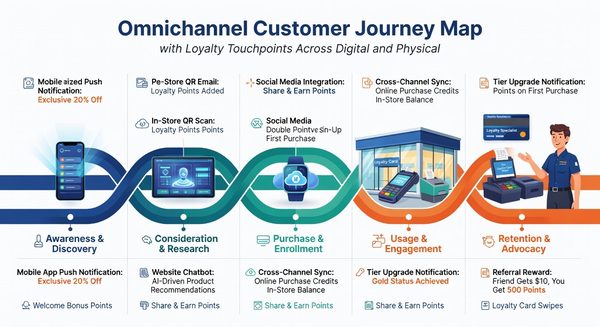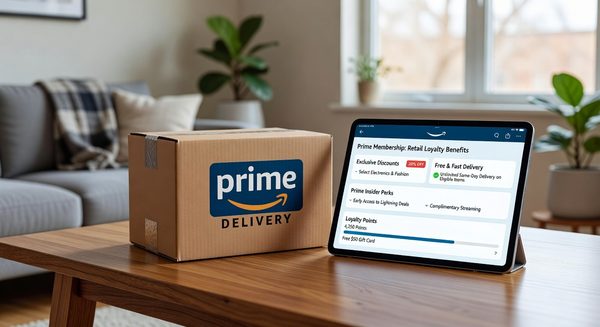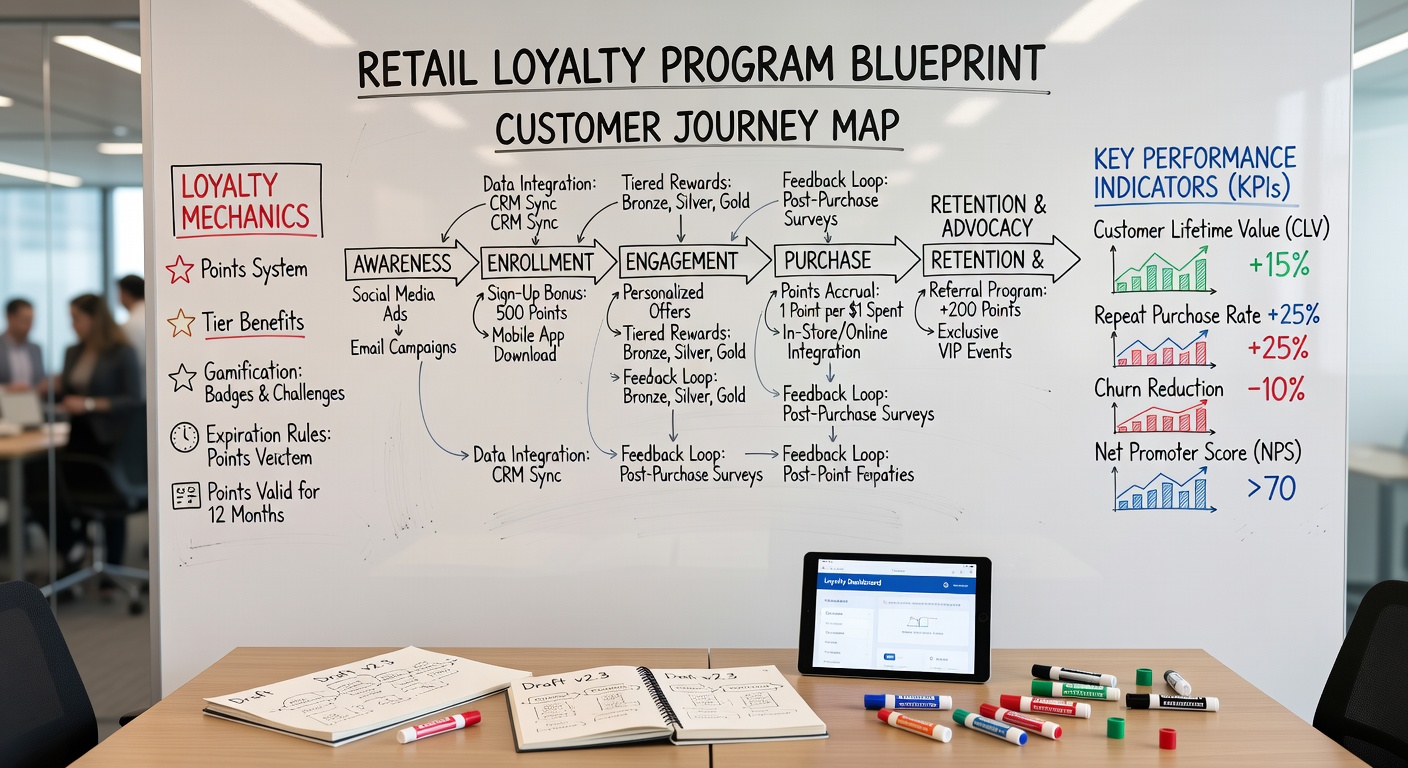
Designing a retail loyalty program in 2025 is a different exercise than it was even five years ago. The shopper expectations have shifted, the technology has matured, the competitive landscape is more crowded, and the right answers for any given retailer are harder to derive from generic best-practice templates. This framework walks through the major design decisions a retailer faces when building or rebuilding a loyalty program, with practical guidance on how to make each decision against the specifics of the business.
The Earn Structure Decision
The first decision is what the program rewards and how it measures the rewarded behavior.
Points per dollar is the most common earn structure and the easiest for members to understand. It scales reward to spend, which is generally what retailers want. The risk is that it can feel like a small kickback on every purchase rather than a meaningful relationship benefit.
Points per visit rewards frequency rather than spend. This works well in categories where the retailer values traffic over per-trip basket size — coffee, fast casual, certain specialty retail. It can produce engagement patterns that misalign with profitability if the program is not designed carefully.
Tiered cashback offers different earn rates by tier or category. This adds complexity but can be useful when the retailer wants to incentivize specific behavior beyond raw spend — promoting high-margin categories, encouraging channel choices, or rewarding the most engaged members at richer rates.
Visit-and-spend hybrid structures combine both mechanics — earning a small reward for any visit and additional reward for the spend. This works in categories where the retailer wants to drive both frequency and basket size.
The right structure depends on the underlying business model. Spend-driven retailers should generally use points per dollar. Frequency-driven retailers should consider visit-based or hybrid mechanics. The mistake is to default to the most common structure without thinking about which behavior the program actually needs to drive.
Reward Portfolio Design
What members can redeem for matters as much as how they earn.
Cash-equivalent rewards — dollars off a future purchase, percent-off coupons — are the most flexible and the most understood by members. They are also the most expensive for the retailer per dollar of perceived value, because the dollar discount has roughly a dollar of margin cost.
Product rewards offer a richer redemption experience and a more favorable cost equation for the retailer. The wholesale cost of a redeemable product is lower than the retail value the member perceives. Beauty samples, branded merchandise, and partner products are common examples.
Experiential rewards — events, services, early access, expert consultations — can deliver high member-perceived value at moderate retailer cost. They also reinforce brand positioning in ways cash discounts do not.
Charitable redemption — donating points to causes — has growing relevance, particularly with younger members. The cost to the retailer is the cash equivalent of the donation, but the brand and engagement benefits often justify it.
The most effective reward portfolios offer multiple redemption types at multiple point thresholds, so members at any engagement level have desirable options. The single-currency, single-reward-type model creates a redemption ceiling problem — members accumulate beyond what they can usefully redeem, and the program’s perceived value flattens.
Tier Architecture
Whether to use tiers, and how to structure them, is one of the most consequential design decisions.
The case for tiers is straightforward. Tiers create status, differentiate the most engaged members, and provide a structure for delivering richer benefits to the segment that drives the most value. Well-designed tier programs significantly outperform flat-structure programs in member engagement and lifetime value.
The case against unnecessary tiers is equally real. Adding tiers to a program that does not need them complicates the member experience, requires more operational support, and can frustrate members who feel they are working toward a status that does not feel meaningfully different from the level below it.
The right question is whether tiers add enough differentiation to justify the complexity. Programs serving a customer base with meaningful variation in engagement and spend usually benefit from tiers. Programs serving a more uniform customer base often do not.
When using tiers, the thresholds should be calibrated such that a meaningful share of engaged members can reach the upper tiers, and the benefits at each tier should be visibly different from the one below. Tiers that all look essentially similar to members produce engagement that is no different from a flat program with the operational cost of tier infrastructure.
Engagement Beyond Transactions
The most effective modern loyalty programs invest in member engagement that does not depend on transactions.
App features — content, tools, services, community elements — keep members engaged with the brand between purchases. The Starbucks app’s ordering features, the Sephora app’s beauty content, and the Nike app’s community features are all examples of program adjacencies that strengthen the loyalty relationship.
Content delivery — editorial, tips, how-to guides, product education — gives members reasons to engage with the program when they are not buying. Done well, this also reinforces the retailer’s category authority.
Community elements — member forums, social features, sharing mechanics — create network effects that traditional loyalty programs do not capture. Younger members particularly value the social dimension.
Non-purchase earning mechanics — points for reviews, account engagement, surveys, app actions — close the loop between engagement activity and the program’s core currency. This integration is what makes the engagement layer feel like part of the program rather than a separate marketing effort.
The Enrollment Funnel
How members enter the program is often under-designed.
The enrollment offer should be compelling enough to drive immediate sign-up without being so generous that it attracts members who never engage beyond claiming the welcome benefit. A modest welcome reward calibrated to the program’s normal economics is usually the right balance.
The data captured at enrollment should be the minimum needed to operate the program well. Excessive enrollment friction depresses sign-up rates without producing usable insight. Email and a basic identity are usually sufficient at enrollment, with additional profile data captured progressively over time.
The activation period — the first weeks after enrollment — is the highest-leverage moment in the member relationship. Onboarding communications that explain the program clearly, drive an early redemption experience, and surface relevant benefits produce significantly better long-term engagement than passive post-enrollment communication.
Omnichannel Consistency
For retailers operating both online and in physical stores, the program must deliver a consistent experience across channels.
Member identification at the in-store register has to be seamless. Asking the cashier to enter a phone number while the line builds is a friction point that erodes the program. The leading programs use member ID via scannable code, payment instrument linkage, or app-based check-in.
Point earning, balance display, and redemption have to work identically regardless of channel. A member who shops both in store and online should never have to think about which channel they used to earn or which channel they can redeem in.
Service capability should extend across channels as well. A member should be able to get help with the program through any reasonable channel — chat, phone, in-store associate, app — without being told the issue can only be handled by a different team.
Technology Stack Requirements
The platform and integration requirements have to support the program design.
The loyalty platform itself must handle the program’s structural complexity — the tier mechanics, the earn rules, the reward catalog, the segmentation needs.
Point-of-sale integration is required for any program operating in physical stores. The integration must support member identification, point earning, redemption at the register, and reliable data flow to the loyalty platform.
E-commerce integration handles the online side of the same requirements.
Email or marketing automation integration drives member communication. The integration depth determines how much segmentation and personalization the program can actually deliver.
Customer data platform integration is increasingly common at the mid-market and above, providing the unified member view that segmentation and personalization depend on.
Analytics and reporting capability — whether native to the loyalty platform or layered on top — is required to actually measure program performance.
Common Design Mistakes
Several mistakes recur in retail loyalty program design.
Over-complex reward catalogs confuse members and dilute the perceived value of any single reward. Programs with hundreds of redemption options often perform no better than programs with a curated dozen.
Tier thresholds set too high mean few members reach the differentiated benefits. Tier thresholds set too low mean the upper tiers do not feel meaningful.
Earn rates that look generous but produce slow accumulation — common with low point-per-dollar rates against high-priced reward thresholds — frustrate members. Members should be able to see a path to a meaningful redemption within a reasonable number of purchases.
Inconsistent program rules across channels, payment methods, or member segments create confusion that erodes trust. Members will discover the inconsistencies and react poorly.
Heavy promotional activity that competes with the loyalty rewards trains members to wait for promotions rather than engage with the program. Programs running in parallel with aggressive coupon strategies often underperform because members are getting the value either way.
Communication that focuses on the program rather than on what the member values produces low engagement. Members do not care about the loyalty program’s mechanics. They care about what the program does for them.
FAQ
Should every retailer have a loyalty program? No. Retailers without the customer base, transaction volume, or operational capability to run a meaningful program may be better served by other engagement mechanisms. The decision to launch a program should follow from a clear understanding of what the program is supposed to accomplish.
How long does it take to design and launch a new loyalty program? From initial design through technical implementation to launch, a meaningful new program typically takes between six months and a year for mid-market retailers, and longer for enterprise programs with deeper integration requirements.
Should we copy a competitor’s program or design from scratch? Use competitor programs as reference points for what is competitively expected, but design from the specifics of your business and your customer base. Copying a competitor’s program rarely produces a program that fits any better than the original would have.
How do we know if our existing program is worth redesigning? Look at the underlying metrics — engaged member share, lifetime value of members versus non-members, redemption activity, tier progression. If those metrics are weak relative to category benchmarks, the program is worth a redesign. If they are strong, incremental improvement is usually the better path.
Closing Thought
Retail loyalty program design in 2025 is more sophisticated than the points-and-tiers conversation of a decade ago, but the core question has not changed. What does the program have to do for the customer to keep them engaged with the retailer over time? Every other design decision flows from that question. The frameworks, the technology stacks, and the benchmark comparisons are useful — but they are inputs to the decision, not substitutes for it. The programs that succeed are the ones designed by retailers who know their customers well enough to answer that core question honestly and build the rest from there.
Further Reading from Authoritative Sources
- National Retail Federation — NRF publishes the industry design benchmarks and performance standards that form the competitive reference framework for the earn structure, reward portfolio, tier architecture, and enrollment funnel guidance in this comprehensive design guide.
- Association of National Advertisers — ANA research on loyalty program design and effectiveness supports the guide’s framework for engagement mechanics, non-purchase earning activities, and communication strategies that sustain member participation between transaction cycles.