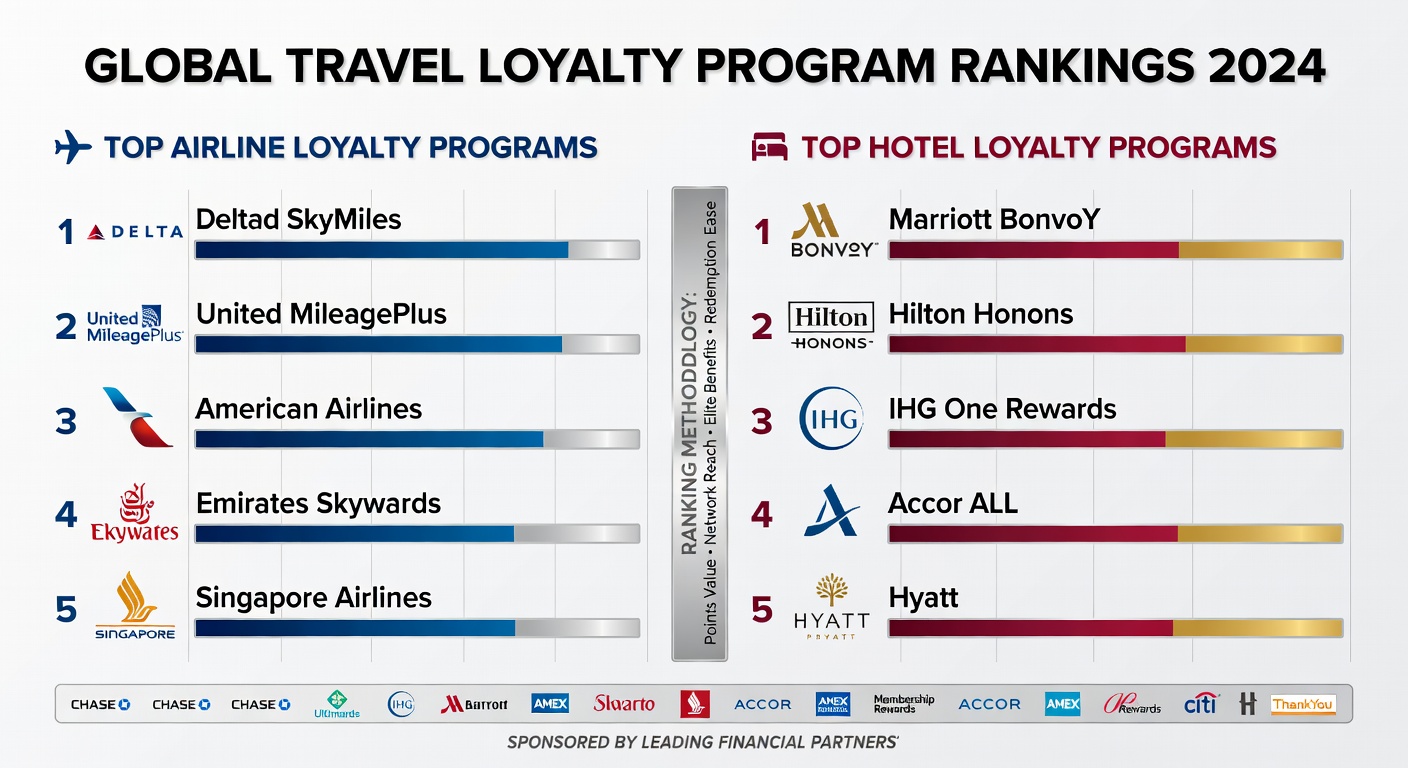
Ranking travel loyalty programs is more useful when the methodology is honest about what’s being measured. A program that delivers excellent value per point for sophisticated redeemers may be a poor program for casual travelers. A program that’s easy to navigate but stingy on rewards is a different kind of imperfect. The rankings below try to be specific about which kind of value each program delivers — and which kind of traveler it serves best.
Methodology
The rankings use six dimensions:
Points value: cents-per-point delivered at typical redemptions, including peak and off-peak averages.
Earn rate: how quickly meaningful balances accumulate through travel spending plus credit card alignment.
Redemption flexibility: variety of redemption options, availability of award space, and rules around changes and cancellations.
Partner ecosystem: airline alliance reach, hotel transfer relationships, and bank-point transfer partnerships.
Customer experience: program transparency, member communication, problem resolution, and the digital experience.
Elite benefit quality: consistency of elite delivery at the property or in-flight level, and meaningful differentiation between tiers.
No single program leads on all six. The rankings identify category leaders rather than a single overall winner.
Airline Rankings
Domestic Travel: Southwest Rapid Rewards
Southwest leads on domestic value for travelers who fit its route map. Points are revenue-based but redeem at a relatively stable cents-per-point rate. No change fees, no expiration with activity, and the Companion Pass benefit (earned through significant annual spending or flying) effectively halves the cost of travel for two for a year-plus period. The weakness: Southwest doesn’t fly internationally outside the Americas and lacks alliance partners, so the program is poor for travelers whose patterns extend beyond its route network.
International Travel: Air Canada Aeroplan
Aeroplan has reinvented itself in recent years and now offers one of the strongest fixed-chart award redemption structures in the industry. Strong Star Alliance partner access, generous stopover rules, and Aeroplan-specific perks like the family pooling feature give it real differentiation. Aeroplan also receives transfers from Amex, Chase, and Capital One, making it accessible from multiple bank point currencies.
Alliance Reach: United MileagePlus
Among US carriers, United offers the strongest Star Alliance partner network for travelers who want to redeem on a wide variety of international carriers. Partner award pricing on long-haul business class remains one of the more attractive uses of MileagePlus miles, and the Chase Ultimate Rewards transfer relationship provides flexibility.
Premium Cabin Value: Cathay Pacific Asia Miles
For travelers focused on premium cabin redemptions across Oneworld carriers, Asia Miles consistently delivers strong per-mile value, particularly for business and first class on long-haul itineraries. The award chart is more transparent than several US carriers, and accumulation is possible through Amex and Citi transfer partnerships.
No-Expiration Reassurance: Delta SkyMiles and United MileagePlus
Both programs offer no-expiration policies. For travelers who fly these airlines occasionally and want balances that won’t disappear, this is a real benefit, though both programs have dynamic award pricing that can erode value over time.
Hotel Rankings
Points Value: World of Hyatt
Hyatt continues to deliver the strongest per-point redemption value among major hotel programs. Its retained category chart provides planning predictability that dynamic-pricing competitors no longer offer. The Chase Ultimate Rewards 1:1 transfer relationship is one of the most valuable points-transfer opportunities in travel. The weakness: portfolio size — Hyatt is significantly smaller than Marriott or Hilton, so coverage in many markets is limited.
Portfolio Breadth: Marriott Bonvoy
No program comes close to Marriott on portfolio size. From extended-stay budget to ultra-luxury, Marriott has a property in nearly every market. The credit card lineup is the broadest in the industry, and anniversary night certificates across multiple cards deliver strong recurring value. The weakness: elite benefit consistency varies widely by brand and property.
Business Traveler Experience: Hilton Honors
For frequent business travelers who want reachable mid-tier status with reliable benefits, Hilton remains the strongest choice. Gold status is achievable through credit card alone, complimentary breakfast or food and beverage credit is delivered consistently across most full-service brands, and the digital experience (mobile check-in, digital key, room selection) is industry-leading.
Suite Upgrade Reliability: World of Hyatt Globalist
For travelers willing to chase top-tier status, Hyatt Globalist delivers the most reliable suite upgrade experience among the major US hotel programs. The benefit is published clearly, and execution at owned and managed properties is generally strong.
Resort Destination Specialist: IHG One Rewards
IHG often gets overlooked, but for travelers focused on Holiday Inn and Holiday Inn Express in secondary markets, the program delivers strong value. The credit card-based path to Diamond status (through annual spending) and the points-and-cash flexibility make it useful for specific traveler profiles.
Programs Punching Above Their Size
A few programs deliver value disproportionate to their footprint:
Wyndham Rewards: a small footprint in upscale markets but strong value at the budget and mid-market end, with transfer flexibility from Capital One Miles.
Choice Privileges: another small-footprint program with select transfer partnerships and occasional sweet-spot redemptions through partner airlines.
Singapore Airlines KrisFlyer: not a US-based program but accessible through bank transfers from Amex, Chase, Citi, and Capital One. For travelers redeeming Singapore Airlines premium cabins, KrisFlyer is the single best path to access those redemptions.
Programs Declining in Value
A few programs have moved in the wrong direction recently or maintained structural weaknesses:
Some major US carriers’ Delta-style dynamic pricing implementations have aggressively raised mileage requirements on popular routes and peak periods, eroding per-point value.
Several hotel programs that adopted dynamic pricing in recent years have continued category restructuring that effectively raises redemption costs.
A few smaller programs have lost transfer partnerships or saw their credit card relationships restructured in ways that reduced flexibility for members.
The honest framing: the long-term trend across the loyalty industry continues to favor program economics over member value, with selective exceptions.
Building a Travel Loyalty Portfolio
For travelers who can only commit meaningfully to one airline and one hotel program, the right combination depends on actual travel patterns.
For travelers based in the Eastern US with frequent business travel: Hilton Honors (hotel) plus either Delta SkyMiles or United MileagePlus depending on hub city. Add a Chase Sapphire Reserve or Amex Platinum for flexible currency.
For travelers based in the Western US with frequent business travel: Marriott Bonvoy or Hilton Honors (hotel) plus United MileagePlus or Alaska Mileage Plan depending on hub city. Same flexible currency advice.
For occasional travelers with mixed business and leisure patterns: Marriott Bonvoy plus either of the major US airlines (whichever flies most reliably from your home airport). Bank-point currencies become more important than program-specific earning at lower travel volumes.
For affluent leisure travelers focused on premium experiences: World of Hyatt plus a Star Alliance or Oneworld carrier matched to your typical international destinations. Chase Ultimate Rewards is the most flexible bank currency for this profile.
For travelers prioritizing international premium cabin redemptions: Build around Amex Membership Rewards, Chase Ultimate Rewards, or Capital One Miles depending on which transfer partner list aligns with target redemptions. Treat specific airline accounts as accumulation points rather than primary programs.
How to Build a Travel Loyalty Portfolio That Works
The travelers who get the most out of loyalty programs in 2025 share a few habits.
They match programs to their actual travel pattern, not the pattern they imagine. The Hyatt loyalist who never stays at Hyatt properties is worse off than the Marriott loyalist who stays at Marriott every month.
They keep balances in transferable currencies until specific redemption opportunities arise. Bank-point flexibility outperforms program-specific concentration for all but the most committed single-program flyers.
They concentrate elite chasing in one airline and one hotel program rather than spreading across many. Elite benefits matter only where they’re reliably delivered, and they’re only reliably delivered when status is consistently maintained.
They redeem actively. Hoarded balances lose value to devaluation over time. Earning and burning on a one-to-two-year horizon outperforms saving for “someday.”
They watch for transfer bonuses, status match opportunities, and category bonus promotions — without obsessing over every offer.
Frequently Asked Questions
Is there a single best travel loyalty program? No. The right program depends on travel pattern, redemption goals, and credit card alignment. The dominant programs are dominant because they serve large numbers of travelers competently, not because they’re optimal for any individual.
Should I focus on a single program or diversify? Most travelers benefit from one primary airline, one primary hotel, and a flexible bank-point currency. Beyond that, additional concentration delivers diminishing returns.
Are credit card rewards better than airline and hotel loyalty? Different rather than better. Bank-point flexibility is strongest for sophisticated redeemers. Direct airline and hotel loyalty is strongest for travelers who consistently use the same providers.
How important are elite benefits compared to point earning? For travelers who fly or stay frequently enough to reach meaningful elite tiers, elite benefits often deliver more total value than point earning. For occasional travelers, point earning typically matters more.
The Big Picture
The travel loyalty landscape in 2025 rewards informed travelers more than ever. The structural shifts of the past decade — dynamic pricing, revenue-based earning, the rise of bank-point currencies, the consolidation of hotel and airline portfolios — have made the gap between informed and uninformed members significantly wider than it used to be.
The good news: getting the basics right matters more than mastering every detail. Pick programs that fit your travel pattern. Hold a flexible bank-point currency. Redeem before devaluation. Use category bonuses on credit cards. Match status when you switch programs. That handful of habits delivers most of the value available in modern travel loyalty — and the travelers who execute them consistently end up well ahead of the pack.