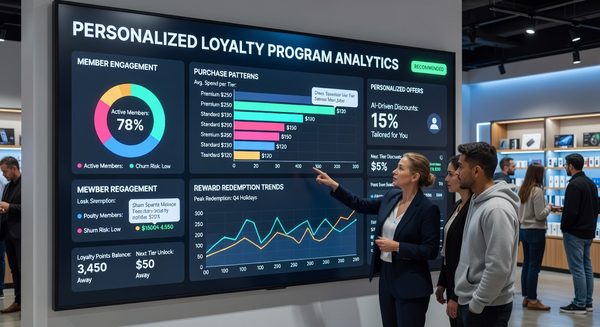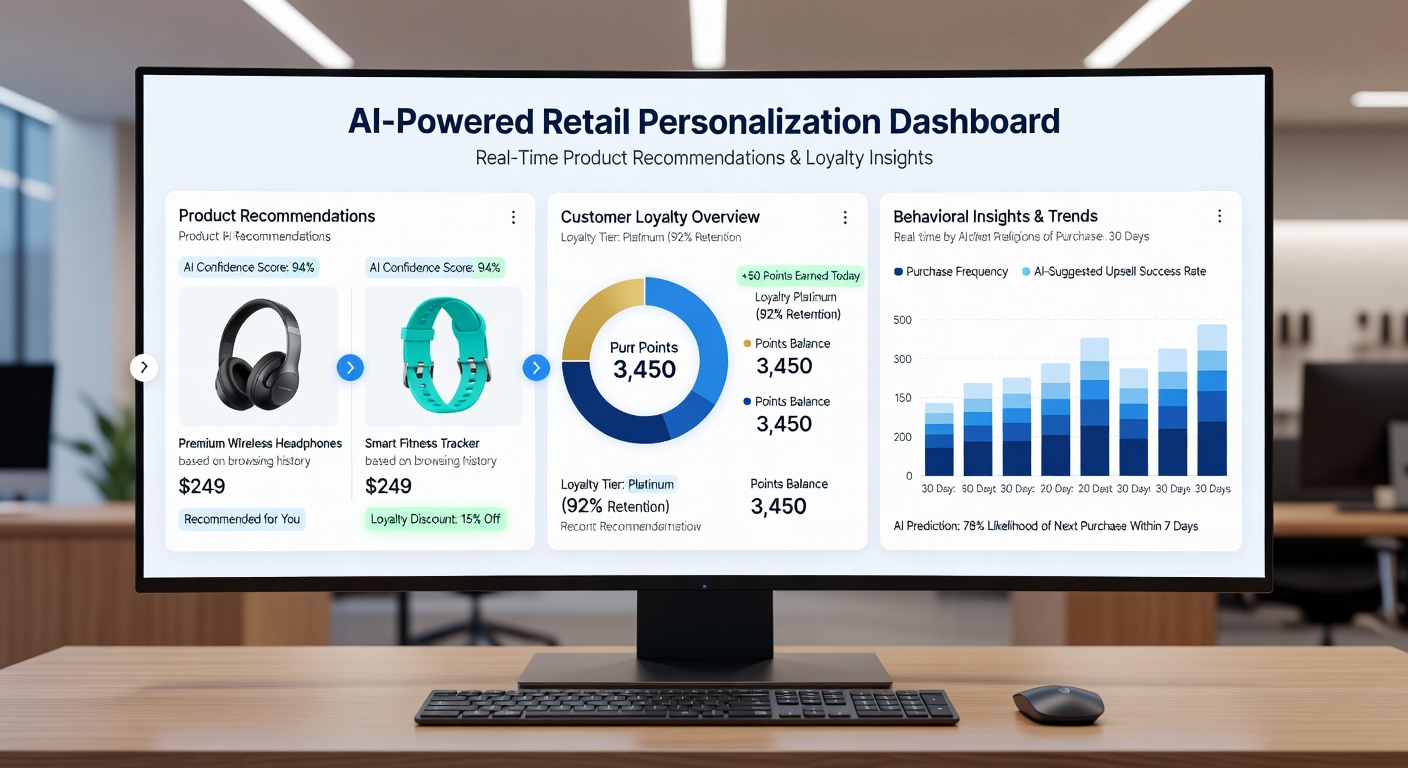
Every loyalty platform vendor in 2025 markets AI capability. The marketing language often outruns the operational reality, and retailers evaluating these claims need a clearer picture of what AI in retail loyalty can actually do, what it still cannot do, and what conditions are required for it to work. This is not an argument against AI in loyalty — meaningful AI capability is genuinely available and growing — but a guide to separating what is real from what is marketing in the current vendor landscape.
What AI Genuinely Does in Loyalty Today
Several AI capabilities are operational at scale in retail loyalty programs in 2025.
Next-best-offer prediction uses member data to predict which offer, from a catalog of options, is most likely to drive incremental behavior from a specific member at a specific moment. This capability is mature enough that the leading loyalty platforms can deploy it without significant data science work on the retailer side. The results are typically incremental rather than transformational — a few percentage points of lift over rule-based offer matching — but the incremental lift compounds over millions of impressions and is real.
Churn scoring identifies members at elevated risk of disengagement or attrition. The scoring lets the program target retention campaigns at members where the marginal effort has the highest expected return. This is one of the most useful applications of AI in loyalty, because the cost of retention campaigns is real and the ability to focus them improves the program’s economics noticeably.
Dynamic reward valuation adjusts the perceived value of rewards in real time based on member context, inventory, and broader campaign goals. A loyalty program can offer the same reward to two members and have it priced in points slightly differently based on what the member is most likely to respond to. This capability is less widely deployed but is operational at the more sophisticated programs.
Automated campaign triggers use behavioral signals to launch the right campaign to the right member without manual orchestration. Cart abandonment is the simplest example, but the same logic extends to category browsing, lifecycle transitions, and many other behaviors. AI-driven trigger sophistication has improved meaningfully over the past few years.
Recommendation systems for both products and content are largely AI-driven at this point. The recommendation layer in a modern loyalty app is doing real machine learning, and the quality of recommendations has measurably improved.
What AI Still Struggles With
Several areas of AI marketing claims have not yet caught up to operational reality.
True one-to-one personalization across all channels in real time is still aspirational for most programs. The infrastructure required — unified real-time member view, decisioning engine, cross-channel orchestration — exists at the enterprise level for the largest retailers, but the mid-market reality is segmentation with personalization overlays, not true 1:1.
Cross-program network effects — using AI trained on multi-retailer data to improve any single retailer’s program — are largely promised but not yet widely delivered. Data sharing across retailers has significant business and privacy obstacles, and the AI capability that genuinely benefits from a multi-retailer training set is more limited than vendors claim.
Generative AI for loyalty communications has interesting potential but is being deployed cautiously. The risk of off-brand or off-strategy communication generated at scale has slowed enterprise adoption. Templated content variation is being assisted by generative AI more broadly than fully autonomous campaign generation.
Predictive lifetime value modeling is real but the accuracy on individual members remains limited. Aggregate predictions and segment-level forecasts are reasonably reliable. Individual-member CLV predictions, particularly for newer members or in categories with infrequent purchase, are noisy enough that the predictions should be used as inputs to decisions rather than as definitive numbers.
Vendor Landscape Reality
Loyalty platform vendors in 2025 fall into several camps when it comes to AI capability.
A small number of leading platforms have invested heavily in AI as a core part of the product and have meaningful capability built on substantial data foundations. These platforms typically serve enterprise customers and price accordingly.
A larger group of platforms have added AI features incrementally, with varying depth. Some of these features are genuinely useful — particularly the next-best-offer and churn-scoring capabilities — even when they are not as transformational as marketing claims.
A meaningful share of vendors have added AI marketing language to features that have not materially changed underneath. Rule-based segmentation is now sometimes labeled “AI-driven segmentation.” This kind of relabeling is widespread enough that retailers should ask specific questions about what each AI feature actually does.
Some specialized AI vendors operate as overlays on existing loyalty platforms. These can deliver meaningful capability uplift, but they add integration complexity and operational cost.
The right vendor evaluation approach in 2025 is to ask each platform to demonstrate the AI features with the retailer’s own data, on a defined use case, with measurable outcomes. The platforms that can deliver this demonstration are credible. The ones that can only show generic demos are likely overstating their capability.
Data Requirements for AI in Loyalty
Effective AI in loyalty depends on data foundations that many retailers do not yet have at the required quality.
Unified member identity across channels is a prerequisite. AI models trained on partial views of member behavior produce partial predictions.
Granular transaction data, including SKU-level history, channel, daypart, and supporting attributes, is required for meaningful prediction beyond the most basic level.
Sufficient data volume matters. AI models need enough training data to produce stable predictions. Smaller retailers often do not have the volume to support sophisticated modeling on their own data alone.
Ground-truth outcomes for the prediction tasks the AI is trying to perform are necessary. If the program does not have clean records of who churned, who responded to which campaign, and who upgraded to which tier, the models cannot be trained reliably.
For mid-size retailers, the realistic path is to focus AI investment on use cases where the available data is sufficient — typically churn scoring and basic next-best-offer prediction — rather than chasing the most ambitious applications immediately.
Implementation Realities for Mid-Market Retailers
AI in loyalty requires scale of data, infrastructure, and team capability that not all retailers have. The mid-market reality is more constrained than enterprise case studies would suggest.
Mid-market retailers typically should not build their own AI capability. The platform-provided AI features are the right starting point. The lift from rule-based to AI-driven offer matching is meaningful and accessible without dedicated data science resources.
When platform-provided AI is insufficient, the right next step is usually a managed service from the loyalty platform vendor or a specialized AI provider — not an in-house build.
Measurement infrastructure is the most overlooked AI implementation requirement. Programs deploying AI features without holdout groups and clean attribution cannot tell whether the AI is delivering value. This measurement gap is more common than the lack of AI capability itself.
The team capability required to operate AI-enhanced loyalty programs is meaningful even when the underlying capability is vendor-provided. Someone has to understand what the models are doing, monitor their performance, and intervene when results drift. The lights-out operation that AI marketing implies is rarely the operational reality.
Where to Start
For a retailer in 2025 wanting to add intelligence to an existing program, the practical sequence is clear.
Start with churn scoring. The capability is mature, the use case is high-value, and the implementation is relatively contained. A working churn-scoring overlay on retention campaigns will produce measurable lift within the first year of operation.
Add next-best-offer prediction to high-volume campaign streams. The same campaigns being sent to broad segments today can be enhanced with AI-driven offer selection, and the lift is measurable against the rule-based baseline.
Invest in measurement infrastructure simultaneously. Holdout groups, control cells, and unified attribution should be in place before broader AI deployment. Without these, the program cannot defend its AI investment with hard numbers.
Defer the more ambitious AI applications — full 1:1 personalization, real-time decisioning at scale, generative communication — until the foundational capabilities are operational and the team has experience working with AI-driven outputs.
FAQ
Is AI really making a difference in retail loyalty in 2025? Yes, but more incrementally than vendor marketing suggests. The meaningful applications — churn scoring, next-best-offer, automated triggers — produce real but modest lift over rule-based alternatives. Compounded across millions of member interactions, the lift is significant.
Should mid-market retailers invest in AI loyalty capability now? Yes, by leveraging the AI features built into modern loyalty platforms rather than building bespoke capability. The platform-provided AI is the right entry point for most mid-market programs.
What’s the biggest mistake retailers make with AI in loyalty? Deploying AI features without rigorous measurement. Without holdout groups and clean attribution, the program cannot tell whether the AI is paying for itself, and the investment becomes difficult to defend over time.
Is generative AI changing what’s possible in loyalty communications? Generative AI is being deployed cautiously for content variation and personalized copy. Fully autonomous campaign generation is not yet the operational norm in major retail loyalty programs, and the brand-safety concerns are real.
Closing Thought
AI in retail loyalty in 2025 is genuinely capable and genuinely overhyped at the same time. The capabilities that work are valuable and accessible. The capabilities that do not work are widely marketed anyway. For retailers evaluating AI claims, the right discipline is to focus on specific use cases with measurable outcomes, to lean on platform-provided AI rather than building bespoke capability, and to invest in the measurement infrastructure that lets the program prove the AI is doing what it claims. AI is a real lever in loyalty. It is also a lever that has to be pulled deliberately to do useful work.
Further Reading from Authoritative Sources
- Harvard Business Review — HBR publishes research on algorithmic personalization in retail and the measured business outcomes of AI-driven marketing, providing the rigorous context for evaluating loyalty platform AI claims.
- FTC consumer data guidance — FTC guidance on consumer data use and algorithmic decision-making is directly relevant to how retailers can legally collect and use loyalty member data to train AI personalization models.