Loyalty programs are easy to defend on instinct and hard to defend on a spreadsheet — at least until you understand the structure. CMOs and finance partners often have the same conversation: “We know it works, but show me the math.” This piece walks through the economics of a loyalty program from the brand’s perspective, with enough structure that an operator can map their own program against it.
There are no invented dollar figures here. The goal is the framework that a thoughtful loyalty leader and a skeptical CFO can both work from.
The Cost Side: Where the Money Actually Goes
Loyalty programs have four meaningful cost categories.
Points liability. When a member earns points or a stamp toward a reward, the brand has incurred an obligation to deliver value in the future. The economic cost of this obligation is not the face value of the reward — it is the marginal cost of fulfilling it, adjusted for the probability of redemption. Programs with very high redemption rates carry liability that approaches the face value. Programs with low redemption rates carry less liability, but as discussed in earlier research, low redemption is a sign of disengagement and not a win.
Platform costs. The technology stack that runs the program — member database, points engine, campaign tools, integrations with POS, eCommerce, and mobile — is the line item that finance partners see clearly. Costs scale with member count, transaction volume, and feature footprint. Modern loyalty platforms have become more capable but not always cheaper.
Campaign costs. Communications to members, the design of tiered offers, the production of personalized creative, the agency or in-house team running it all. This is the operating budget that turns the program from an asset into an active engine.
Staffing. The team — loyalty marketing, analytics, operations — that designs, runs, and improves the program. Often underestimated in business cases written by people who haven’t run one before.
The honest accounting of program costs is the sum of all four. Treating only the points liability as “program cost” produces unrealistic ROI calculations that fall apart on review.
The Revenue Side: What the Program Actually Drives
The revenue side of loyalty economics has three distinct levers.
Incremental visit frequency. Active members typically transact more frequently than comparable non-members. The valuable number is not the gross frequency of members — that comparison is misleading because higher-frequency customers self-select into enrollment — but the incremental frequency, measured against a matched control. The matched-pair comparison is harder to produce but is the number that survives finance scrutiny.
Check size lift. Active members typically spend more per visit. Again, the meaningful comparison is incremental, not gross.
Churn reduction. Active members are less likely to defect than comparable non-members. In categories where customer acquisition cost is high, this lever often outweighs the frequency and check-size levers combined.
The revenue case for the program is the sum of these three incremental effects, attributed honestly to the program rather than to customers who would have transacted anyway.
The Break-Even Framework
A simplified break-even logic looks like this:
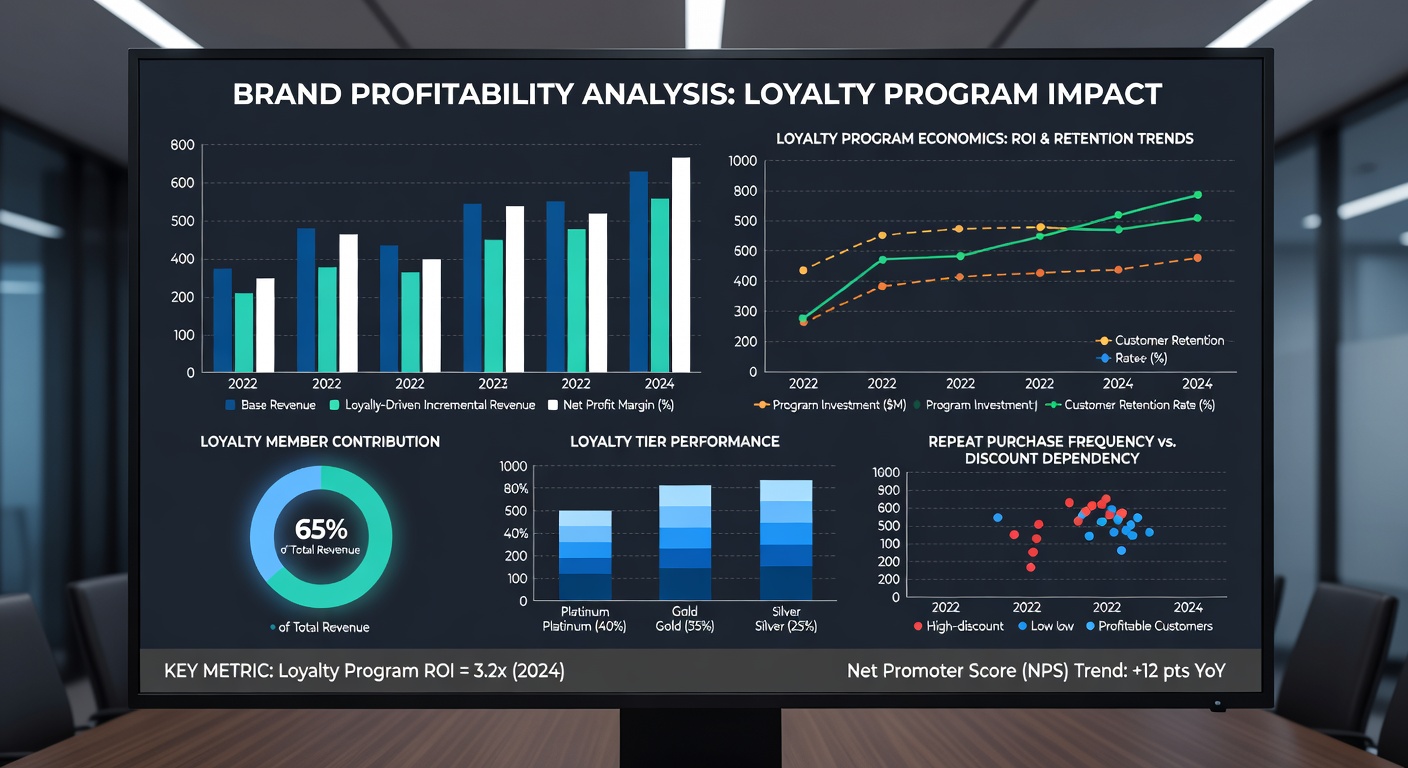
The program is economically justified when the incremental revenue produced — visit lift + check size lift + retained customers — exceeds the fully loaded cost of running it (points liability + platform + campaigns + staffing).
The lever that operators most often misjudge is liability. Programs that look profitable on a campaign-by-campaign basis can be unprofitable on a fully-loaded basis when the unredeemed points liability is accounted for properly.
The lever that finance partners most often misjudge is churn reduction. Because churn is hard to attribute, it tends to be left out of the loyalty business case — which understates the program’s value in categories where retention is the dominant economic question.
How Economics Differ By Category
The shape of loyalty economics varies meaningfully by category.
High-frequency restaurant programs have favorable economics when designed well. The visit cadence is short, the unit economics of an incremental visit are clear, and the rewards can be calibrated tightly. The risk is over-discounting through stacked offers and loyalty rewards on the same transaction.
Lower-frequency retail programs have harder economics. The visit interval is long, attributing incremental behavior to the program is harder, and the rewards must be richer to remain motivating across the gap. Strong retail programs lean on data value and category share rather than transaction-level lift alone.
High-value travel programs have economics dominated by liability management and partner revenue. Miles earned through credit card spend or partner activity often subsidize the cost of miles redeemed on flights and hotels, making the program economically rational even when the per-redemption math looks expensive.
The Liability Management Challenge
Unredeemed loyalty currency is a liability on the balance sheet, and it is one of the few areas where loyalty operations intersect directly with the finance team. Three principles for managing it:
First, calibrate the points-to-reward ratio to the engagement profile you want. A program where rewards are hard to reach builds large liability but produces poor engagement. A program where rewards come easily produces engagement but can produce uncomfortable redemption velocity.
Second, expiration policies are a tool, not a default. Aggressive expiration suppresses liability but damages member trust. The cost of damaged trust is often higher than the liability savings.
Third, breakage — points that are earned but never redeemed — is a real economic factor that should be modeled, not hoped for. Programs that depend on high breakage to be profitable are often the programs that are quietly disengaging members.
How to Build a Loyalty Business Case for Leadership
A credible business case for a loyalty program or program redesign typically has these elements:
A clear statement of the strategic objective the program is supporting (retention, share-of-wallet, first-party data, competitive defense).
A fully-loaded cost projection — not just the redemption cost.
A revenue impact projection based on matched-pair logic, not gross member comparisons.
A liability accrual model that shows the points obligation over time and the expected redemption curve.
A measurement plan that commits the program to specific KPIs and a cadence for reviewing them.
A risk discussion — what could go wrong, what would the response be — that demonstrates the team has thought beyond the rosy case.
FAQ
Should loyalty program cost be calculated on a per-member basis? For some decisions, yes — particularly when comparing channels or testing program changes. For the overall business case, total fully-loaded cost is more useful.
Is breakage a healthy revenue source? Breakage is a real accounting effect, but operators should not design for it. A program optimized for breakage is a program optimized to disappoint members.
How should we think about the data value of the loyalty program? First-party data has real economic value — particularly in a third-party-cookie-deprecated environment. That value is hard to quantify cleanly, but it should be acknowledged in the business case rather than ignored.
What’s a reasonable payback period for a loyalty program investment? For a redesign or expansion, measurable revenue impact within two to four quarters is reasonable. For a brand-new program, the path is longer — the data, behavior, and engagement compound over multiple years.
The Operator’s Takeaway
Loyalty program economics are not mysterious, but they require an honest accounting that many programs don’t do. Fully load the costs. Use matched-pair logic on the revenue side. Take the liability seriously. Account for the harder-to-measure benefits — retention and data value — without overclaiming them. Programs built on this kind of honest math tend to survive leadership changes, budget reviews, and the natural skepticism that any large marketing investment attracts.
Further Reading from Authoritative Sources
- Harvard Business Review — HBR publishes the management finance and marketing analytics research that underpins the article’s fully-loaded cost framework, matched-pair revenue analysis, and the argument that churn reduction — not just visit frequency and check size — is often the most economically significant loyalty program lever.
- Association of National Advertisers — ANA publishes loyalty marketing investment and measurement standards that directly support the article’s framework for building credible loyalty business cases — including the four cost categories, the three revenue levers, and the measurement plan requirements that distinguish defensible programs from those that collapse under finance scrutiny.