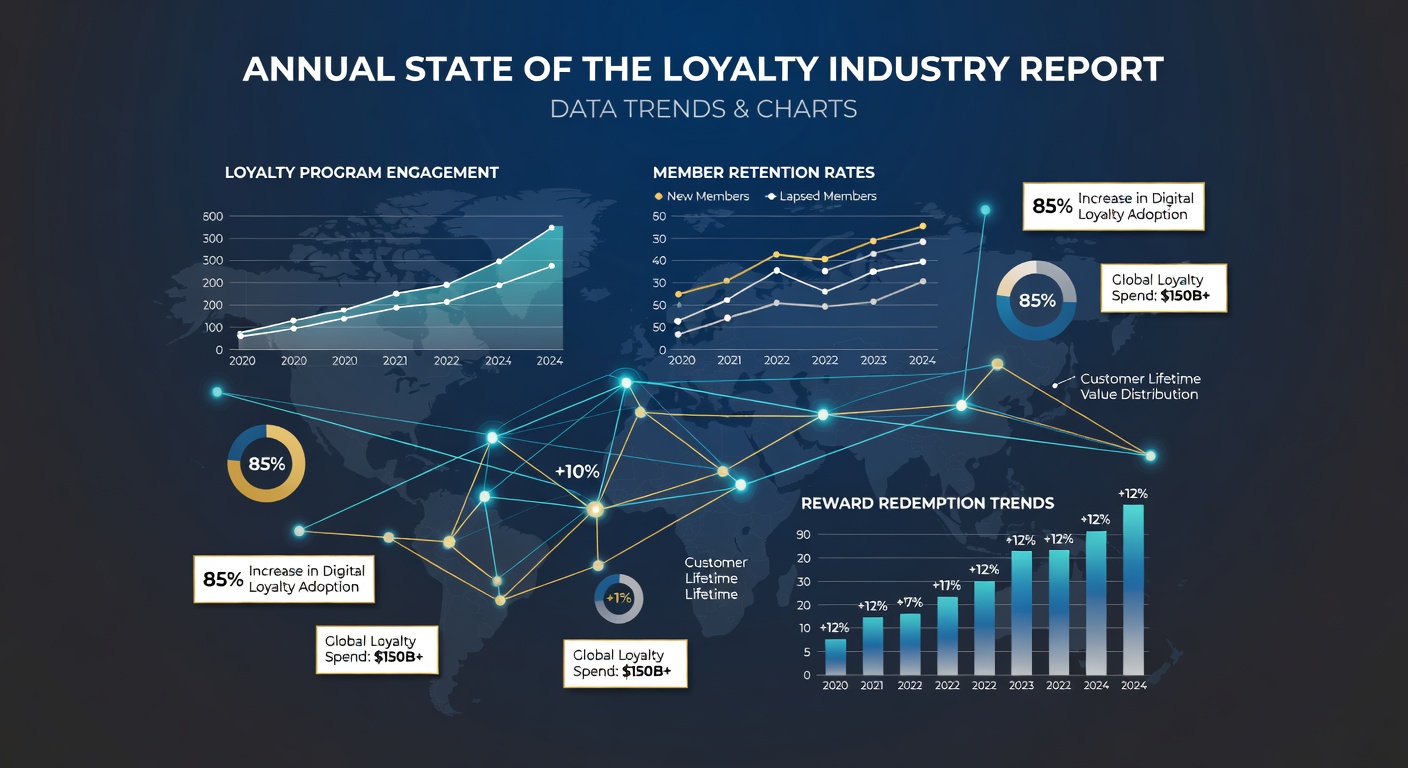
If 2020 through 2022 was the period when loyalty got disrupted, 2024 has been the period when operators began rebuilding around what the disruption taught them. Programs are being redesigned, platforms are being consolidated, and the conversation in loyalty leadership rooms is shifting from “what features should we add” to “what is this program actually for.”
This annual state-of-loyalty synthesis pulls together the macrotrends, the category-level engagement patterns, the technology shifts, and the predictions worth carrying into 2025.
Macrotrends Driving Loyalty Investment
Three macro forces are visibly increasing loyalty investment in 2024.
Inflation loyalty. When consumers feel financial pressure, loyalty programs that deliver tangible everyday value become more important to household budgeting. Operators have noticed. Investment is up in programs that emphasize “save on what you already buy” rather than aspirational rewards. Grocery, pharmacy, and quick-service restaurant programs are leading this shift.
Data strategy. The retirement of third-party cookies and the broader tightening of digital advertising privacy has made first-party data structurally more valuable. Loyalty programs are the most reliable first-party data engine most brands have, and CMOs are funding them at higher levels for that reason as much as for retention. The loyalty conversation has moved from “earn and burn” toward “the program as the data foundation for the entire marketing stack.”
Competitive pressure. In several categories — coffee, quick-service restaurant, fast fashion, premium hotel — competitor program moves are forcing operators to respond. A weak program is no longer a neutral position; it is a competitive disadvantage in categories where the customer has been trained to expect loyalty as table stakes.
Category-Level Engagement Patterns
Restaurant loyalty has continued to digitize, with mobile-first programs dominating new launches. The dominant pattern in 2024 is the merger of loyalty, ordering, and payment into a single member experience. Programs that are still operating as standalone punch-card mechanics are visibly underperforming.
Retail loyalty is bifurcating. Mass retailers are leaning into paid tiers and subscription-style benefits. Specialty retailers are leaning into community, experiences, and recognition. The middle — generic points programs with no distinct angle — is struggling to hold engagement.
Travel loyalty has stabilized after the post-disruption recovery. Elite-tier benefits, dynamic pricing of redemptions, and partnership earning have become the central design conversations. Trust remains the dominant currency in travel loyalty, and the brands that have devalued points or status visibly have paid for it in member sentiment.
Financial services loyalty has matured into the data-and-rewards engine that funds much of the broader rewards ecosystem. Card-linked offers, partnership economics, and the role of the financial services partner in funding retail rewards have become more sophisticated.
AI and Personalization Adoption
AI is the most-discussed and most-uneven topic in loyalty in 2024. Most operators are using AI in some form — usually for next-best-offer recommendations, predictive churn, or send-time optimization. A smaller group is doing meaningful real-time personalization at scale. A still smaller group has integrated AI deeply enough that it is shaping program design itself.
The honest assessment is that AI is delivering measurable lift in narrow use cases — particularly offer relevance and churn prevention — and is not yet replacing the strategic work of program design. The brands that are succeeding with AI in loyalty have approached it as a tool to improve specific decisions rather than as a transformation initiative.
The Paid Loyalty Tier Trend
The growth of paid tiers alongside free loyalty membership is one of the most significant structural shifts in 2024. The model — pay a monthly or annual fee for enhanced benefits, free shipping, priority access, or accelerated earning — has expanded well beyond its mass-retail origins into restaurant, grocery, and specialty retail.
The strategic logic is straightforward: paid members are more engaged, spend more, and produce significantly more reliable revenue than free members. The strategic risk is also real: a poorly designed paid tier creates a two-class experience that can alienate the broader free-member base and trigger churn at the perimeter of the program.
The brands handling this well are positioning the paid tier as additive rather than as a downgrade of the free experience.
Consumer Sentiment
Across consumer research conducted in 2024, three themes are consistent.
Consumers value loyalty programs more in 2024 than they did before — particularly programs that deliver everyday value rather than aspirational rewards.
Consumers are increasingly skeptical of how loyalty data is used. Programs that have not been transparent about data practices are losing the trust portion of the loyalty equation, even when their economics are competitive.
Consumers want simpler programs. The increase in program complexity over the past few years has produced fatigue. Programs that can articulate their value in one sentence are outperforming programs that require a tutorial.
Program Consolidation
Larger brands with multiple historical programs — different programs in different regions, different programs in different business units — are consolidating onto unified platforms. The benefits are real: cleaner data, simpler member experience, lower operational cost. The transition risk is also real: any consolidation that members perceive as a devaluation produces churn.
The pattern from operators that have done this well is to lead with the member benefit (one account, more flexibility, broader earning) and to absorb any short-term economic cost rather than ask members to.
Predictions for 2025
Looking ahead, four predictions feel well-supported:
The paid-tier model will continue to expand into new categories, with the strongest growth in convenience-driven verticals.
AI will move from “tool for marketers” to “design element of the program itself,” with programs that assume AI personalization in their architecture pulling ahead of programs that bolt it on.
B2B loyalty programs — loyalty mechanics applied to business customers, channel partners, and trade buyers — will be a meaningful growth area as more brands recognize that the same psychology applies in commercial relationships.
The privacy-and-loyalty conversation will intensify. Programs that get the privacy frame right will be advantaged; programs that don’t will face friction at enrollment and engagement.
FAQ
Is loyalty investment up or down in 2024? Up, on a meaningful basis. The combination of inflation pressure, first-party data value, and competitive dynamics has pushed loyalty up the priority list for most CMOs.
Are paid tiers cannibalizing free loyalty memberships? In well-designed programs, no — they are largely additive. In poorly designed programs, the perception that “the good stuff is now behind a paywall” produces measurable free-member disengagement.
How widely is AI actually deployed in loyalty in 2024? Most large operators are using AI in narrow use cases. Meaningful deployment of real-time personalization is still concentrated among a smaller set of advanced operators.
Is the third-party cookie retirement actually changing loyalty strategy? Yes, in the sense that first-party data is more valuable and the loyalty program is the most reliable place to collect it. The strategic centrality of loyalty in the marketing stack has grown for this reason.
The Year in One Sentence
2024 is the year loyalty stopped being treated as a marketing tactic and started being treated as the core data and engagement infrastructure of the business — and the operators that internalize that shift will be the ones with meaningful advantage going into 2025.
Further Reading from Authoritative Sources
- Association of National Advertisers — ANA publishes research and industry benchmarks on loyalty marketing investment and program design trends that provide the industry context for the 2024 macrotrends — inflation loyalty, data strategy, and competitive pressure — analyzed in this state-of-loyalty synthesis.
- Harvard Business Review — HBR’s consumer behavior and loyalty research underpins the article’s analysis of why paid tiers succeed or fail and why consumer trust in data practices is becoming a central determinant of loyalty program engagement.