Hilton Honors and Marriott Bonvoy are the two largest hotel loyalty programs in the world. Together they dominate North American business travel, define many of the industry’s loyalty norms, and compete head-on for the same target traveler: the frequent guest who can be persuaded to consolidate stays under one brand. In 2024, the competitive picture between them has sharpened in a few specific ways that are worth understanding before committing to one as a primary program.
Current State of Each Program
Marriott Bonvoy continues to operate the largest hotel portfolio in the world — more than thirty brands and roughly 8,000 properties. The 2024 picture includes continued use of dynamic award pricing across the portfolio, ongoing investment in the Bonvoy app and digital experience, and a credit card lineup spread across Amex and Chase.
Hilton Honors operates a smaller but still vast portfolio with strong coverage in the upscale, upper-upscale, and select-service segments. The 2024 picture includes continued use of dynamic pricing on award nights, deep integration of digital check-in and digital key, the Amex co-branded card lineup, and consistent investment in mobile-first guest experience.
Both programs have made incremental adjustments over the past several years rather than wholesale resets. Bonvoy has continued to refine its post-Starwood-merger structure. Hilton has steadily reinforced what was already a business-traveler-friendly design.
Status Earning Paths
Marriott Bonvoy elite earning:
- Silver: 10 nights
- Gold: 25 nights
- Platinum: 50 nights
- Titanium: 75 nights
- Ambassador Elite: 100 nights plus qualifying spend
Marriott credit cards contribute elite night credits annually (15 nights per year on most cobranded cards), which makes Gold accessible to cardholders without significant stay activity.
Hilton Honors elite earning:
- Silver: 4 stays or 10 nights
- Gold: 20 nights, 40 stays, or 75,000 base points
- Diamond: 60 nights, 30 stays plus 120,000 base points, or 60 nights plus high points activity
Hilton’s premium Amex Aspire card grants Diamond status outright (no nights required) with the card’s annual fee. The mid-tier Amex cards grant automatic Gold.
The practical advantage in 2024 belongs to Hilton on the mid-tier status question. Hilton Gold is reachable purely through a credit card. Marriott Gold via credit card requires meaningful annual spending to reach via card alone, and stay activity is generally needed to reach Marriott Platinum (where Marriott’s most meaningful benefits actually start).
Point Value Comparison
A useful approximation for cents-per-point value at typical redemptions:
Marriott points: roughly 0.7 to 0.9 cents per point at standard mid-category redemptions, with off-peak periods sometimes delivering higher value and peak periods often delivering lower.
Hilton points: roughly 0.4 to 0.6 cents per point at typical redemptions, with off-peak resort redemptions sometimes delivering higher value.
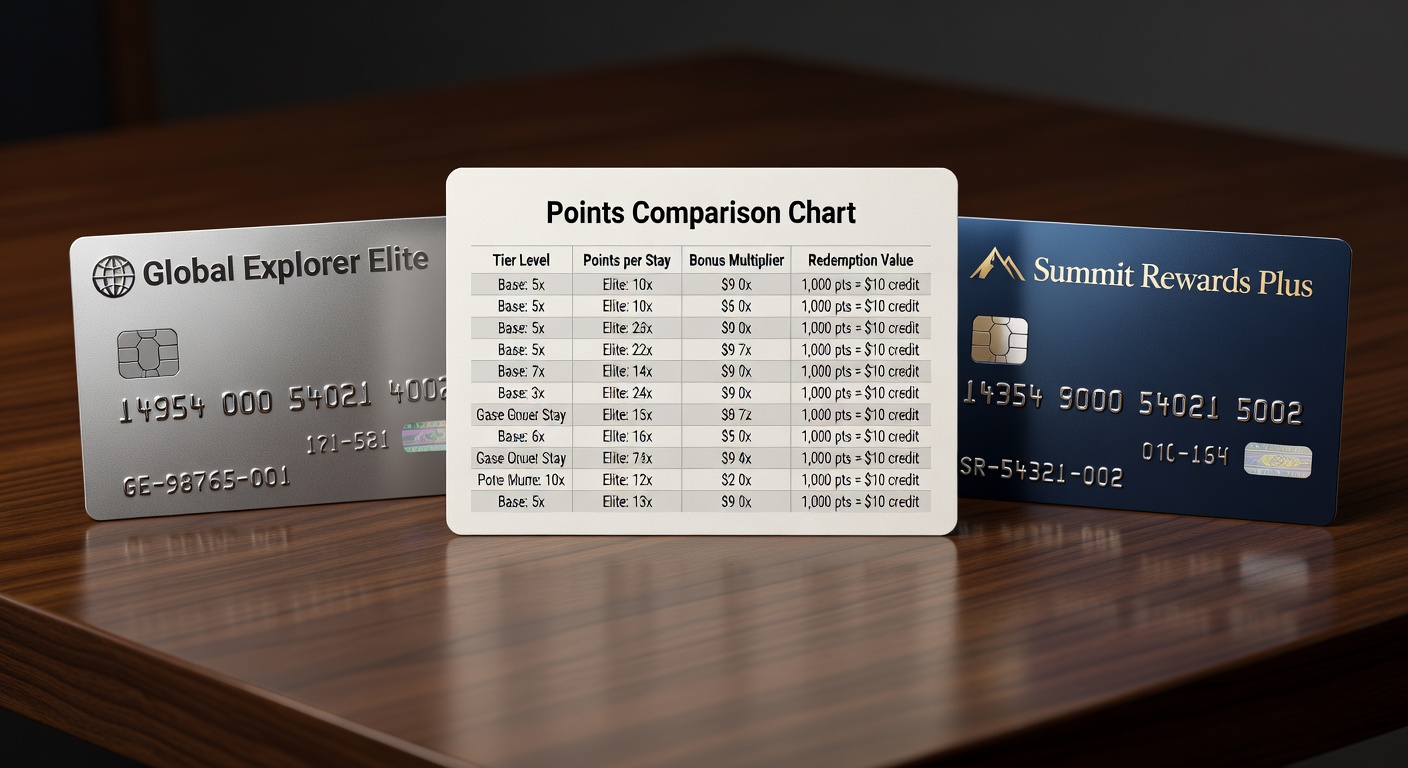
On a strict points-value basis, Marriott points are worth more per unit. Hilton compensates with a higher base earning rate (10 points per dollar at most brands, compared to Marriott’s same nominal rate but at a slightly different effective value point), elite bonus stacking, and easier credit-card-driven earning.
The math typically works out to similar total dollar value for similar levels of engagement, with Marriott favoring per-redemption efficiency and Hilton favoring volume earning.
Credit Card Ecosystems
Marriott Bonvoy card lineup includes:
- Multiple Amex personal and business cards
- Multiple Chase personal and business cards
- Anniversary free-night certificates at various redemption ceilings
- Path to elite status through annual spending
Hilton Honors card lineup (all Amex):
- No-annual-fee Hilton card (Gold-eligible after some spending)
- Hilton Honors Surpass (automatic Gold)
- Hilton Honors Aspire (automatic Diamond, premium card with airline credit, resort credit, and weekend night certificate)
- Hilton Honors Business
The Marriott lineup offers broader card variety and more anniversary night certificates. The Hilton Aspire offers a single, highly-leveraged premium card that grants Diamond status outright — a benefit no Marriott card matches directly.
For travelers who want the strongest single-card hotel benefit, the Hilton Aspire is arguably the most valuable hotel co-branded card in the US market. For travelers who want a broad portfolio of cards across two banks, Marriott offers more options.
Elite Benefits That Actually Matter
The benefits that matter most for typical business and leisure stays:
Complimentary breakfast (or US food and beverage credit): Hilton delivers this reliably at Gold and Diamond across most full-service brands. Marriott delivers it at Platinum and above, primarily at brands above the mid-tier. Hilton wins on accessibility of this benefit because Gold is reachable through a credit card.
Late checkout: Both programs offer late checkout to mid-tier and above elites, subject to availability. Execution at the property level varies in both programs.
Room and suite upgrades: Marriott Platinum and above offer upgrades subject to availability, including suite upgrades. Hilton Gold and Diamond offer upgrades subject to availability. Marriott’s upper-tier suite upgrade benefit is somewhat stronger on paper; execution varies by property in both programs.
Lounge access: Hilton Diamond offers executive lounge access at brands that have lounges. Marriott Platinum and above offer lounge access at most full-service brands. Both are comparable, though lounge availability varies by brand and property.
The fifth-night-free benefit: Marriott offers this to all elite tiers on award stays of five or more nights. Hilton offers this to Gold and Diamond on award stays of five or more nights. Functionally equivalent for elites.
Portfolio Strengths
Marriott wins on:
- Luxury and ultra-luxury concentration (Ritz-Carlton, St. Regis, Edition, JW Marriott)
- Extended-stay options (Residence Inn, TownePlace Suites, Homewood Suites)
- Brand breadth across price points
- Lifestyle brand concentration (Moxy, Aloft, AC, Autograph)
Hilton wins on:
- Business-travel-segment coverage (Hampton, Hilton Garden Inn, Hilton, DoubleTree)
- Consistent mid-tier experience across the portfolio
- Resort destination coverage (Waldorf Astoria, Conrad, certain regional resorts)
- Suburban and secondary-market presence
Which Program Wins by Traveler Type
For frequent business travelers (20-50 nights per year, mostly midweek, mostly major US cities): Hilton Honors. Gold is reachable, Gold benefits are delivered reliably, and the suburban business travel coverage is strong.
For frequent luxury and resort travelers (mix of business and leisure, focus on upper-tier properties): Marriott Bonvoy. Portfolio breadth at the top end is unmatched, and Platinum (when reached) delivers strong benefits at luxury brands.
For occasional travelers who want a default program (under 15 nights per year): Either, with a slight edge to Marriott on portfolio breadth. The right choice depends on which program has stronger presence in the cities you actually visit.
For travelers who want a single-card status play with minimal stay activity: Hilton Honors Aspire (Diamond outright). No Marriott card delivers an equivalent.
For travelers who want maximum credit card variety: Marriott. The combined Amex + Chase lineup offers more anniversary certificate options.
For families and travelers who frequently book five-night stays: Either — both programs offer the 5th-night-free benefit on award stays for the relevant tiers.
Frequently Asked Questions
Can I be a top-tier elite in both programs simultaneously? Yes. Many serious travelers maintain status in both. The Hilton Aspire card delivers Diamond outright; reaching Marriott Titanium requires significant stay activity.
Which program has the better app? Both are competitive. Hilton’s digital key and room selection are widely regarded as the strongest in the industry. Marriott’s app has improved but is generally seen as slightly behind on the mobile experience.
Which program has more devaluation risk? Both have moved to dynamic award pricing, which introduces ongoing devaluation risk. Hilton has a longer history of dynamic pricing and has been more transparent about it. Marriott’s category changes have historically triggered more member dissatisfaction when published.
Are points transfers from credit cards to either program worthwhile? Generally no for both programs. Bonvoy receives Amex transfers at unfavorable ratios. Hilton receives Amex transfers also at unfavorable ratios. For most travelers, earning directly through stays and co-branded card spending delivers better value than transferring from bank points programs.
Verdict
Hilton Honors in 2024 is the better program for the largest segment of US travelers — frequent business guests who want reachable mid-tier status with reliable breakfast and upgrade benefits across a wide network of suburban and business-district hotels. Marriott Bonvoy in 2024 remains the better program for affluent travelers focused on luxury redemption value and portfolio breadth at the top end of the market.
For travelers who can be honest about how they actually travel — rather than how they imagine they travel — the right choice is usually clearer than the marketing of either program would suggest.