Restaurant operators evaluating their MarTech stack tend to encounter the same problem: the vendor landscape is fragmented, the category boundaries are blurry, and every platform claims to do what every other platform claims to do. A clearer way to think about the stack is by layer. Each layer has a specific job, and the right configuration for a given operator depends less on which vendors are fashionable and more on which layers genuinely need to be filled.
The Four Layers of a Restaurant Loyalty Stack
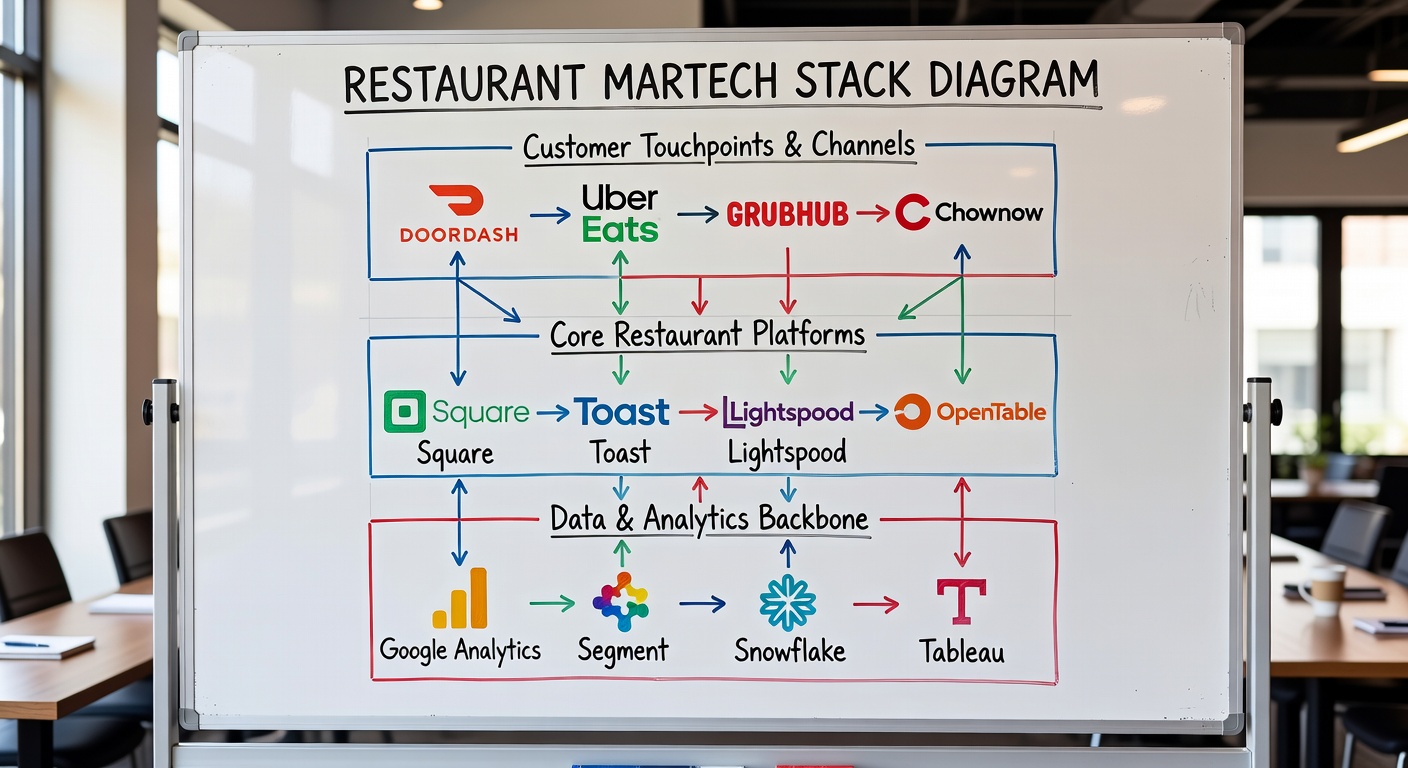
A working restaurant loyalty stack has four layers, in roughly this order of foundational importance:
The loyalty engine. The system that owns member identity, points, offers, tiers, and the rules that govern the program. This is the system of record for the loyalty membership.
The engagement layer. The systems that communicate with members between visits — email, SMS, push notifications, and increasingly conversational channels.
The analytics and segmentation layer. The systems that turn member data into insight, audiences, and decisions.
The ordering layer. The digital ordering platform and the POS, both of which interact with loyalty at the moment of transaction and supply most of the behavioral data the program runs on.
A stack with weakness in any one layer underperforms. A stack with weakness in multiple layers underperforms badly, regardless of how strong any single component is.
The Loyalty Engine
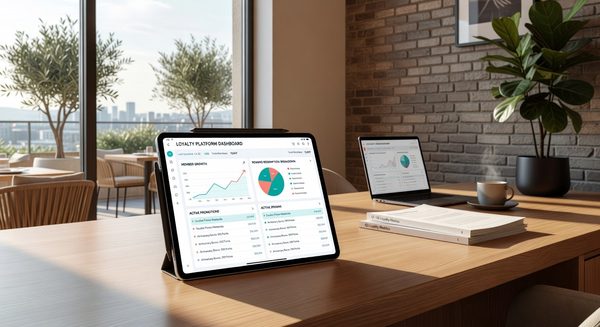
The loyalty engine is the gravitational center of the stack. It holds member identity, transaction history, points balances, available offers, tier status, and program rules. Other systems consume from it and write back to it.
Choosing a loyalty engine means choosing what your program can become. Engines vary in offer flexibility (how exotic an offer can the system actually run), tier and status support, subscription capability, segmentation depth, and integration ecosystem. Operators who treat this choice casually because “loyalty is just points” tend to end up rebuilding the stack two years in when the original engine cannot support what the marketing team wants to do.
The major restaurant-focused loyalty engines — Paytronix, Punchh/PAR, Thanx, Olo Engage, and POS-native options including Toast Loyalty — each have meaningful strengths and trade-offs. Selection depends on operator size, POS, and program ambition.
The Engagement Layer
Once the loyalty engine knows what to say and to whom, the engagement layer carries the message. Email and SMS are the workhorses; push notifications add a real-time channel where an app exists; conversational and chat-based channels are emerging.
Some loyalty engines include built-in messaging. Others require integration with a dedicated marketing automation platform — Klaviyo, Iterable, Braze, and peers. The native option is simpler; the dedicated option is more capable. Operators with sophisticated segmentation and lifecycle automation needs tend to land on a dedicated platform; smaller operators with simpler needs tend to find the native option sufficient.
The right architecture depends on how much the marketing team needs to do, not how much the platform can theoretically do.
The Analytics and Segmentation Layer
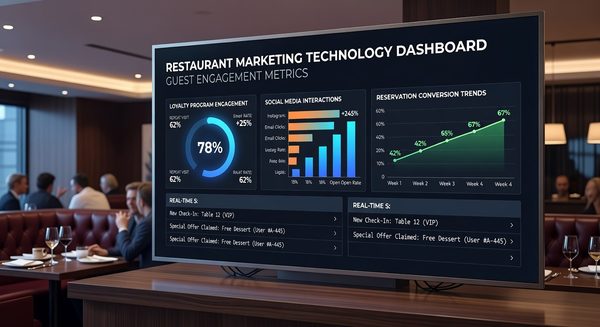
Analytics in a restaurant loyalty context spans three needs: program reporting (how is the program performing), member analytics (who are our members and what do they do), and audience activation (turn analysis into actionable segments).
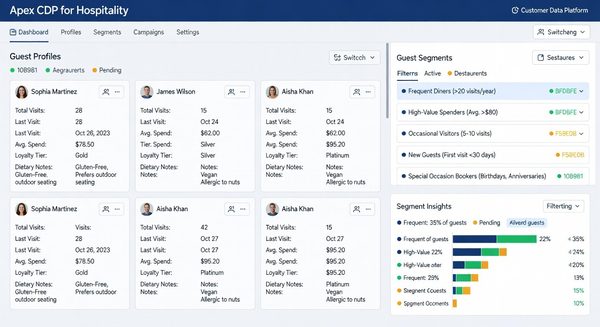
Loyalty engines typically include native reporting and basic segmentation. The native tools usually handle reporting adequately and segmentation marginally. Operators who want serious segmentation often add a layer on top — a CDP, a BI tool with marketing extensions, or a marketing automation platform’s segmentation features.
The most common analytics shortfall is not the tool — it is the absence of a discipline. Programs that produce useful analytics tend to have an owner who consumes the reports weekly and acts on them. Programs without that owner tend to have analytics dashboards nobody opens.
The Ordering Layer
Loyalty depends on the ordering layer for almost all of its useful data. The POS sends transaction events; the digital ordering platform sends online behavior. Without both flowing correctly, the loyalty engine is running blind.
For chain operators, the ordering layer often involves Olo or a comparable platform sitting between the digital channels and the POS, aggregating orders and providing a single integration point. For smaller operators, the POS may be the only ordering system and the integration is more direct.
The single biggest stack-level decision involving the ordering layer is whether loyalty is POS-native or integrated separately. POS-native loyalty (Toast Loyalty, Square Loyalty) carries the deepest natural integration at the cost of being tied to the POS roadmap. Best-of-breed loyalty integrated with the POS via API offers more capability but requires more integration work.
Integration Architecture Choices
Two patterns dominate restaurant stack architecture:
All-in-one. A single vendor provides the loyalty engine, the engagement layer, and often basic analytics, with integrations into the POS and digital ordering platforms. Simpler to operate and less expensive at smaller scale. The trade-off is that any single platform’s weakest layer becomes the program’s weakest layer.
Best-of-breed. A specialized vendor provides each layer, with integration glue (sometimes via middleware) tying them together. More capable in each layer at the cost of more vendors to manage, more integrations to maintain, and higher total cost.
Larger operators tend to migrate toward best-of-breed as program complexity grows; smaller operators usually do better with all-in-one until that ceases to fit.
Stack Configurations by Operator Size
Single unit and small multi-unit (under ten locations). POS-native loyalty plus the POS-native or simple integrated email tool. The operational simplicity outweighs the capability ceiling at this scale.
Mid-scale (ten to fifty units). Dedicated loyalty platform integrated with POS, with native or basic third-party messaging. The dedicated loyalty platform pays off as program complexity grows and the operator wants offers and segmentation the POS-native option cannot deliver.
Larger chains (fifty to five hundred units). Dedicated loyalty platform, dedicated marketing automation, dedicated analytics or BI layer, with thoughtful integration. The investment in a real stack starts producing meaningful returns at this scale.
Enterprise (five hundred plus units). Full best-of-breed stack with a CDP, real-time decisioning, and a dedicated MarTech engineering function. The complexity is appropriate to the scale; smaller operators trying to replicate this configuration usually create more cost than value.
Total Cost of Ownership
Stack TCO has several components beyond platform license fees: implementation, integration engineering, ongoing platform administration, marketing operations headcount, and the inevitable replatforming cost when a layer needs to be swapped.
Operators evaluating stacks often focus on license fees because they are the most visible cost. License fees are usually one of the smaller line items over a five-year horizon. Implementation, integration, and ongoing administration consume more.
The Build vs. Buy vs. Integrate Decision
Almost no restaurant operator should build a loyalty platform from scratch. The category is mature enough that buying or integrating is essentially always the right answer. The real decision is between buying a platform and operating it well versus assembling integrated components and operating them well. Either path can produce a strong program; both fail when the operational discipline is missing.
FAQs
Can a small operator run an effective loyalty program with just a POS-native loyalty module? Yes, at small scale, POS-native loyalty is often the right choice. The capability ceiling becomes the issue as the program grows.
When does a CDP become worth the investment? For most restaurant operators, the CDP question arises at substantial scale and multi-channel complexity. Smaller operators rarely benefit from the investment.
How long does a full stack implementation take? A reasonable timeline for a meaningful new stack — loyalty engine plus engagement plus analytics — runs several months to a year, depending on integration complexity.
What’s the most common stack mistake? Underinvesting in integration. Operators pick strong platforms and then fail to wire them together properly, producing a stack that looks impressive on a diagram but runs worse than a simpler alternative.
Closing
A restaurant loyalty MarTech stack is a system, not a collection of products. The configurations that work are the ones where each layer is filled appropriately for the operator’s scale, the layers are integrated cleanly, and the team operating the stack has the discipline to use it. The configurations that fail are the ones where one layer is far stronger than the others, or where integration was treated as an afterthought. Operators who think in layers tend to build stacks that hold up over time.
Further Reading from Authoritative Sources
- Interactive Advertising Bureau — IAB establishes standards for data flow and audience management between marketing technology layers that are directly applicable to the integration decisions restaurant operators face when building loyalty MarTech stacks.
- Association of National Advertisers — ANA publishes research on MarTech investment, stack integration, and the organizational capabilities needed to operate marketing automation systems effectively.