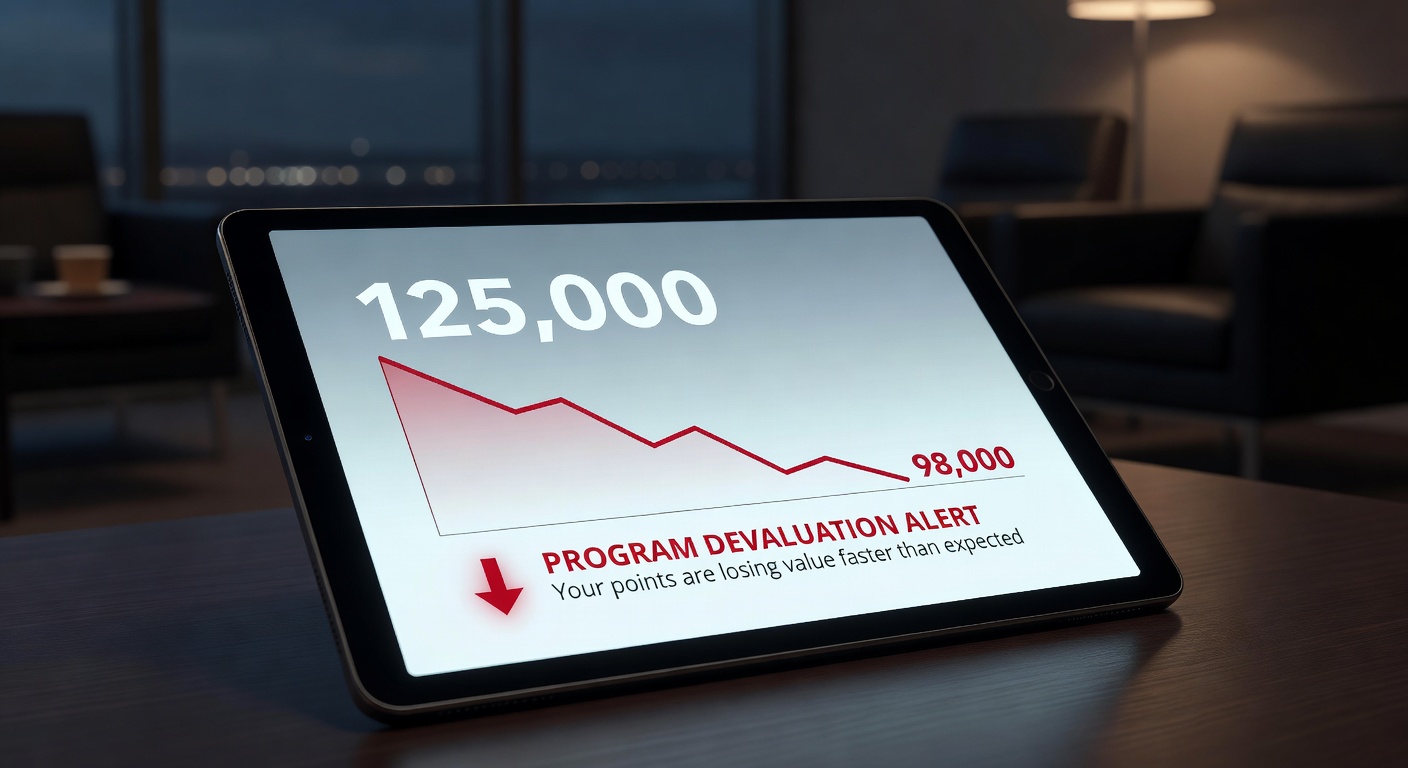
The most important thing to understand about a loyalty point is that it isn’t money. It looks like money — you earn it, hold it, and spend it — but unlike money, the issuer can change what your balance is worth at any time, without warning, and without compensation. That asymmetry is the central reality of any points-based loyalty program, and ignoring it is the most common mistake members make.
The pace of change has accelerated. Between late 2024 and late 2025, Hilton Honors devalued its top-end hotels three times in nine months, pushing the standard award ceiling to 250,000 points per night. World of Hyatt repriced 118 properties upward (against just 33 moved down) in a single March 2025 update, thinning out its cheapest Category 1 inventory. Emirates Skywards went from being a 1:1 transfer partner for all four major bank currencies to a degraded or removed partner at all of them by early 2026. If you were coasting on autopilot, 2025 was an expensive year to do it.
What Devaluation Actually Means
Devaluation is any change that reduces what a given number of points can buy. The change can be visible — a published increase in the number of points required for a specific redemption — or hidden, which is usually more damaging because members notice later.
The most common forms:
A category shift. A hotel that previously redeemed at a published tier moves up one or two levels. The hotel didn’t change. The points required to stay there did. In Hyatt’s March 2025 restructuring, 118 properties moved up while only 33 moved down. The Grand Hyatt Tokyo moved from Category 7 to Category 8 — above the ceiling on most free-night certificates.
A dynamic pricing implementation. A program replaces a published award chart with variable pricing tied to the cash rate. The same redemption that cost a fixed number of points now has no ceiling. Hilton’s top-tier properties reaching 250,000 points per night is a direct consequence of uncapped dynamic pricing.
A transfer ratio change. A 1:1 transfer partner becomes a 1:0.75 partner. In 2025–2026, Emirates Skywards went through this sequence: Citi ThankYou devalued the transfer ratio in July 2025, Amex Membership Rewards followed in September 2025, Chase Ultimate Rewards removed Emirates entirely in October 2025, and Capital One reduced its ratio to 1,000:750 effective January 13, 2026. Four of the four major bank currencies — degraded or cut in six months.
A benefit restriction. The suite upgrade benefit narrows to a shorter list of hotels. The 5th-night-free perk gets restricted to higher elite tiers. The point balance stays the same, but the premium value layered on top of it shrinks.
An earning restriction. American Airlines announced that AAdvantage miles and Loyalty Points will no longer accrue on basic economy tickets purchased on or after December 17, 2025. The accrual change is itself a devaluation — new members building toward status or redemptions face a longer climb.
How and Why Devaluation Happens
Loyalty programs are managed as businesses, and points are liabilities on the issuing company’s balance sheet. Every outstanding point represents a future obligation. When point liability grows faster than redemption activity — because members earn more points than they redeem — programs face increasing pressure to adjust the equation.
The standard lever is redemption mechanics. Earning adjustments are politically harder, since members equate earning rates with program generosity. Redemption adjustments tend to arrive first, and they typically come as quiet category changes, increases in published award floors, or shifts to dynamic pricing that obscure the change in the noise of variable rates.
Member behavior also drives targeted devaluations. When a specific redemption becomes a known sweet spot — a transfer partnership at 1:1, a hotel at a low category, a partner airline at a fixed premium-cabin rate — concentrated redemption activity follows. The program identifies the drain and closes it. The Capital One/Emirates situation is a clean example: as Emirates became a well-publicized transfer target for premium cabin redemptions, the economics stopped working and partner banks walked away one by one.
The 2025 Record: A Case Study in Speed
The pace and breadth of changes in 2025 are worth treating as a standalone case study because they illustrate what a concentrated devaluation cycle looks like:
Hilton Honors: Three devaluations in nine months (December 2024, May 2025, September 2025). Standard award ceiling rose to 250,000 points per night at top-tier properties. Some properties were subsequently partially rolled back — the Waldorf Astoria Beverly Hills returned to 120,000 points per night — but the ceiling itself was set as a new structural reality.
World of Hyatt: March 25, 2025 category restructuring moved 118 properties up and 33 down (151 total), thinning the cheapest Category 1 inventory. Free-night certificates from co-branded credit cards — previously one of Hyatt’s most valued differentiators — were made less useful at 11 properties that moved from Category 4 to Category 5. Hyatt retained a published award chart while others abandoned it, which means the devaluation was at least announced clearly.
Emirates Skywards / transfer currencies: A cascade of transfer ratio changes across Citi (July), Amex (September), Chase removal (October), and Capital One (January 2026) effectively closed one of the most popular premium cabin redemption channels in the hobby. Members who held Emirates miles accumulated through bank transfers faced sequential deterioration in their currency’s origin path.
Lufthansa Miles & More: Moved Lufthansa Group-operated awards from a fixed chart to variable mileage pricing effective June 3, 2025 — the canonical move toward dynamic pricing that erases chart-based predictability.
Singapore Airlines KrisFlyer: Adjusted award rates effective November 1, 2025, with increases concentrated in premium cabin redemptions.
The Compound Effect
The most underappreciated aspect of devaluation is that it asymmetrically punishes savers.
Earning a balance large enough to redeem for a meaningful trip takes months or years. Devaluation can occur overnight. A member accumulating points for three years faces structural risk that a member who earns and burns quickly does not. The Hilton example is instructive: a member who held 150,000 Hilton points in December 2024 targeting a specific Waldorf Astoria property would, nine months later, find that their balance no longer covered the same stay after three sequential devaluation rounds.
The math compounds across programs and years. Inflation isn’t just a currency phenomenon. It’s a loyalty phenomenon.
How to Recognize Devaluation Before It Hits
A few signals consistently precede major changes:
Communication that emphasizes “value” without specifics. When a program publishes marketing material about “delivering more value” or “enhancing the member experience” without naming specific benefits, a structural change is often in the pipeline.
Quiet removal or modification of award charts. When published charts move to “starting from” language, or when a program announces it is “simplifying” its structure, dynamic pricing is usually next.
Partner relationship renegotiations. When co-branded card agreements are renegotiated, loyalty program mechanics are typically restructured as part of the deal. The Emirates devaluations correlated with changed economics of the Emirates Skywards currency.
Earnings calls and investor communications. Loyalty programs are significant revenue drivers in airline and hotel financials. When parent companies signal increased loyalty program revenue without obvious explanation, the explanation is often a redemption mechanic change that members will notice later.
Community signals. Frequent flyer forums, points-focused blogs, and social media communities routinely surface upcoming changes before formal announcements. Monitoring these channels is one of the most actionable defenses.
Strategies to Stay Ahead
Earn and burn rather than accumulate. Holding points only long enough to fund the next planned trip minimizes devaluation exposure. Don’t accumulate balances for an unspecified future trip.
Concentrate in transferable bank currencies — but diversify partners. American Express Membership Rewards, Chase Ultimate Rewards, Citi ThankYou, and Capital One Venture Miles provide flexibility to move to whichever partner currently delivers best value. The Emirates devaluation cycle illustrates both the strength of this model (you could transfer before the deadline) and its limits (all four currencies degraded the same partner in sequence).
Redeem at peak value when possible. Premium cabin international awards and aspirational hotel redemptions generally deliver more cents-per-point value than budget redemptions. The trade-off: high-value redemptions are the first targets when programs tighten. Book sooner rather than later when a high-value redemption is in reach.
Watch cancellation policies. Programs with free award cancellation and full points reinstatement reduce the risk of committing to a redemption that changes before your travel date. Hyatt’s historically permissive cancellation policies are part of its competitive moat.
Take advance notice windows seriously. When a program announces future changes with an effective date, the window between announcement and implementation is an opportunity to book at current rates. Hyatt’s March 2025 changes were announced with enough lead time for members to lock in pre-change pricing for bookings made before March 25, 2025.
The Counterargument
Not all programs devalue equally or at the same frequency. World of Hyatt retained a published award chart through its 2025 restructuring — a meaningful differentiator in a landscape where Hilton, Marriott, and major airlines have largely abandoned transparent pricing. Some programs have added genuinely valuable transfer partners or improved earning rates in specific categories.
The honest framing: devaluation is real, ongoing, and structurally unavoidable over long time horizons. But careful program selection, active redemption behavior, and attention to change signals can substantially reduce exposure.
What Program Design Features Predict Risk
Structural features that correlate with elevated devaluation risk:
- Dynamic award pricing without a published ceiling or floor
- Heavy reliance on co-branded credit card revenue as a profit center
- Recent program rebrand or “enhancement” announcements
- Significant transfer partner consolidation or partner ratio changes
- Public statements about loyalty program “monetization” in investor materials
- Aspirational redemption categories that attract concentrated member behavior
Frequently Asked Questions
Do all loyalty programs devalue eventually? In the long run, yes. The structural pressure to reduce per-point liability is ongoing. The question is rate and predictability, not direction.
Is it better to redeem now or save for a bigger trip? For most members, redeeming sooner limits exposure. The exception is when a specific aspirational redemption is in clear sight, a published award chart makes the price predictable, and the program has shown relative stability — World of Hyatt with advance notice of category changes is a better candidate for planning than Hilton with dynamic uncapped pricing.
Are bank transferable points safer than airline or hotel points? Safer in the sense of optionality — you can redirect value to whichever partner currently performs best. But the Emirates devaluation cycle in 2025–2026 demonstrates that transfer partners themselves can degrade simultaneously, reducing the diversification benefit.
Should I let points expire to avoid tracking them? No. Most programs have low-friction activity options that reset expiration — a single qualifying transaction, a partner shopping portal purchase, a hotel stay. Active management is almost always less costly than expiration.
The Underlying Lesson
Loyalty points behave like money in every aspect except the one that matters most: who controls their value. The 2025 devaluation cycle — accelerated, multi-program, and in some cases deliberately obscured — made this clearer than any prior year in recent memory. Treat points as a perishable currency, not an investment. The members who get the most out of loyalty programs are the ones who recognize the structural risk, redeem actively rather than hoarding, and stay alert to the signals that another change is coming.
The points game isn’t won by accumulating. It’s won by spending well, at the right time, before the program decides to change the rules.
Further Reading from Authoritative Sources
- Hilton Honors — Wikipedia documents the Hilton Honors program structure that the article uses as its primary case study for accelerated, repeated devaluation — the three rounds in nine months and the 250,000-point ceiling illustrate the concrete mechanics of uncapped dynamic pricing at scale.
- World of Hyatt — Wikipedia provides documented background on World of Hyatt’s award chart approach — the article positions Hyatt’s retention of a published category chart as the key contrast to fully dynamic programs, and the March 2025 restructuring data (118 up, 33 down, 151 total) is the article’s central Hyatt devaluation example.