Every loyalty platform pitch deck this year features “AI personalization.” Some of the claims are real, some are aspirational, and some are rebranded versions of features that have existed for a decade. For restaurant operators trying to decide where to spend the next dollar of MarTech budget, the useful question is not whether AI is in the platform — it almost certainly is, somewhere — but what specifically it does and whether the data exists to make it work.
What AI Personalization Actually Means in This Context
The phrase covers four distinct capabilities that are often bundled together in marketing material but operate quite differently in practice:
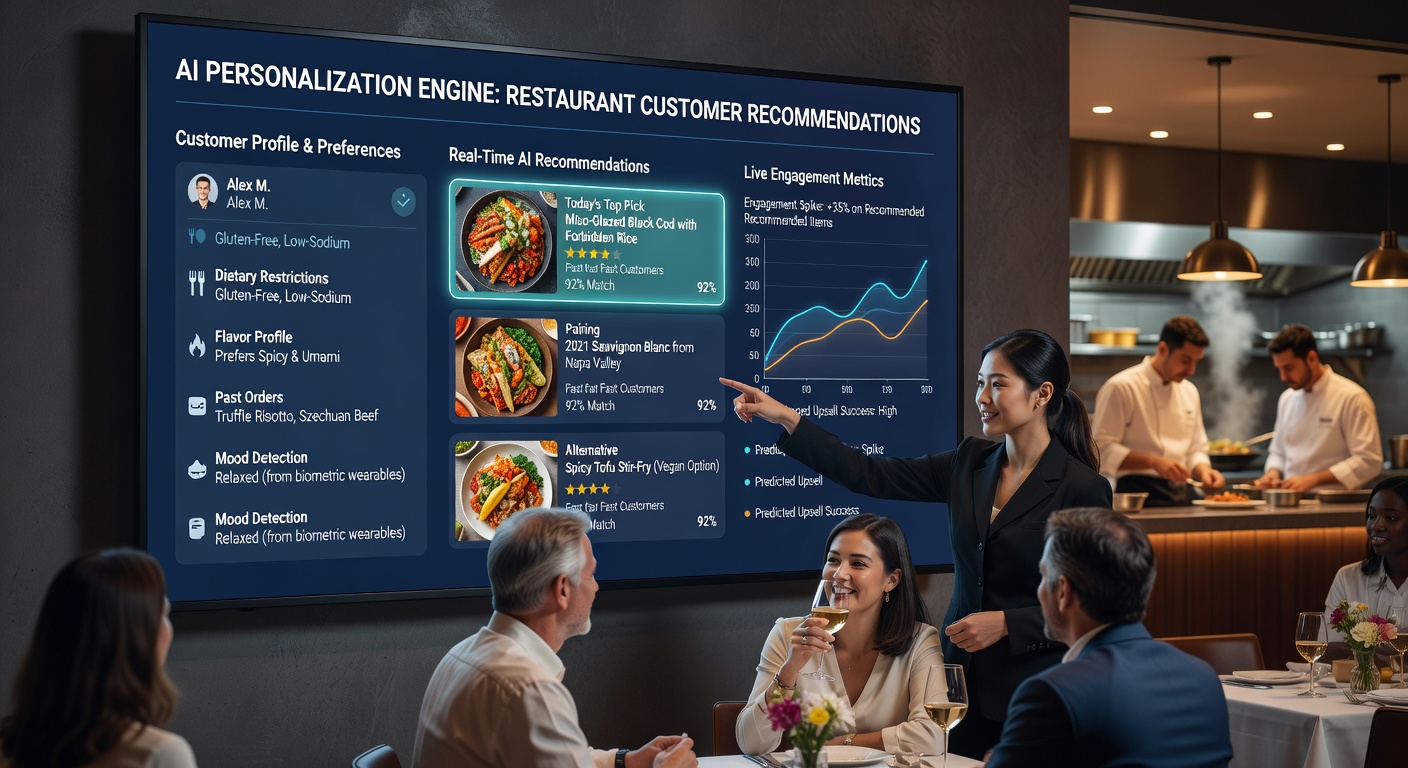
Recommendation engines. Models that predict which menu items a specific member is most likely to want next, based on past behavior and patterns across similar members. The same family of techniques that powers product recommendations in ecommerce, adapted to a menu rather than an SKU catalog.
Next-best-offer prediction. Models that select the optimal offer to present to a member from a candidate set, balancing predicted response rate against offer cost. Far more sophisticated than rule-based offer targeting, and meaningfully harder to implement well.
Churn prediction. Models that estimate the probability a member will lapse and stop visiting within a defined window, allowing reactivation effort to focus on members most at risk. These models have a long history in subscription businesses and are increasingly common in restaurant loyalty.
Dynamic reward valuation. Models that adjust reward thresholds, point values, or offer richness based on a member’s predicted lifetime value or current engagement state. This is the most operationally complex of the four and the least mature in production deployments.
What Leading Platforms Are Building Versus Marketing Hype
Most major restaurant loyalty platforms now offer at least basic recommendation and offer-selection capabilities. The depth and rigor of these features varies dramatically. The honest evaluation question is whether the platform has actually trained a model on the operator’s data, whether the model’s predictions are exposed transparently, and whether marketing teams can see why the system selected a particular offer for a particular member.
Vendors that can answer those questions clearly tend to have real capabilities. Vendors that retreat to “the AI handles it” generally have a thinner offering than the marketing implies. Operators evaluating platforms should ask for specific case examples and, where possible, run a paid pilot before committing to enterprise terms.
The capabilities that are genuinely new — versus rebranded — usually involve scale of personalization that was previously infeasible. Sending one of forty different offers to forty different segments was possible a decade ago. Sending one of forty thousand offer variants to forty thousand individually-scored members is closer to new ground, and is what AI personalization, done well, actually delivers.
The Data Requirements
The unflattering truth about AI personalization is that it requires more data than most operators initially realize, and more data than smaller operators usually have. Models need enough transaction history per member to learn patterns, enough members to make patterns generalize, and enough channel and product variety to make recommendations meaningful.
For a chain with a few thousand monthly active members and a relatively simple menu, the marginal value of AI personalization over good rule-based targeting is modest. For a chain with millions of members, dozens of menu categories, and multiple channels, the gap between sophisticated personalization and basic targeting becomes commercially significant.
This is why personalization tends to be a scale-dependent investment. Operators who try to deploy enterprise-grade AI features at sub-scale tend to find the system makes decisions that look random to members because the underlying models lack the data to do better.
Use Cases With Measurable Impact
The personalization use cases that consistently produce measurable lift in restaurant programs are not the most futuristic ones. The bread and butter looks like this:
Targeted reactivation. Members who have not visited in a category-appropriate window receive offers calibrated to their typical purchase pattern. Generic reactivation messages produce some response; personalized ones consistently produce more.
Channel-shift targeting. In-store-only members receive prompts to try digital ordering, with offers designed to overcome the friction of the first digital order. Once shifted, these members typically increase frequency.
Product trial. New menu items get surfaced to members whose history suggests affinity. Trial rates on personalized recommendations meaningfully exceed broadcast trial promotions.
Daypart smoothing. Members who order primarily at lunch see breakfast or dinner offers calibrated to nudge them into additional dayparts.
Each of these works within existing program structures. They are personalization use cases, not AI moonshots, and they produce most of the program-level impact attributed to personalization in mature programs.
A Practical Starting Point Without a Full AI Platform
Operators who want personalization gains without the platform investment have a workable path. Start with rule-based targeting on the segmentation dimensions that matter most: recency of last visit, channel preference, category affinity, and tier status. A well-segmented manual program — six to eight rule-based segments with differentiated offers — captures most of the value an early AI deployment would deliver, at a fraction of the implementation cost.
Once the rule-based program is mature, the case for a platform upgrade becomes clearer because the comparison is no longer between AI and nothing — it is between AI and a respectable baseline. The lift required to justify the upgrade is whatever it takes to beat that baseline, and a serious vendor should be willing to commit to that test.
What to Avoid
Two failure modes are common. The first is buying an AI capability and never wiring it to actual offer execution — the model produces scores nobody acts on. The second is granting the model autonomy without instrumented oversight, leading to drift, bias, or outright bad decisions that nobody catches because the system is treated as a black box.
The right operating posture is to treat the AI layer as a powerful recommendation system whose decisions are reviewed by marketing operators on an ongoing basis. Trust grows with track record; full autonomy is earned, not granted on day one.
FAQs
Is AI personalization worth it for smaller operators? For most independent operators and small chains, no — not yet. The data requirements and platform costs do not pencil out against the marginal lift over good rule-based targeting.
What’s the minimum scale for serious AI personalization? The threshold varies by program design and channel mix, but most mature deployments sit at programs with at least several hundred thousand active members.
How do I evaluate whether a platform’s AI is real? Ask for case examples with measurable outcomes, ask to see the model’s predictions for specific members, and ask how the system handles model drift and bias monitoring.
What about generative AI in loyalty? Generative AI use cases — content generation, conversational interfaces, automated copy variants — are an adjacent and rapidly developing area. They are mostly separate from the predictive personalization use cases discussed here.
Closing
AI personalization in restaurant loyalty is real, increasingly capable, and worth investing in at the right scale. It is also overpromised by vendors and underprepared for by operators in roughly equal measure. The path that consistently works starts with a strong segmentation discipline, builds toward predictive capability as scale justifies it, and treats every model as a tool to be supervised rather than a black box to be trusted. Done that way, the technology earns its keep. Done badly, it produces personalization that members experience as randomness — which is worse than no personalization at all.
Further Reading from Authoritative Sources
- Harvard Business Review — HBR publishes the applied AI and marketing analytics research that underpins the article’s analysis of which AI personalization capabilities are real versus marketing hype, and what scale requirements must be met for AI to outperform rule-based segmentation.
- Interactive Advertising Bureau — IAB establishes the data and identity standards that define what constitutes a sufficient first-party data foundation for AI-powered personalization — directly relevant to the article’s analysis of data requirements that most operators initially underestimate.