McDonald’s came to loyalty late by category standards, but the program it launched arrived at a scale no competitor could match. Within its first stretch as a national U.S. program, MyMcDonald’s Rewards became one of the largest loyalty memberships in the restaurant industry, and remains a benchmark for what QSR loyalty can look like when executed at the franchise system level. The program is worth studying not because it does anything radically novel, but because of how it handles the operational complexity of running a single loyalty experience across tens of thousands of locations.
Program Mechanics
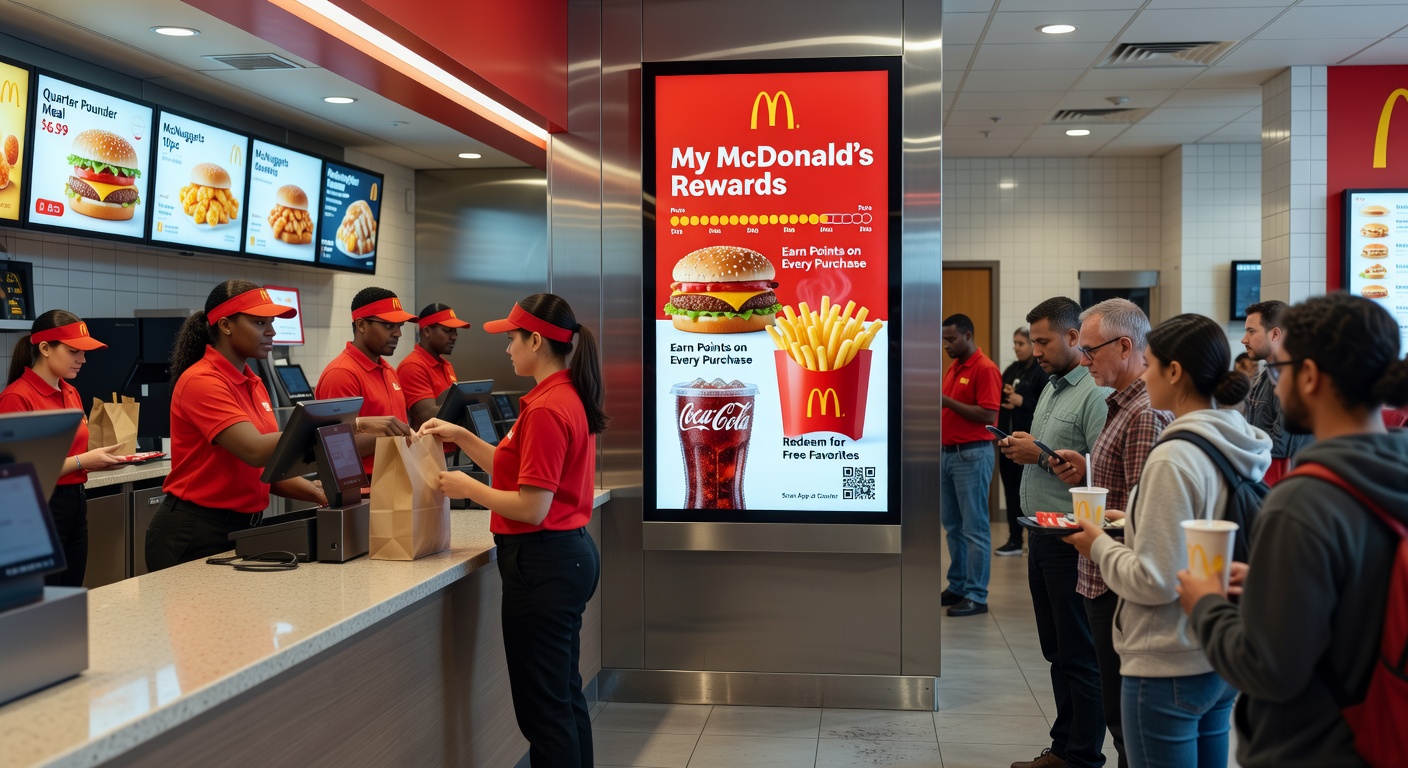
The structure is intentionally simple. Members earn points on qualifying purchases at a fixed rate per dollar. Points accumulate toward redemption thresholds that unlock specific menu items at various tiers — small items at the lowest threshold, premium items at higher thresholds. Redemption is straightforward: members select a reward in the app, generate a code, and apply it at the order point.
The simplicity is a feature, not a limitation. At McDonald’s scale, any program complexity multiplies into operational and training problems across an enormous franchise system. The fixed earn rate, fixed redemption tiers, and binary reward selection make the program legible to members and operationally tractable for crew members at any location.
What Distinguishes a Program at QSR Scale
Three operational realities shape what is possible at McDonald’s scale:
Transaction volume. The program processes a transaction count that dwarfs most peer programs combined. Every architectural choice — from data infrastructure to offer delivery to redemption authorization — has to operate at a throughput few platforms ever face. The platform stability the program has delivered is, in its own quiet way, an engineering achievement.
Geographic breadth. Loyalty has to function consistently across urban flagships, suburban drive-thrus, highway locations, and small-town franchises. The lowest-common-denominator location determines what the program can do at the front line, and the program design respects that constraint.
Franchise system complexity. Every operator-level decision touches franchisees who run their own businesses. Loyalty cost allocation, training requirements, and any operational friction the program creates all become franchisee relations issues. The program’s design choices reflect awareness that simpler is usually more deployable across a system this size.
Personalization Within a Simple Framework
The program’s static structure does not mean its communications are static. Targeted offers, birthday rewards, regional menu variations, and channel-specific bonuses run on top of the base mechanics. A member who orders through the app gets different offer treatment than one who orders in-store. A member whose preferences trend toward breakfast sees breakfast-oriented offers. A member who has not visited in three weeks gets a reactivation message.
The personalization is mostly offer-layer rather than program-layer. The underlying program looks the same to every member; what differs is the offers surfaced in the app and the messages delivered to the phone. This separation is useful: it allows behavioral targeting without complicating the core experience.
The App-Ordering Flywheel
The strategic value of MyMcDonald’s Rewards extends well beyond loyalty in the traditional sense. The program functions as the gravitational center of McDonald’s digital customer relationship — the reason members install the app, the reason they keep it on their phone, and the reason they use it to order rather than walking up to the counter.
Every digital order delivers operational benefits at scale: more accurate orders, smoother kitchen workflow, integrated payment, and most importantly, a connected identity that links transactions over time. Loyalty is what makes the app worth keeping; the app is what makes digital ordering scale. The two reinforce each other, and the program’s contribution to digital order penetration is plausibly more valuable than its contribution to incremental visit frequency.
Lessons for Other QSR Operators
Even operators a fraction of McDonald’s size can take useful lessons from the program design:
Simplicity scales better than cleverness. Every additional rule, tier, or exception adds operational and training cost. Programs that resist creeping complexity tend to perform better at the front line.
The digital ordering tie matters more than the program itself. Loyalty programs in QSR that are not integrated tightly with digital ordering leave most of their potential value uncaptured.
Personalization belongs in the offer layer, not the program layer. Keeping the base program simple while differentiating offers preserves operational sanity without sacrificing relevance.
Speed of redemption matters in QSR. Members in a drive-thru lane do not want to navigate a complex app flow. Redemption design has to assume the user is in a hurry.
Crew training is a real cost. Any program that requires crew members to do anything novel at the order point has to budget for the training and the inevitable inconsistency. Programs designed to minimize crew interaction perform more consistently.
Where the Program Has Room to Grow
No program is perfect. The areas where MyMcDonald’s Rewards has visible upside include richer tier and status mechanics for the highest-frequency members, deeper subscription-style benefits for specific menu categories, expanded partnership and gamification programs, and more sophisticated predictive personalization. The program is also still maturing in its non-U.S. markets, where local execution varies by market structure.
The pattern that has worked is incremental: launch a basic program, scale it, iterate on offers and personalization, then add structural enhancements. Operators sometimes underestimate the value of getting the basics right first; McDonald’s did not.
FAQs
Is the McDonald’s loyalty program design replicable at smaller scale? The structural simplicity is highly replicable. The scale benefits are not — a smaller operator will not have the transaction volume to fuel the personalization engine in the same way. But the design principles travel well.
What’s the single most strategic feature of the program? Its role as the anchor for digital ordering. The loyalty program’s contribution to digital order penetration is arguably more commercially significant than its direct loyalty effects.
Does the program use status or tiers? The base structure is a flat points-and-thresholds program. Status mechanics are an area where the program has room to develop.
How does the program handle franchise cost allocation? The specifics are not public, but the program’s design acknowledges franchisee economics by keeping operational complexity low and reward cost manageable.
Closing
MyMcDonald’s Rewards is a study in what a loyalty program looks like when executed at industrial scale. The mechanics are not novel; the execution is. For QSR operators thinking about their own loyalty programs, the takeaway is not to copy the specific point values or threshold levels, but to internalize the operational discipline that makes a program work consistently across tens of thousands of locations and tens of millions of members. Simplicity, ordering integration, and patient iteration are the through-lines. Most programs that struggle in this category are missing one or more of those three.
Further Reading from Authoritative Sources
- McDonald’s — Wikipedia documents McDonald’s franchise system structure and scale that is foundational to the article’s analysis — the tens of thousands of locations, geographic breadth from urban flagships to highway locations, and franchise economics that determine what program design choices are operationally feasible at McDonald’s scale.
- Harvard Business Review — HBR’s research on operational simplicity in large organizations and consumer loyalty program design provides the analytical framework for the article’s core lessons — including why simplicity scales better than cleverness at franchise scale, and why the digital ordering flywheel created by loyalty app integration may be more commercially significant than direct loyalty effects.