The customer data platform question reaches most restaurant operators eventually, usually in the form of a vendor pitch or a strategy memo from a new digital leader. The case sounds compelling: unify all your customer data, activate it across every channel, unlock personalization at scale. The cost — financial, organizational, and engineering — is rarely as clearly presented. A clear-eyed answer to the CDP question starts with understanding what these platforms do, what a loyalty platform already does, and where the actual gap is in a typical restaurant stack.
What a CDP Does That a Loyalty Platform Cannot
A loyalty platform manages members. It knows who is enrolled, what they have purchased through tracked channels, what their points balance is, what offers they have redeemed, and what tier they belong to. Within the loyalty membership, it has a strong view of behavior.
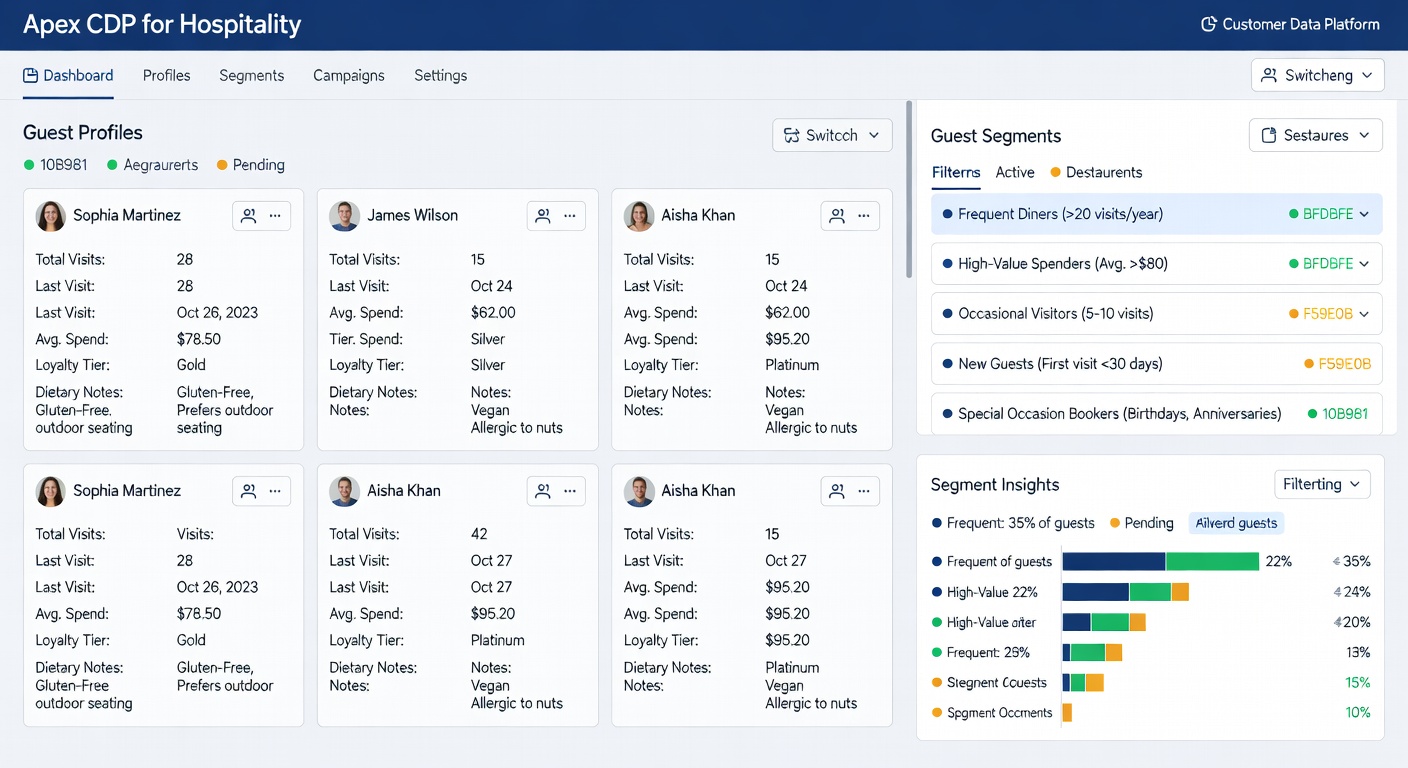
A CDP manages everyone. Its purpose is to unify identity across all channels and known touchpoints — loyalty membership and non-members, app users and web visitors, in-store guests and delivery channel customers, email subscribers and SMS opt-ins. The unification is the core feature: a CDP resolves the same human across email address, phone number, device ID, loyalty ID, and any other identifier the brand collects.
In a typical restaurant operation, that resolution is meaningful. A guest might order through DoorDash under one identity, sign up for loyalty under another, visit the website anonymously under a third, and respond to a Facebook ad under a fourth. Each of these systems thinks it knows a different person. The CDP’s job is to recognize that there is only one person, and to maintain a unified profile that any downstream system can use.
When You Actually Need a CDP
The honest answer for most independent operators and smaller chains is: not yet. A well-integrated loyalty platform plus a competent marketing automation tool (Klaviyo or a peer) handles most of the work a CDP would do, at a fraction of the cost and engineering effort.
The threshold for serious CDP consideration tends to involve several conditions in combination:
Scale. The operator has enough customer volume that the marginal value of better identity resolution justifies platform cost. The break-even is somewhere in the multi-hundreds of millions of revenue range for most concepts.
Channel complexity. The operator runs a meaningful business across multiple channels that do not natively share identity — direct app and web ordering, third-party delivery, in-store, and significant paid digital activity.
Personalization ambition. The operator wants to do personalization that goes beyond what a loyalty platform’s offer engine can deliver — true predictive next-best-action, dynamic content selection, real-time decisioning at the edge.
Engineering capacity. The operator has or can hire the technical resources to implement and maintain a CDP, which is substantially more involved than implementing a loyalty platform.
Without all four conditions, the CDP investment usually underperforms simpler alternatives.
CDP Vendors Relevant to Restaurant
A few platforms appear most often in restaurant evaluations:
Segment. The most widely adopted general-purpose CDP. Strong developer experience, deep integration ecosystem, and a flexible event model that adapts well to restaurant data structures. Pricing scales with event volume, which can become significant at chain scale.
mParticle. Comparable scope to Segment with stronger mobile-first heritage. Often selected by operators where app behavior is central to the customer model.
ActionIQ. Heavier-weight enterprise CDP with stronger activation and audience-building features for marketers. Tends to land in larger enterprise stacks where the marketing team’s day-to-day involvement with the platform is high.
Tealium, Treasure Data, and others. Multiple capable platforms exist in adjacent positioning. The right fit depends on the operator’s specific data sources, downstream activation needs, and engineering preferences.
The vendor choice is less important than getting the implementation right. A poorly implemented best-in-class CDP delivers less value than a well-implemented adequate one.
Use Cases That Justify the Investment
Three use case families produce most of the demonstrable ROI in restaurant CDP deployments:
Identity resolution across channels. Linking app, web, in-store, and delivery channel behavior under unified profiles enables analytics and marketing that simply cannot happen in fragmented data. This alone often justifies the platform.
Personalization at scale. Once unified profiles exist, the loyalty platform, the marketing automation tool, the digital ordering platform, and the paid media stack can all pull from the same enriched data. Personalization becomes consistent across channels rather than each system having its own incomplete view.
Predictive modeling. Churn prediction, lifetime value forecasting, and next-product modeling become tractable when training data is consolidated. The models are only as good as the data that feeds them, and a CDP is often the bridge between scattered transactional systems and a workable modeling environment.
The Implementation Reality
A CDP is not a tool you buy and turn on. Implementations typically involve months of source system mapping, event schema design, identity stitching configuration, and downstream activation wiring. The work is engineering-heavy and rarely delivers visible marketing value in the first quarter of effort.
The most common failure mode is buying the platform before clarifying the use cases. A CDP without specific, measurable use cases becomes a costly data warehouse that nobody uses. The right sequence is use case definition first, vendor selection second, implementation third.
Building the Case to Leadership
A clean internal case for a CDP rests on three elements. First, a specific list of business problems the platform will solve, expressed in commercial terms (incremental revenue from better targeting, cost savings from deduplicating media spend, retention lift from better lifecycle automation). Second, an honest accounting of total cost — platform license, implementation engineering, ongoing maintenance, and the opportunity cost of the technical resources required. Third, a phased plan that delivers visible value early rather than promising everything in eighteen months.
Leadership teams that have been burned by oversold CDP projects will ask the third question whether or not you raise it. Bringing it up first is usually the better move.
FAQs
Can I run effective marketing without a CDP? For most operators, yes. A strong loyalty platform integrated with marketing automation and a reasonable analytics tool covers most use cases. CDPs become valuable at larger scale and higher channel complexity.
Is a CDP the same as a customer data warehouse? No. A warehouse stores data; a CDP unifies and activates it. The two are complementary rather than competitive, and many sophisticated operators run both.
How long does a CDP implementation take? Realistic timelines for a useful first activation run six to twelve months. Full maturity takes longer.
What’s the most common implementation mistake? Buying the platform before defining the use cases. The platform is not a strategy; it is infrastructure for a strategy.
Closing
A CDP is a powerful piece of infrastructure for restaurant operators who have outgrown what a loyalty platform alone can do. For most operators, the right answer is not a CDP yet — it is a better-integrated stack of the tools already in use. The discipline is in being honest about which side of that line you are on. Operators who buy the platform too early waste capital; operators who delay too long leave personalization value on the table. The middle path is to define the specific use cases you cannot satisfy today, and then evaluate whether a CDP is the cheapest way to solve them.
Further Reading from Authoritative Sources
- Interactive Advertising Bureau — IAB establishes data and identity standards used in audience resolution and cross-channel attribution — directly relevant to the identity-stitching use cases that justify CDP investment for restaurant operators.
- FTC consumer data guidance — FTC guidance on consumer data collection, storage, and sharing practices applies directly to the comprehensive customer profiles that a restaurant CDP creates and activates.