Operators spend enormous energy designing rewards. They spend much less designing the enrollment moment — the brief decision in which a customer either becomes a member or doesn’t. That is backwards. Most research on loyalty program performance shows that what happens in those few seconds determines the demographic shape, engagement potential, and long-term economics of the entire program.
This piece synthesizes consumer research on what actually drives loyalty enrollment, what kills it, and how the drivers shift across categories.
The Primary Drivers
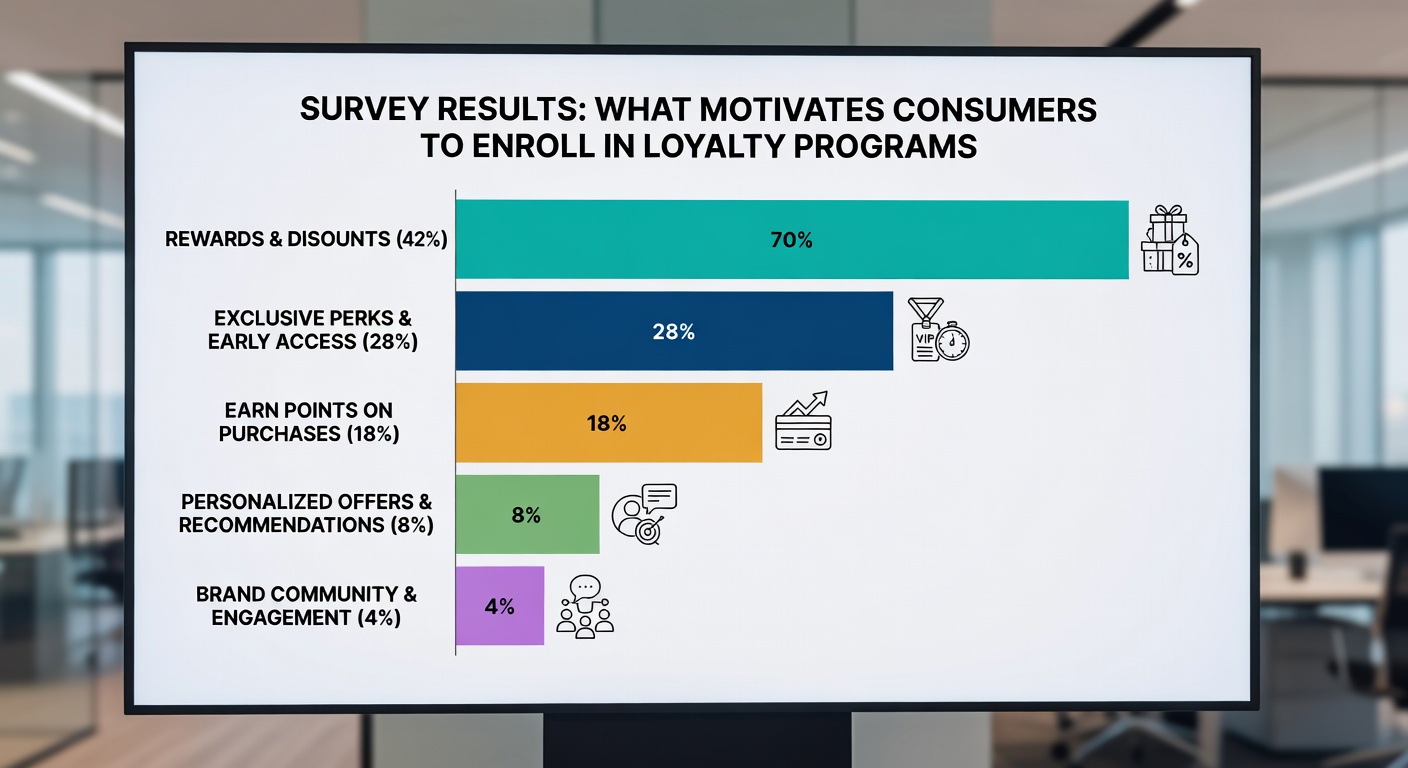
Across studies, four enrollment drivers come up repeatedly as the prime movers.
Immediate value. The single strongest predictor of enrollment is a clear, tangible benefit available right now — a discount on this transaction, a sign-up bonus that is meaningful relative to the purchase, or a free item with the next visit. Programs that lead with “you’ll earn toward a future reward” enroll fewer members than programs that lead with “you get this benefit today.” This is not because consumers don’t value future rewards; it is because they discount them sharply and need a reason to believe the program is worth their attention upfront.
Social proof. Consumers join programs they believe other people are happy in. Visible cues — staff using member language naturally, “members save…” framing on signage and screens, app store reviews — all increase enrollment intent. A program that feels like the default in its category enrolls faster than a program that feels like a niche option.
Trusted brand. Trust shows up in two distinct ways at enrollment. Brand trust (the customer trusts the company generally) makes the customer willing to share contact information. Program trust (the customer trusts that the rewards will be honored, the points won’t be devalued, the fine print won’t bite them) makes the customer willing to participate seriously.
Enrollment simplicity. The number of fields required, the time the process takes, and the channel options all affect enrollment rates measurably. Programs that require an email address only enroll meaningfully more members than programs that require email plus phone plus address plus birthdate at the moment of sign-up.
The Secondary Drivers
A second tier of drivers shows up consistently in research, particularly for engaged consumer segments.
Status aspiration. Programs with visible tiers — silver, gold, platinum — appeal to consumers who value the recognition that comes with elevated status. This driver is most powerful in travel and premium retail and least powerful in convenience-driven categories like quick-service food.
Fear of missing out on points. Once a category has multiple loyalty programs, consumers who don’t enroll feel that they are “leaving money on the table.” This driver matters more once a category is mature. In a new category, it is weak. In a mature category, it can be the dominant driver.
Personalization promise. Some consumers join programs explicitly because they want offers that are relevant to them rather than generic. This is a smaller driver in aggregate, but it correlates with high-engagement member behavior — these are members worth designing for.
The Enrollment Killers
What stops a willing customer from completing enrollment? Research consistently surfaces three killers.
Too much information required. Every additional field at sign-up reduces completion rates. Birthdate, full address, household composition, communication preferences — each of these is reasonable to want, and each of these reduces enrollment if asked at the wrong moment. The fix is progressive profiling: get the email at enrollment, ask for the rest later when the relationship has earned the question.
No immediate benefit. A customer who is told “sign up and you’ll start earning toward future rewards” with no upfront value rarely completes enrollment except in highly engaged categories. The fix is a real first-visit benefit that the customer can use today.
Skepticism about data use. A meaningful portion of customers will not enroll because they don’t trust how their data will be used. Transparent privacy language, the ability to enroll with minimal personal information, and a visible track record of not over-emailing all reduce this barrier. In categories where the brand has been associated with aggressive marketing, this killer is larger.
How Enrollment Drivers Differ By Category
The relative weight of these drivers shifts meaningfully by category.
Restaurant programs lean heavily on immediate value and enrollment simplicity. Customers are at the counter with limited patience. The winning enrollment flows tend to offer a real benefit on this transaction in exchange for an email address, with everything else deferred.
Retail programs rely more on a mix of immediate value, social proof, and the FOMO-on-points driver. The enrollment moment is often less rushed than in restaurants, allowing slightly more information capture, but the benefit framing still needs to be tangible and present-tense.
Travel programs lean on status aspiration and trust more than the others. The rewards are large, the time horizon is long, and the consumer is making a real bet on the brand. The trust factor matters disproportionately, which is why travel programs invest so heavily in elite-tier credibility and member protection.
The Frontline Role
One finding shows up across nearly every piece of research on loyalty enrollment: a verbal offer from a frontline employee outperforms passive signage by a large margin. A barista, server, or cashier saying “Would you like me to sign you up — you’ll get [specific benefit] right now” enrolls members at a rate that signage and app prompts alone cannot match.
This is operationally inconvenient. It requires training, incentive alignment, and ongoing reinforcement. It is also one of the highest-leverage investments an operator can make in their program, because the quality of the enrollment moment shapes everything downstream.
What Program Designs Produce Higher Enrollment
Pulling the drivers and killers together, the program designs that consistently produce higher enrollment share a small set of features:
- A meaningful first-transaction benefit that the customer experiences in real time
- An enrollment flow that asks for email only at the moment of sign-up
- A clear, short articulation of the value proposition that a frontline employee can deliver in one sentence
- Visible signals — in-store, in-app, on receipts — that members are getting a different and better experience
- Transparent, plain-language treatment of data and communication preferences
FAQ
Is digital enrollment better than in-person enrollment? Both have their place. Digital enrollment scales without staff effort but tends to attract less engaged members. In-person enrollment with a verbal offer attracts more engaged members but requires operational investment.
Should the first-visit benefit be a discount or a free item? Both work. Free-item offers tend to outperform percentage discounts on enrollment intent because they are more concrete. The right answer depends on the unit economics of your category.
How quickly should follow-up communication start after enrollment? Within 24 hours, with content that reinforces the value proposition and invites a second behavior. The first week after enrollment is the highest-leverage communication window in the entire program.
Should we use enrollment incentives during a launch versus steady-state? Slightly richer enrollment incentives during launch can be useful for breaking inertia, but they should not be so generous that they distort the long-term economics. The goal is to attract members who will engage, not to inflate enrollment numbers.
The Operator’s Takeaway
The enrollment moment is the most expensive piece of real estate in a loyalty program — not in dollars, but in consequence. The customers you enroll determine the customers you can later engage, retain, and grow. Investing in the design of that moment, the frontline behavior around it, and the immediate experience after it pays returns that no amount of downstream campaign optimization can replicate.
Further Reading from Authoritative Sources
- Harvard Business Review — HBR’s consumer behavior and behavioral economics research provides the theoretical foundation for the article’s four-driver framework — particularly the finding that consumers discount future rewards sharply (explaining why immediate value dominates) and that trust and social proof are prerequisite conditions for data-sharing decisions at enrollment.
- National Retail Federation — NRF publishes consumer loyalty enrollment research and retail program benchmarks that contextualize the article’s synthesis of enrollment drivers — including the documented gap between frontline-offer enrollment rates and passive-signage enrollment rates, and the progressive profiling practices that distinguish high-enrollment restaurant programs from those that require too much at sign-up.