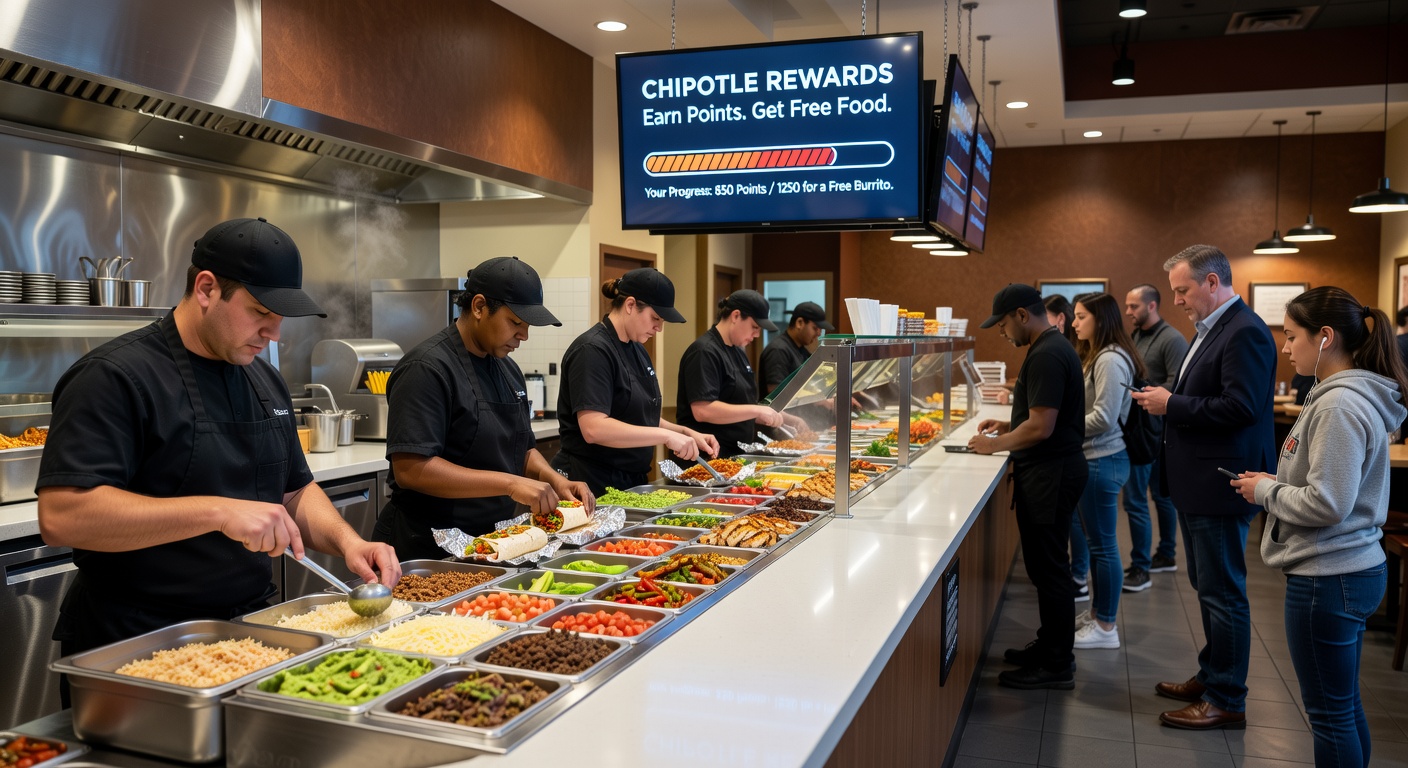
Few fast casual loyalty programs have scaled as quickly or as visibly as Chipotle Rewards. Launched after years of internal debate about whether a brand built on quality and culture even needed a points program, it grew into one of the largest loyalty memberships in restaurants — and arguably the most engaged. The program’s design tells a useful story about what differentiates a fast casual loyalty program that drives behavior from one that simply tracks it.
Program Mechanics: The Foundation
At its core, Chipotle Rewards uses a straightforward structure familiar from other category programs. Members earn points per dollar spent on qualifying purchases. Points accumulate toward thresholds that unlock free entrées or other reward items. Free chips and guac on a birthday — a low-cost benefit with outsized emotional impact — anchors the early relationship.
What makes the structure feel different in practice is the layered system on top of the base mechanic. Bonus point events appear regularly — sometimes seasonal, sometimes channel-specific (extra points on digital orders), sometimes product-specific (try this new menu item for double points). The base rate is the floor; bonuses are the engine.
What Chipotle Did Differently
Three design choices separated the program from peers:
Gamification through challenges. Rather than treating loyalty as a passive accrual engine, Chipotle introduced challenges — visit three times in a week, try two different menu items, order through the app — that reward members for specific behaviors. This shifted the program’s psychology from “earn points eventually” to “complete this objective now,” which is far more behaviorally activating.
Personalization at scale. Offers are not uniform across the member base. Visit patterns, channel preferences, and menu history feed targeted offers that arrive when the member is most likely to act on them. A lapsed digital orderer gets a different prompt than a frequent in-store guest. Done well, this kind of personalization makes the program feel responsive rather than algorithmic.
Digital ordering integration. Loyalty and digital ordering live in the same app, and they reinforce each other. The app is the most efficient way to order, and ordering through the app is the most efficient way to earn. That mutual reinforcement turned the loyalty membership into a digital-order acquisition engine — arguably its most strategically valuable function.
Enrollment Growth and the Digital Flywheel
The enrollment trajectory tells the story of a program that scaled in step with broader digital adoption. The acceleration during the period when digital ordering became a default channel was not coincidental — loyalty members made the transition more readily, and digital orderers signed up for loyalty at higher rates. Each channel pulled the other forward.
The strategic insight here is that fast casual loyalty in the modern era is rarely valuable as a stand-alone program. Its real value comes from being the wrapper around an integrated digital experience: order, pay, earn, redeem, repeat. Operators evaluating loyalty in isolation, separate from their digital ordering platform, are looking at half the picture.
The Status and Tier Layer
Beyond the base points program, Chipotle added a higher-engagement tier — a way for the most frequent guests to access additional benefits, exclusive content, and elevated rewards. Tiered loyalty has a long history in airlines and hotels, but in restaurants it had been used sparingly. Chipotle’s experiment showed that even in a fast casual context, members responded to status. The mechanic produced measurable behavior change among the top of the file — more frequent visits, more digital orders, higher attached purchases.
The design choice that mattered most was making the tier achievable without being trivial. Status that requires extreme behavior excludes too many members; status that comes too easily means nothing. Calibration is everything.
Channel and Product Strategy
The program’s bonus structure quietly does strategic work. Promotions tied to specific menu items help drive trial of new launches without permanent menu price impact. Channel-specific bonuses pull behavior toward higher-margin digital orders. Time-of-day bonuses smooth daypart utilization. None of this is unique to Chipotle, but the consistency and visibility of the calendar — there is almost always a bonus running — keeps members checking the app, which keeps the brand in mental availability.
What Other Fast Casual Operators Can Learn
A few lessons travel well across the category:
The app and the loyalty program should be the same product. Treating them as separate initiatives almost guarantees a weaker outcome than treating them as a single integrated experience.
Challenges work better than passive accrual. A points balance is interesting once a month. A specific objective with a clear reward is interesting every visit.
Bonus calendars beat static structures. Members engage with programs that change. A rate that has been the same for three years stops getting attention.
Personalization is worth the integration work. Differentiated offers based on actual behavior produce materially better response rates than blast offers, and the data is sitting in the loyalty platform waiting to be used.
Status mechanics work even at fast casual. The hesitation that “our guests aren’t airline frequent flyers” has been disproven by program after program in this category.
Where the Program Could Still Improve
No program is finished, and the obvious next-frontier questions for Chipotle Rewards include deeper subscription-style benefits, broader payment integration, and richer tier-specific experiences. The program’s strength has been a willingness to iterate, and operators studying it should pay as much attention to the cadence of changes as to the structure of the program at any one moment.
FAQs
Is the Chipotle Rewards design replicable for smaller operators? The structure is replicable; the integration depth is harder. A small operator can run a points program and a bonus calendar without difficulty. Building a unified digital ordering and loyalty experience at the same fidelity requires platform investment.
What’s the most important single design feature? The integration between loyalty and digital ordering is the load-bearing element. Almost everything else builds on top of that foundation.
Are challenges and gamification overrated? The data from operators who have tried both passive and active program designs has been consistent: active mechanics produce more visits and more engagement, in a category where attention is scarce.
How does the Chipotle program affect food cost? The included rewards carry a measurable food cost line, but the program’s net contribution typically remains strongly positive once incremental frequency and attached purchases are accounted for.
Closing
Chipotle Rewards is not a model that works because of any single clever mechanic. It works because it is integrated, active, and consistently iterated. For fast casual operators thinking about loyalty as a project rather than a product, the program is a useful reminder that the difference between an average loyalty rollout and a category-leading one is mostly a difference of treating it as core infrastructure rather than a marketing add-on.
Further Reading from Authoritative Sources
- Chipotle Mexican Grill — Wikipedia provides documented background on Chipotle’s brand positioning, digital-first strategy, and loyalty program growth that contextualizes the program design choices analyzed in this article.
- Harvard Business Review — HBR’s behavioral economics research underpins the article’s analysis of why gamification challenges produce more behavioral activation than passive points accrual and why status mechanics work even in fast casual categories where they were previously assumed to be irrelevant.