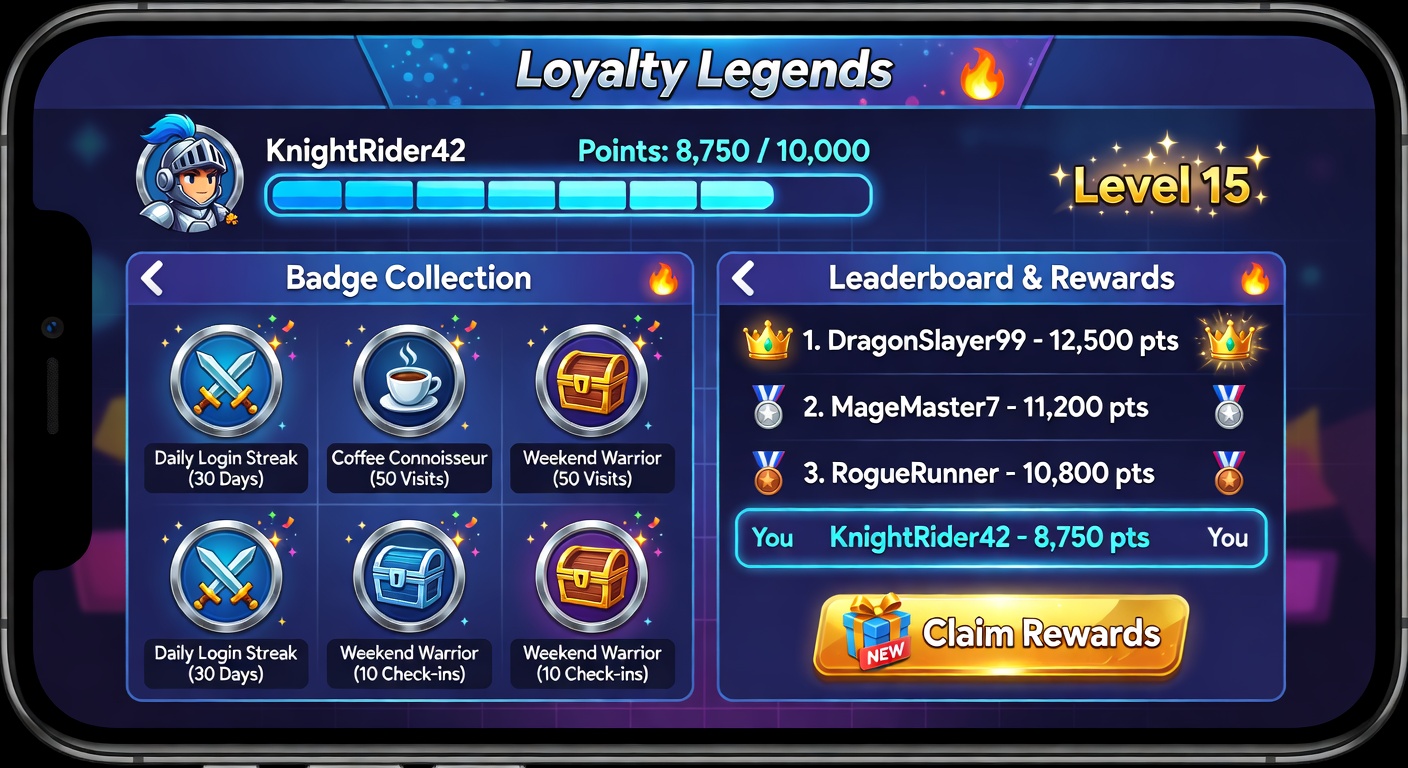
Gamification has earned a mixed reputation in loyalty. Done well, it transforms a transactional program into one that members genuinely enjoy using. Done badly, it adds visual clutter that masks the absence of real value. The difference is not in whether the program uses game mechanics — most modern programs do — but in whether those mechanics are aligned with the underlying psychology of how people respond to progress, reward, and challenge.
This piece is a practical guide to loyalty gamification: the mechanics that work, the psychology behind them, the common mistakes, and the measurement that separates real lift from theatrical engagement.
The Core Mechanics
Five gamification mechanics show up repeatedly in successful loyalty programs.
Progress bars. A visual representation of how close the member is to the next reward. The mechanic taps into the goal-gradient effect — motivation increases as a goal approaches — and works particularly well when the goal feels reachable in the near term.
Tier ladders. A structure of named levels that members move through based on cumulative activity. The mechanic provides ongoing direction beyond the immediate transaction and creates a status component that operates independently of the reward economics.
Limited-time challenges. Time-bounded behaviors that, if completed, produce a defined reward. The mechanic creates urgency and gives members a concrete short-term goal that complements the longer-term tier and points economics.
Streaks. Continuous behavior over consecutive periods (days, weeks, visits) with rewards tied to maintaining the streak. The mechanic taps into loss aversion — members work to avoid breaking the streak — and produces highly habitual engagement when the streak is calibrated correctly.
Surprise rewards. Unpredictable rewards delivered at variable intervals. The mechanic uses variable reward schedules, which produce more durable engagement than predictable rewards because the member can never quite anticipate when the next reward will arrive.
Most strong loyalty programs use some combination of these. Programs that try to use all five without a coherent design end up cluttered.
The Psychology Behind Each Mechanic
The reason these mechanics work is not magic — it is well-documented behavioral psychology.
Loss aversion. People work harder to avoid losing something they have than to gain something they don’t. Streaks, status maintenance, and expiring rewards all use loss aversion. A reward “you might lose” produces more behavior than a reward “you might gain” of equivalent value.
Goal-gradient effect. Motivation increases as proximity to a reward increases. This is why a “buy 10, get 1 free” punch card with two pre-stamped spots produces faster completion than a “buy 8, get 1 free” card with no pre-stamps, even though the actual effort required is identical.
Variable reward schedules. Predictable rewards produce predictable behavior; variable rewards produce more persistent behavior. This is why surprise rewards, mystery offers, and unexpected status moments outperform their predictable equivalents over time.
Status and recognition. People value being recognized as belonging to a meaningful group. Tier names, member-only signals, and visible recognition of progress all tap into this — at modest economic cost to the brand and meaningful psychological value to the member.
Sense of agency. Members who feel they are making choices — which reward to redeem, which challenge to accept — engage more than members who feel they are being shown what to do. Gamification that increases agency tends to outperform gamification that reduces it.
What Gets It Wrong
Three patterns produce gamification that falls flat:
Pure novelty without value. A program adds a colorful new mechanic — a wheel to spin, a badge to earn — that has no real connection to the program’s value proposition. Engagement spikes briefly and falls back. The mechanic was entertaining, not motivating.
Complexity that confuses. A program layers so many mechanics on top of each other that members can no longer hold the rules in their heads. Progress bars, tier ladders, challenges, streaks, surprise drops, and partner offers all running simultaneously can produce dashboard fatigue rather than engagement.
Mechanics that don’t connect to real behavior. A challenge to “open the app five times this week” or “post about us on social media” can generate the appearance of engagement without generating real customer value. These mechanics inflate the engagement metrics without inflating the business metrics, and the gap becomes visible over time.
Challenges as a Specific Mechanic
Limited-time challenges deserve their own design discussion because they are one of the highest-leverage and most-misused mechanics in modern loyalty.
A well-designed challenge has four properties:
It is reachable but not trivial. A challenge that any member can complete with no behavior change isn’t a challenge. A challenge that only the top 5% of members can complete excludes the audience that most needs the engagement.
The reward is calibrated. The reward should be meaningful enough to motivate the behavior but not so large that the math doesn’t work. Challenges with rewards out of proportion to the effort produce the wrong cohort — bargain hunters rather than engaged members.
The timing creates real urgency. A two-week window with daily reminders creates productive urgency. A six-month window with no reminders creates background noise.
The behavior matters to the business. The best challenges drive a behavior the brand actually wants more of — incremental visits, category trial, premium-tier purchase. The worst challenges drive behaviors that look like engagement but don’t move the business.
Design Principles That Hold Across Mechanics
Three principles separate gamification that drives behavior from gamification that just looks fun:
Connect every mechanic to a real value flow. Every progress bar should lead to a reward the member actually wants. Every challenge should drive a behavior the brand actually wants. Mechanics that don’t connect both ends are decoration.
Keep the mental model simple. A member should be able to describe how the program works in one or two sentences. If the gamification has made the program too complex to explain, the gamification has overrun the program.
Test with real members, not with the marketing team. Gamification that excites the team building it is not always gamification that motivates the people using it. The most reliable validation is real-world behavior measured over time, not internal enthusiasm.
Measurement
The right measurement framework for gamification has three layers:
Mechanic engagement. How many members are interacting with the mechanic — opening the challenges, watching the progress bars, working toward the streak.
Behavioral lift. What the mechanic is doing to actual purchase behavior — visit frequency, check size, category mix. This is the layer that justifies the mechanic to leadership.
Long-term retention. Whether members exposed to the mechanic engage longer than comparable members not exposed. Gamification that produces short-term engagement spikes and long-term retention drops is a bad investment, even if the short-term metrics look good.
FAQ
Is gamification effective for older demographics? Yes, when designed thoughtfully. The framing matters — “earn rewards toward your next free service” works across demographics, while pure-game framing skews younger.
Can gamification work in low-frequency categories? Yes, but the mechanics have to be calibrated to the natural cadence. Daily streaks don’t work for a category with quarterly visits. Annual challenges might.
How often should new challenges or mechanics be introduced? Often enough to feel fresh, rarely enough that members can finish what’s already in front of them. A reasonable rhythm is monthly or every six weeks for limited-time mechanics, with stable underlying tier and points structures.
What’s the biggest gamification mistake? Adding mechanics on top of a program that already has poor underlying economics. Gamification can amplify a good program. It cannot fix a bad one.
The Strategic Takeaway
Gamification works when it is in service of a real value proposition and aligned with the way people actually respond to progress, reward, and challenge. It fails when it is used to dress up programs that lack underlying substance. The most useful question to ask before adding any gamification element is: does this mechanic make it easier and more motivating for members to do something they and we both want — or is it just something that looks like engagement? Programs that ask this question honestly tend to add fewer mechanics, but the ones they add tend to work.
Further Reading from Authoritative Sources
- Harvard Business Review — HBR publishes behavioral economics and consumer psychology research — including goal-gradient and loss aversion studies — that directly underpins the psychological explanation for why each gamification mechanic works.
- Association of National Advertisers — ANA research on loyalty marketing effectiveness and behavioral engagement metrics provides the measurement framework for evaluating whether gamification mechanics are producing real business outcomes.