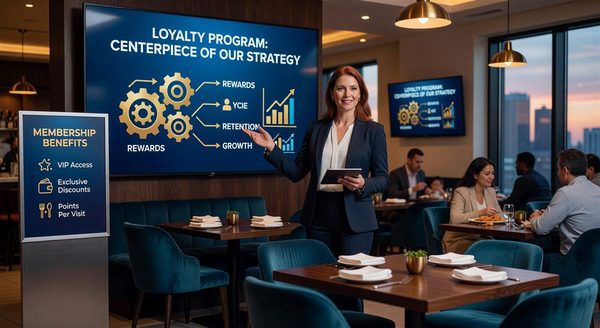
The shift of restaurant ordering toward third-party delivery platforms over the past several years has created a structural problem that most operators are still working out how to solve. The platforms — DoorDash, Uber Eats, Grubhub, and their international counterparts — capture the customer relationship and the data that goes with it. The restaurant fulfills the order but does not see the customer’s name, contact information, ordering history, or behavioral signals. From a marketing perspective, the restaurant has effectively been disintermediated from a meaningful and growing share of its own transactions.
Loyalty programs have become the primary mechanism by which restaurants recover access to customer data. This piece looks at why that is, what data restaurants should be collecting, and how leading operators activate it.
The Data Problem Created by Third-Party Delivery
Before third-party delivery scaled, restaurants knew their customers to the degree they collected information directly — at the counter, through reservations, at the loyalty enrollment, or through online ordering on the restaurant’s own channels. The data was incomplete, but the architecture was straightforward: the restaurant owned every channel through which it served customers, so the restaurant owned the data.
Third-party delivery changed the architecture. The aggregator owns the customer relationship. The restaurant sees an order arrive in the kitchen, knows the items and the total, but does not see who ordered, where they live (beyond a delivery zone), how often they order, what else they have ordered from competitor restaurants, or how the customer’s behavior changes over time. The aggregator sees all of this and uses it to drive its own marketing, including promoting competing restaurants to the restaurant’s own former customers.
The data problem is not abstract. A restaurant whose digital order volume runs significantly through third-party platforms is, by that share, marketing-blind. It cannot retarget those customers, cannot personalize offers for them, cannot prevent churn it cannot see, and cannot reactivate lapsed customers it cannot identify. The growth of third-party delivery has, for many operators, been simultaneous with a measurable erosion of marketing capability.
Loyalty as the Data Recovery Strategy
The most reliable response to this problem has been pulling customers into a direct relationship through loyalty enrollment. The mechanics vary — branded apps with integrated ordering, web ordering tied to loyalty profiles, in-store enrollment with digital channel association, receipt-scan programs that work for third-party orders — but the strategic intent is consistent: the restaurant trades incentives for direct customer relationships, and uses those relationships as the foundation of its first-party data strategy.
The benefits compound over time. A customer enrolled in the loyalty program produces transaction data, engagement data, channel preference data, and (often) demographic data, all flowing into a profile the restaurant owns. As the relationship matures, the data gets richer and more useful. A customer with two years of loyalty history is a marketing asset of meaningful value; an anonymous third-party delivery customer is not.
For multi-unit chains, the strategic importance of loyalty is hard to overstate. Loyalty enrollment is essentially the price of admission to running a serious marketing operation in the current environment.
What Data to Collect
The data restaurants should be collecting through loyalty programs falls into four categories.
Identity data. Name, email, phone number, opt-in status for each channel, and a stable unique identifier. This is the minimum required to communicate with the customer and the foundation everything else builds on.
Transaction data. Every transaction the loyalty system can see — date, time, location, channel (dine-in, pickup, delivery, third-party), items ordered, total, payment method where available, and any promotional or loyalty redemption applied. This is the behavioral spine of the customer profile and drives most segmentation and personalization.
Engagement data. App opens, email opens and clicks, SMS responses, push notification interactions, redemption events, and other signals of customer attention. Engagement data is often less rich than transaction data but adds important behavioral context.
Preference data. Self-reported information collected through enrollment forms, preference centers, surveys, and inferred from behavior — dietary preferences, channel preferences, location associations, household relationships. Preference data is often collected too thinly because operators worry about enrollment friction; the long-term marketing value tends to justify slightly more deliberate collection.
How to Activate the Data
Collected data that does not drive marketing decisions is overhead. Activation is where first-party data strategy actually produces value, and the patterns that work are reasonably well understood.
Segmentation-driven targeting. Audiences defined by behavioral attributes — recent activity, channel preference, lifetime value, churn risk, item history — receive offers and communications calibrated to their context. Generic blasts get replaced by targeted campaigns that perform meaningfully better on every metric.
Lifecycle marketing. Customer journey stages (new enrollee, regular, lapsing, win-back candidate) drive automated communications appropriate to the stage. Lifecycle programs run mostly on their own once configured and produce sustained engagement gains over manually run campaign calendars.
Personalization within campaigns. Beyond targeting, the content of individual messages can be personalized based on the customer’s profile — preferred location, typical order items, favored channels. Personalization quality is a meaningful driver of campaign performance.
Operational decisions. First-party data also informs decisions beyond marketing — menu optimization, location performance analysis, channel mix planning, capacity decisions. Loyalty data is some of the cleanest behavioral data a restaurant has, and using it operationally is often under-exploited.
Data Governance Basics
Restaurants collecting customer data have basic obligations that should be addressed deliberately rather than absorbed by accident.
Consent. Marketing communications require appropriate opt-in. Email, SMS, and push all have distinct consent requirements. Loyalty platforms generally handle this, but the operator is responsible for using the platform correctly.
Privacy disclosures. The loyalty program’s privacy policy should clearly describe what data is collected, how it is used, who it is shared with, and how customers can access, correct, or delete their data. Jurisdictions vary in their specific requirements; operators serving California, Canada, the EU, or other regulated markets should comply with the strictest applicable regime.
Data retention. Customer data should be retained only as long as needed for legitimate purposes, with documented policies governing what is kept and what is deleted. Indefinite retention without policy is a legal and reputational risk.
Vendor agreements. The loyalty platform and any other vendors handling customer data should have data processing agreements in place specifying their obligations. This is increasingly standard but should be confirmed rather than assumed.
Security. Customer data has real value to bad actors and real consequences when compromised. Encryption, access controls, vendor security review, and incident response planning are baseline expectations.
How Leading Chains Differentiate
The chains that have built the strongest first-party data positions tend to share several practices.
They treat loyalty enrollment as a strategic priority, not a marketing tactic — the program is positioned, staffed, and measured at a level that reflects its role as core customer infrastructure.
They unify data across channels into a single guest profile, rather than running separate views for in-store, digital, and third-party. The unified profile is what makes serious segmentation possible.
They invest in marketing operations capable of using the data — analysts, campaign managers, lifecycle marketers, and the technology stack that supports them. Data without activation capacity is wasted.
They measure marketing programs against control groups rather than absolute outcomes, which lets them distinguish what the loyalty program is actually causing from what would have happened anyway. Operators who skip this step often overestimate the impact of their programs.
FAQ
How much of a restaurant’s customer base typically enrolls in loyalty? Enrollment rates vary widely by category and program quality. Strong programs in QSR and fast casual commonly capture meaningful shares of repeat customers; casual dining and fine dining programs tend to enroll smaller proportions of overall traffic. Operators should benchmark against category norms rather than absolute targets.
Can first-party data be used to retarget customers who order through third-party platforms? Yes, if the restaurant has independently captured the customer’s identity through loyalty enrollment, in-store interactions, or other direct channels. The first-party data exists independent of any individual transaction channel.
How does first-party data interact with paid digital advertising? Loyalty data can be used to build custom audiences on most major ad platforms — Meta, Google, and others — for retargeting, lookalike modeling, and suppression. The integration adds meaningful efficiency to paid media.
What happens to first-party data if the loyalty platform contract ends? The data is the operator’s, but the practical experience of exporting and migrating it varies by vendor. Operators should confirm export rights and processes before signing a contract, not after.
The restaurants making meaningful progress against the data erosion problem created by third-party delivery are the ones treating loyalty programs as the strategic data infrastructure of the business. The technology is available, the practices are reasonably well understood, and the operational capacity required is buildable. The brands that move first on this tend to widen the gap on competitors over time, because the data advantage compounds.
Further Reading from Authoritative Sources
- Interactive Advertising Bureau — IAB establishes the first-party data and identity standards that directly support the article’s framework for what restaurant loyalty programs should collect, how to activate it across paid digital channels, and what consent and governance obligations operators must address — particularly the opt-in standards for email, SMS, and push that vary by jurisdiction.
- Federal Trade Commission — The FTC publishes consumer data privacy guidance that operators must address when building restaurant loyalty data strategies — including the consent requirements for marketing communications, the privacy disclosure obligations the article identifies as baseline, and the data security expectations that apply to stored customer loyalty program data.