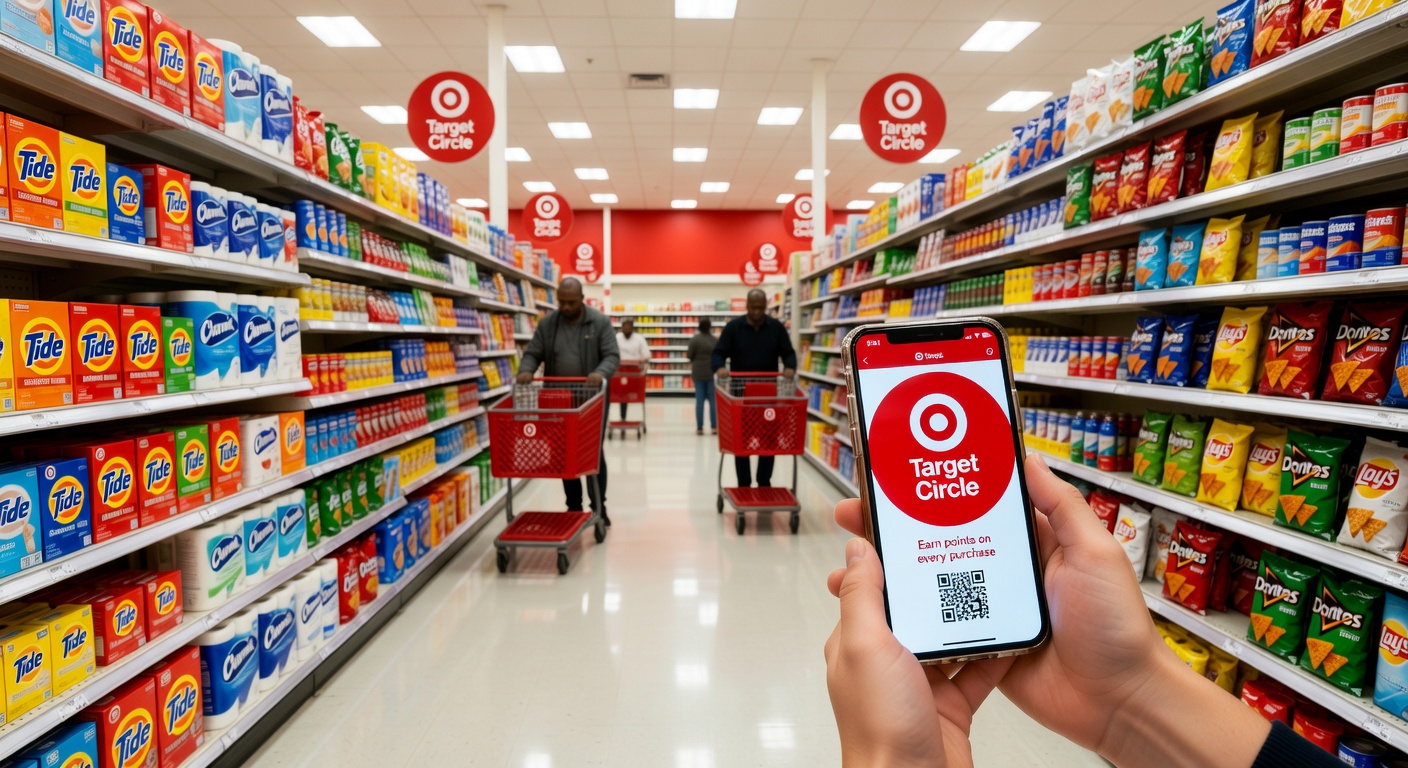
When Target reorganized its loyalty efforts around the Target Circle program, the company made a quiet but consequential choice. The free loyalty program would not require a Target RedCard credit account. That decision separated the loyalty mechanic from the credit relationship, and it positioned Circle to compete with the digital-first programs at Walmart, Amazon, and the warehouse clubs rather than with the traditional store-credit loyalty model. For mass retail loyalty, Target Circle is one of the more interesting case studies of the past few years.
The Mechanics
The free Target Circle program is built around three earn-and-engage mechanics. Members earn one percent back in Circle Earnings on every qualifying purchase, which can be redeemed against a future Target transaction. Members get access to personalized and category-based deals layered into the app, often discounting items the shopper already buys. And members vote periodically to direct a share of Target’s community giving budget — a small but symbolically important gesture that wraps the program in the company’s broader brand identity.
A more recent paid tier, Target Circle 360, adds same-day delivery and other premium-membership benefits. The free tier and the paid tier together let Target compete across the loyalty landscape — basic free loyalty against grocery and mass competitors, paid membership against Walmart+ and Amazon Prime.
What Makes Target Circle Notable
Three design choices set Circle apart from older mass retail loyalty programs.
The first is the decoupling from the credit card. The historical pattern in mass and department retail was that the meaningful loyalty benefits required a store credit card. Target ran that model with the RedCard for years and continues to offer it. The Circle program adds a parallel loyalty experience that does not require credit, which captures the large segment of shoppers who will not open a single-store card but do want rewards.
The second is the one percent instant earn. Most retail loyalty programs use a point currency that takes time to accumulate before it can be redeemed. Circle’s one percent earn is denominated in dollars, accumulates immediately, and can be applied to any subsequent transaction. The simplicity makes the program easy to understand and easy to use, which matters in mass retail where shoppers may not invest much time learning program rules.
The third is the personalized offers layer. Circle’s app surfaces category and item-level deals tailored to the member’s purchase history. For a retailer with Target’s category breadth, this is a meaningful tool — it lets the program drive trial in adjacent categories, defend share against competitors on the items the member buys most often, and clear targeted inventory through audience-matched promotions.
The Free Plus Paid Architecture
Target Circle now sits in a two-tier architecture. The free Circle program is the broad enrollment layer that captures data, drives basic loyalty behavior, and competes for the everyday shopper. Circle 360 is the paid tier that competes for the higher-frequency, higher-spend shopper who wants delivery and premium benefits.
This is a meaningful evolution. Free loyalty alone is increasingly hard to differentiate on — every mass retailer offers some version of it. Paid loyalty alone has a high barrier to enrollment that limits scale. A combined free-and-paid program lets the retailer enroll broadly and convert the most engaged members into a paid relationship over time. Target’s architecture mirrors the structure that has worked for Amazon and Walmart, adapted to the Target value proposition.
Where Circle Fits Versus the RedCard
The RedCard credit and debit products offer a five percent discount on most Target purchases, which is a richer ongoing benefit than Circle’s one percent earn. This raises the question of how the two programs coexist.
The answer is that they target different shoppers. The RedCard works for shoppers willing to use a Target-branded payment instrument and who shop Target frequently enough to justify the additional payment relationship. Circle works for shoppers who want a no-friction loyalty mechanic regardless of how they pay. RedCard members who also enroll in Circle stack both benefits, which is the most rewarded path. But shoppers who would never open the RedCard now have a meaningful loyalty option, which they did not have at scale before Circle launched.
The Data Flywheel
Like most modern retail loyalty programs, Circle’s strategic value to Target goes well beyond the immediate reward economics. The program identifies shoppers, links online and in-store purchases, and creates a data foundation for personalization, media monetization through Roundel, and category planning. The personalized offers feature is the most visible output of the data layer, but the underlying capability supports advertising relationships, supplier marketing programs, and inventory decisions that have broader business value than the direct loyalty ROI.
Comparison to Walmart+ and the Competitive Picture
Walmart+ is Target Circle 360’s most direct competitor, and the two programs make different design choices. Walmart+ is paid-only and emphasizes delivery and fuel discounts. Target’s two-tier approach keeps a broader free enrollment base. Both companies are attempting to build the mass-retail equivalent of Amazon Prime — a membership construct that locks in repeat purchase across categories. Neither has matched Prime’s scale, but both are building the operational and digital capabilities that the membership model requires.
What Mass Retailers Can Adapt
The Target Circle playbook is most useful for retailers in the mass and grocery categories who have been over-reliant on a store credit card as the loyalty mechanism. The lessons are practical. A simple, instant-earn loyalty mechanic that does not require a credit relationship will enroll a much broader base than a credit card alone. A two-tier free-and-paid architecture lets the program serve different shopper segments without forcing one design to do both jobs. Personalized offers in the app create defensible category share that broad promotions cannot.
The harder lesson is that the program needs the underlying digital and data infrastructure to deliver on the personalization promise. Without it, Circle would just be a one-percent rebate. With it, the program becomes a strategic asset.
FAQ
Is the free Target Circle program worth using if I’m not a frequent Target shopper? The one percent earn is modest, but the personalized offers and birthday discount can be meaningful for occasional shoppers in specific categories. The program is free and the friction to enroll is low, so the return is positive even at lower frequency.
How does Circle 360 compare to Walmart+ and Amazon Prime? Circle 360 is the closest analog to Walmart+ — both are paid memberships emphasizing same-day delivery and premium benefits. Prime operates at a different scale and includes a much larger digital media bundle.
Should I get the RedCard if I’m already a Circle member? The RedCard’s five percent discount is richer than the Circle one percent earn, but it requires opening a credit or debit relationship with Target. The decision depends on shopping frequency and willingness to manage another payment relationship.
What does Target use Circle data for beyond the loyalty program itself? The data supports personalization, the Roundel retail media business, supplier marketing programs, and category-level planning. The loyalty program is the data acquisition vehicle for a broader set of capabilities.
Closing Thought
Target Circle is not the most lavish loyalty program in retail, and it does not need to be. It is a well-designed mass retail program that uses simple mechanics, removes the credit card barrier, and uses data to do the heavy lifting on personalization. For mass and grocery retailers thinking about how to modernize their own loyalty efforts, Target Circle is a more practical reference than Sephora or Nordstrom — it shows what a competitive loyalty program looks like at scale, in a category where every dollar of reward economics has to defend itself.
Further Reading from Authoritative Sources
- National Retail Federation — NRF publishes consumer research and industry analysis on retail loyalty adoption that contextualizes Target Circle’s design choices within the broader mass retail competitive environment.
- FTC consumer data guidance — FTC guidance on consumer data collection and commercial use is directly relevant to how Target uses Circle loyalty data to power its Roundel advertising business and personalized offer targeting.