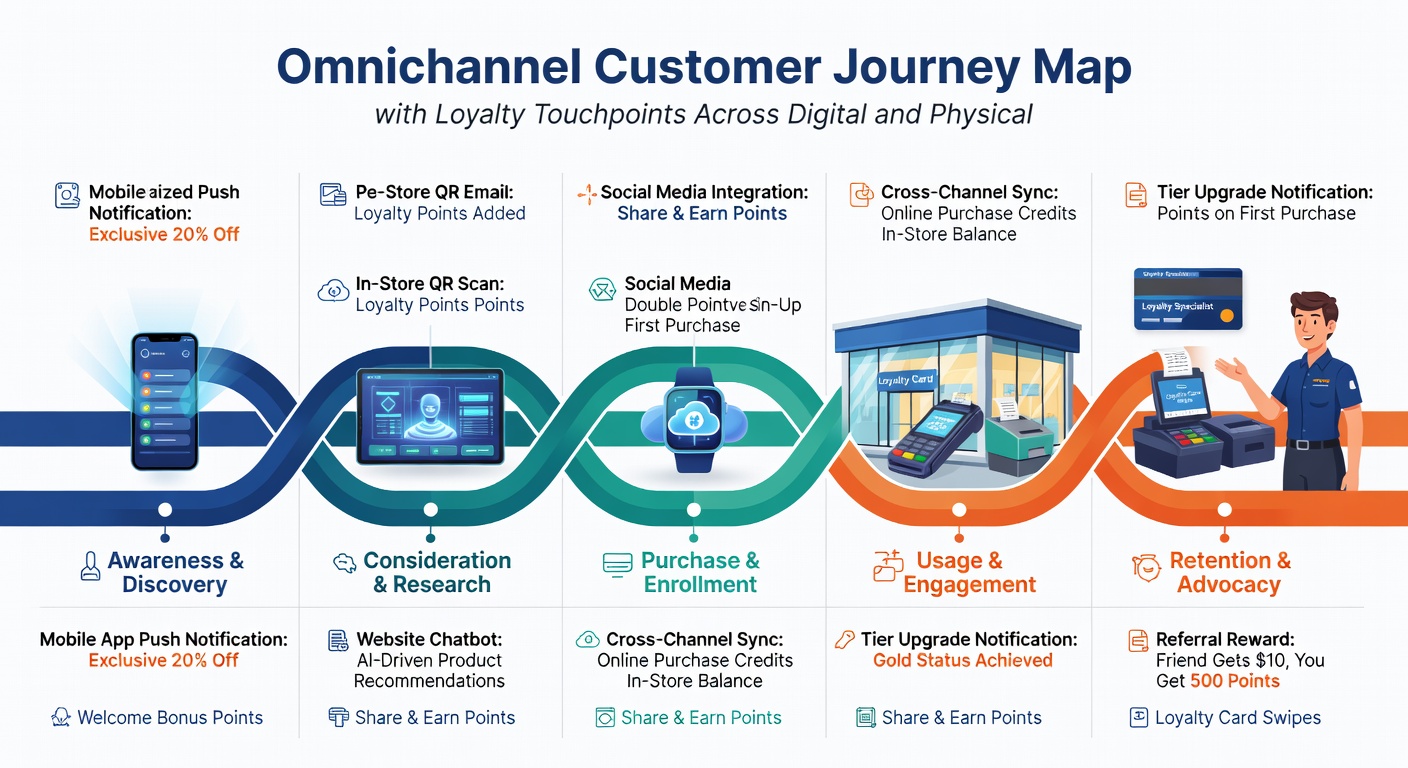
Omnichannel is one of the most overused words in retail and one of the most underdelivered experiences in loyalty. Most programs that describe themselves as omnichannel are actually multichannel — present in several places but inconsistent across them. The member who earns points in-store and then opens the app to discover those points haven’t shown up has been promised omnichannel and delivered multichannel. The difference, from the member’s perspective, is significant.
This piece walks through what omnichannel loyalty actually means, where most programs break down, the design principles that hold across implementations, and a phased approach for operators who aren’t fully there yet.
What Omnichannel Loyalty Actually Means
Omnichannel loyalty has three components, and a program is only genuinely omnichannel when all three are working.
One account, every channel. The member has a single identity that is recognized across in-store, web, app, kiosk, drive-thru, delivery, customer service, and any other touchpoint where the brand operates. No separate accounts. No re-registration. No “I’m a member but the app doesn’t know me.”
Consistent experience across channels. The look, the language, the offers, the benefits, and the rules are coherent across channels. Tier benefits behave the same way online and in-store. Earning rules don’t quietly change between channels. Redemption works the same way regardless of where the member chooses to use the program.
Unified earning and redemption. Points or rewards earned in one channel can be used in another. A purchase made online accrues to the same balance as a purchase made in-store. A reward issued through the app can be redeemed at the register.
Programs that have one of these but not the other two are multichannel programs that want to be omnichannel programs.
The Identity Resolution Challenge
The technical core of omnichannel loyalty is identity resolution — the ability to recognize that the customer in the store, on the website, and in the app is the same person. This sounds simple. In practice it is the single biggest reason most programs fall short.
The member in-store may identify themselves with a phone number, a scannable code, an email address, or a name. The member on the website logs in with an email. The member in the app may be logged in continuously or may have to re-authenticate. The customer in a third-party delivery app may not be identified at all. Reconciling these into a single member record requires deliberate data infrastructure and consistent operational processes.
Programs that solve this well typically have a unified customer identity layer that sits beneath the loyalty engine — not as a side project, but as foundational architecture. Programs that don’t have this architecture end up patching cases one at a time, never quite reaching the unified view the member expects.
Common Omnichannel Failure Points
Five failure points show up consistently when omnichannel loyalty breaks:
Points that work in some channels and not others. Members earn for in-store purchases but not for delivery orders, or vice versa. The cause is usually integration cost. The member experience is “this program is incomplete.”
Channel-specific offers that create confusion. An email offer that only works in-store, an app offer that only works online, with no clear visual cue. Members try to redeem in the wrong channel, are turned away, and disengage.
Tier benefits that vary by channel. An elite member gets a perk online and the same perk is unavailable or unrecognized in-store. The inconsistency is more damaging than not offering the perk at all.
Customer service that can’t see the full picture. A member calls about a missing point credit, and the service representative can see the website orders but not the in-store transactions. Resolution takes longer than it should, and the member learns that the brand doesn’t have a unified view of them.
App-store gaps. The member sees something in the app and finds the experience in-store doesn’t match. The mobile experience promises personalization that the physical experience can’t deliver.
Design Principles for Omnichannel Loyalty
Five principles that hold across implementations:
Design for the channel-switching member, not the single-channel member. The high-value member is increasingly the one who uses multiple channels. The program should be optimized for that pattern.
Make the member experience identical wherever possible, and intentional where it must differ. If a benefit can only exist in one channel for a legitimate reason — say, a free coffee that has to be redeemed in-store — communicate that clearly rather than letting members discover it the hard way.
Treat the loyalty data as a single source of truth. Every channel should read from and write to the same member record in real time. Batch reconciliation is a workaround, not an architecture.
Invest in frontline tooling. The in-store staff need to see the same member record the app sees. If they can’t, the program is structurally limited to whichever channel has the better tools.
Communicate channel-agnostic value. Program communications should focus on what the member has and can do, not on which channel they have to use to do it. “You have a reward waiting” is better than “Visit our app to see your reward.”
Technology Requirements
The technology stack required to support omnichannel loyalty has matured significantly in the past few years. The key components are:
- A customer identity layer that resolves the same person across channels
- A loyalty engine that supports real-time earning and redemption regardless of channel
- POS, eCommerce, and app integrations that all read from and write to the loyalty engine in real time
- A communications platform that can target based on cross-channel behavior
- Analytics that report on the member as a single entity rather than per-channel slices
Operators do not need the full stack on day one. They do need a plan for getting there over time.
A Phased Approach
For operators who aren’t fully omnichannel and can’t be in one project cycle, a phased approach generally works better than a big-bang transformation.
Phase 1: Identity foundation. Establish a single member identity that all channels can read. Do not yet attempt to unify earning across all channels — just make sure the system knows who the member is wherever they show up.
Phase 2: Unified balance. Bring earning into a single balance across at least the two or three most important channels. Members should see their points add up the same way regardless of where they bought.
Phase 3: Cross-channel redemption. Make rewards earned in one channel usable in another. This is operationally the hardest phase because it requires real-time integration at the redemption moment, but it is also the phase that changes member perception most.
Phase 4: Consistent experience and tier benefits. Align the experience across channels — visual, linguistic, structural. Make tier benefits behave the same way everywhere.
Phase 5: Channel-aware personalization. Once the underlying omnichannel architecture is in place, layer in personalization that uses cross-channel behavior to deliver more relevant offers.
Most operators are somewhere in phases 2 or 3. The mistake is trying to skip ahead to phase 5 without completing the foundational work.
FAQ
Is omnichannel loyalty necessary, or is a strong single-channel program enough? For categories where customers actually use multiple channels, omnichannel is becoming table stakes. For categories that are fundamentally single-channel — say, an in-venue-only experience — the case is weaker.
Can a small operator achieve omnichannel loyalty? Yes, in the sense that smaller operators often have less legacy integration debt and can build cleanly. The platform options for smaller operators have improved considerably.
Should mobile be considered a channel or the central spine? For many programs, mobile is increasingly the central spine — the place where the member identity, balance, and communication all live. The other channels feed into and reference the mobile experience.
What is the biggest mistake operators make in omnichannel loyalty? Skipping the identity foundation. Programs that try to deliver cross-channel rewards before they have solved the identity layer end up with member-facing breakage that damages the program faster than the cross-channel rewards build it up.
The Strategic Takeaway
Omnichannel loyalty is more architectural than promotional. It is solved with identity, integration, and consistent design — not with bigger offers. Operators that invest in the foundation, even when it doesn’t show up as a member-facing feature for several quarters, end up with programs that scale gracefully and that deliver the member experience the marketing has been promising all along. Operators that skip the foundation produce a series of patches that the member eventually stops trusting.
Further Reading from Authoritative Sources
- Harvard Business Review — HBR’s customer experience and retail loyalty research provides the analytical framework for the article’s omnichannel-versus-multichannel distinction, the identity resolution requirement as the primary technical constraint, and the design principle of optimizing for the channel-switching member — all of which reflect HBR’s research on how omnichannel customer behavior differs from single-channel behavior in ways that determine loyalty program design.
- Interactive Advertising Bureau — IAB establishes the first-party data and marketing technology standards that define the infrastructure requirements the article describes — particularly the unified identity resolution standard, the CDP layer needed to maintain consistent member profiles across channels, and the real-time data synchronization requirements that determine whether a loyalty program can deliver consistent earning, redemption, and recognition across every member touchpoint.