The physical loyalty card was already in decline before 2020. By the second half of that year, it was effectively dead in most restaurant categories. What replaced it was not a single mechanic but a portfolio — QR codes, phone-number lookup, app check-in, receipt scanning, and order-platform earning — each suited to a different operational moment. Operators who handled the transition well treated the rebuild as an opportunity to fix friction that had quietly limited enrollment for years. Operators who handled it poorly bolted contactless mechanics onto card-era assumptions and lost members in the migration.
This piece looks at the mechanics that actually replaced the card swipe, how they performed in practice, and what strong implementations had in common.
The QR Code Came Back From the Dead
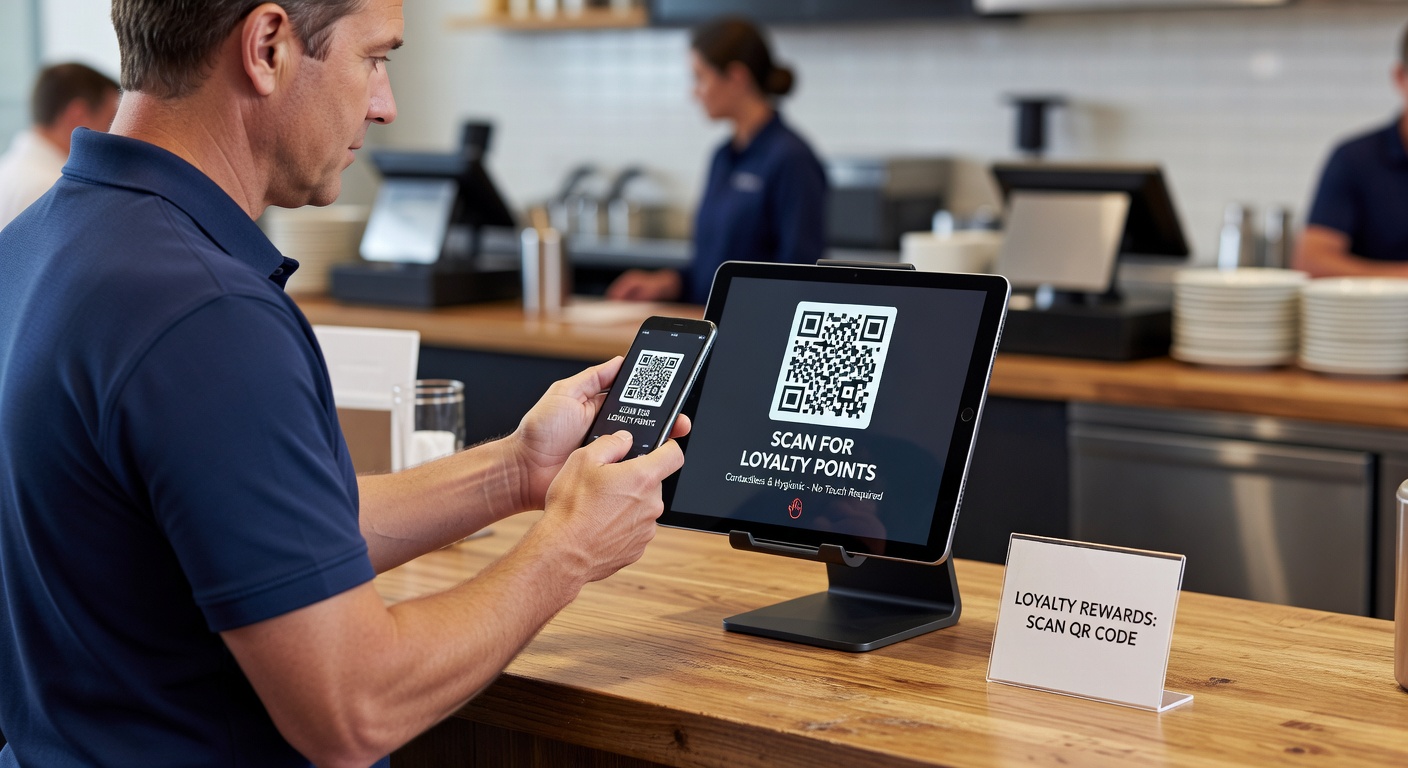
QR codes had been written off in much of North America for most of the previous decade. They were too clunky, required dedicated reader apps, and never solved enough of a problem to justify the friction. That changed when iOS and Android native cameras began parsing QR codes automatically, and the timing aligned with the moment restaurants urgently needed a no-touch way for customers to interact with the brand.
For loyalty, QR codes filled three roles. The first was check-in: a code at the counter, table, or drive-thru window that a customer could scan to associate the transaction with their account. The second was enrollment: a code on signage, receipts, or table tents that took a new customer directly to a sign-up page. The third was redemption: a customer-presented code from the loyalty app that staff scanned to apply a reward.
The implementations that worked treated QR codes as one entry point, not the only one. Customers who didn’t want to scan could still give a phone number or use an app. The implementations that struggled forced QR-only flows on customers who weren’t comfortable with them, particularly older demographics, and lost participation as a result.
Phone-Number Lookup Quietly Did Most of the Work
For all the attention QR codes received, phone-number lookup remained the workhorse of contactless loyalty identification in most restaurant categories. Customers at the counter or drive-thru spoke a number to staff, who entered it on the POS. Phone-based pickup orders could be associated automatically by caller ID where the integration supported it. Online orders were matched by the phone number entered at checkout.
The mechanic is old, but its strengths show against the alternatives. It requires no app, no scanning, no learning curve, and works across every demographic. The data quality is generally good — phone numbers do not change as often as email addresses and serve as durable unique identifiers.
The weakness is privacy perception. Some customers do not want to give a phone number, particularly in public counter environments where the number is spoken aloud. Operators who softened this experience — POS prompts that allowed quiet entry, signage explaining the data practice, alternatives offered without friction — preserved more enrollment than those who didn’t.
App-Based Check-In: The Highest-Value Identification
When a customer opens a branded app to check in or place an order, the operator gets the richest interaction available. The app authenticates the customer, captures device and location data, supports push notifications, and creates a measurable behavioral record over time. Operators with strong apps used the shutdown period to drive aggressive enrollment and conversion campaigns, often with bonus-points incentives.
The challenge with app-based check-in is the acquisition gap. Customers who do not already have the app at the moment of decision have to download, install, sign up, and verify before they can earn — and most won’t. Operators bridged this gap in two ways. Some allowed a phone-number fallback so the customer earned points and was prompted to install the app afterward to access the balance. Others ran heavily incentivized enrollment campaigns (“Sign up and get $5”) to push the install rate up before relying on the app for everyday transactions.
Receipt Scanning Filled the Third-Party Gap
The biggest blind spot in restaurant loyalty during this period was third-party delivery. When a customer ordered through DoorDash, Uber Eats, or Grubhub, the platform owned the transaction and the data. The restaurant often could not associate the order with a loyalty profile at all.
Receipt scanning emerged as a partial workaround. Customers photographed receipts (or printed delivery confirmations) and uploaded them through the app or a web form. The platform parsed the receipt for restaurant, date, and amount, then credited points after verification. Several loyalty platforms added native receipt-scan capability during this period, and the mechanic became a default offering rather than a novelty.
Receipt scanning never reached high participation rates as a primary mechanic — the friction is real and customers default to easier paths when available — but as a delivery-attribution backstop, it filled a meaningful gap.
Drive-Thru: The Hardest Channel to Solve
Drive-thru remains the most difficult operational environment for loyalty identification. Time-per-car targets are tight, the headset interaction discourages number entry, and the customer is not in a position to scan anything reliably. Several patterns emerged.
The most common was phone-number capture at the pay window, where staff had a few seconds of stationary interaction with the customer. Operators with mobile apps pushed app-based ordering and pickup-lane workflows that linked the order to the loyalty profile in advance. License-plate recognition systems started appearing in a few enterprise chains, allowing for automatic customer identification with no interaction required at all.
None of these were universal solutions, and operators with significant drive-thru volume generally accepted lower loyalty attendance in that channel than in dine-in or pickup.
Fraud Considerations
Removing the physical card removed a friction layer that had quietly prevented certain fraud patterns. Phone-number lookup created exposure to staff-entered fake numbers used to claim points for non-existent customers. Receipt scanning created exposure to duplicate or forged receipts. App-based earning was generally safer but introduced its own patterns (referral abuse, multi-account creation).
Most platforms responded with rate-limiting, anomaly detection, and de-duplication rules. Operators with serious fraud problems tightened earning rules — caps on points per day, mandatory in-store presence verification, receipt expiration windows — without significantly hurting legitimate participation.
Consumer Adoption Across Demographics
Younger customers adopted contactless mechanics fastest, as expected. The more interesting pattern was the speed at which older demographics followed. The shutdown period normalized QR codes and contactless interactions across the entire customer base in a way that years of marketing had not. Adoption gaps narrowed, though they did not close — operators with significant older-skewing customer bases preserved phone-number lookup as a primary channel longer than QSR brands serving younger guests.
FAQ
Did QR codes really stick after the shutdown ended? Largely yes, particularly for menu access and loyalty check-in. The native camera support across iOS and Android made the mechanic durable in a way it hadn’t been previously.
Is phone-number lookup still relevant if the app is doing well? For most operators, yes. App users are a subset of customers; phone-number lookup catches the rest and provides a unified identification fallback.
How accurate is receipt scanning for third-party orders? Accuracy varies by platform and receipt format. Most implementations handle major aggregator receipts well, but disputed scans require manual review and create some operational overhead.
What’s the best contactless mechanic for drive-thru? There is no single best answer. Phone-number capture at the pay window remains the most common, with app-based pre-order or LPR systems being stronger options for chains that can invest in them.
The card-to-contactless transition that compressed into a few months of 2020 reset what restaurant operators expect from loyalty identification. The programs that came through with growing membership were the ones that offered multiple entry points, met customers where they actually were, and treated friction reduction as a core design principle rather than an afterthought.
Further Reading from Authoritative Sources
- Interactive Advertising Bureau — IAB establishes the mobile marketing and contactless identification standards that provide the technical context for the restaurant loyalty card-to-contactless transition the article analyzes — particularly the QR code adoption acceleration driven by native iOS and Android camera support, and the data capture architecture required to make contactless loyalty mechanics feed a restaurant’s first-party data strategy.
- National Retail Federation — NRF publishes restaurant and retail technology adoption research that contextualizes the 2020 contactless loyalty transition — including the demographic adoption patterns, fraud management approaches, and multi-mechanic identification strategies that defined which restaurant operators successfully grew loyalty membership through the card-to-contactless rebuild.