The week dining rooms closed across most of North America, restaurant operators found themselves locked out of their primary customer relationship — the one that happens face-to-face at the counter or table. What remained was whatever digital infrastructure they had built before the crisis: an email list, a loyalty database, a mobile app, a points balance attached to a phone number. For chains that had invested in loyalty platforms, those systems quickly shifted from marketing tools to lifelines. For chains that hadn’t, the gap became impossible to ignore.
This piece looks at how the major categories of restaurant loyalty technology responded in the first weeks of the shutdown — what platforms did, what operators did with them, and which program types proved most resilient when foot traffic disappeared.
The First 72 Hours: Loyalty Databases Became Communication Lists
Before the shutdown, most loyalty databases were used to drive repeat visits — birthday rewards, points-balance reminders, occasional offers. In mid-March, that purpose flipped overnight. Operators with mature loyalty programs suddenly had something most of their competitors did not: a deliverable, opted-in list of customers who had already raised their hands and said they wanted to hear from the brand.
The earliest messages were practical. Hours had changed. Dining rooms were closed but pickup was open. Curbside protocols were new and needed explaining. Drive-thru remained available at chains that had one. Email open rates during this window were unusually high — operators commonly reported engagement well above their normal baseline, because customers were actively looking for status updates from the brands they cared about.
Loyalty platforms with strong email and SMS infrastructure had an immediate edge. The chains that suffered most were the ones whose communication tools depended on physical signage or in-store conversations.
Enterprise Platforms: Points Became Stimulus
Enterprise loyalty vendors — Paytronix, Punchh, Thanx, and similar — moved quickly to help operators repurpose existing point balances as a recovery mechanism. Two patterns emerged.
The first was the bonus-points-on-digital-orders campaign. Chains that had previously rewarded points only on in-store transactions extended earning to online ordering, delivery, and gift cards, often at multiplied rates. The mechanic was simple: convert customers who had previously been dine-in regulars into digital customers without forcing them to start over.
The second was the bank-now-redeem-later campaign. Operators issued credits to be redeemed when dining rooms reopened. The promise was psychological as much as transactional — a small commitment from the brand that there would be a “later” worth waiting for. Gift card sales spiked in parallel for similar reasons.
These maneuvers required platforms that could quickly reconfigure earning rules, push them to all locations, and communicate them through email, SMS, and app push in a coordinated wave. Operators on rigid platforms struggled. Operators on flexible ones moved within days.
POS-Native Loyalty: Strength in Simplicity, Weakness in Reach
Loyalty programs built into POS systems — Toast, Square, Clover, and similar — were a different story. Their strength has always been ease of setup and unified reporting. Their weakness, exposed by the shutdown, was that they were designed around in-store transactions and often had thinner email, SMS, and app capabilities than dedicated loyalty vendors.
Small operators using POS-native loyalty did find ways to pivot. Many leaned on the email lists their POS had quietly collected at sign-up and sent personal messages — sometimes from the owner’s own inbox — announcing pickup, family meal bundles, or gift card promotions. The intimate, single-location voice worked surprisingly well. What POS-native loyalty lacked in sophistication, independent operators sometimes made up for in authenticity.
Multi-unit operators on POS-native programs had a harder time. Without the segmentation and automation depth of enterprise platforms, scaled communication often defaulted to single-message email blasts, with all the engagement drop-off that implies.
Email-Based and Hybrid Programs
A meaningful number of independent and small-chain operators run what could charitably be called loyalty programs but are really email lists with occasional offers. These programs had no points engine, no app, no SMS. They were, in some ways, the most exposed.
But many of them adapted faster than expected. Without a complex platform to reconfigure, owners simply wrote and sent. The cadence increased, the tone got more personal, and the offers got more direct. “Buy a gift card now, we’ll add 20%” became a common pattern. Survival-focused messaging — telling customers honestly that the business needed support — drove response rates that more polished campaigns rarely match.
The lesson was not that simple beats sophisticated. The lesson was that the relationship between operator and customer matters more than the technology stack, provided the operator has any way at all to reach the customer.
Contactless Mechanics Replaced the Card Swipe
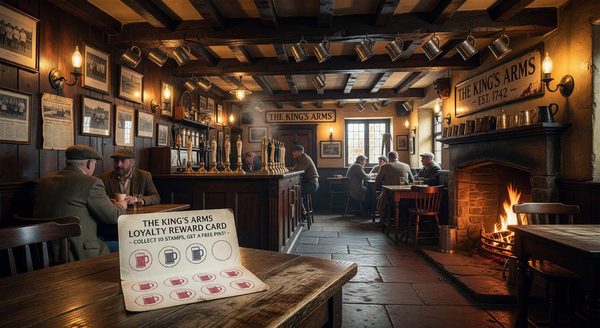
The other major shift during this period was the rapid retirement of physical loyalty cards. Touching a shared device, handing over a plastic card, or letting a server enter a phone number on a shared screen became politically and practically awkward. Platforms responded by accelerating contactless enrollment and identification — QR codes on receipts, phone-number lookup tied to caller ID for phone orders, app-based check-in, and receipt-scan programs that allowed customers to earn points without any in-store interaction at all.
This shift had been underway before 2020. The shutdown compressed years of expected adoption into months.
What Survived, What Struggled
Three patterns separated the programs that came through the early shutdown in reasonable shape from those that didn’t.
Programs with strong digital ordering integration had an obvious advantage. If a customer could earn and redeem points on an online or app order, the loyalty program kept working. If earning required an in-store swipe, it didn’t.
Programs with operator-controlled email and SMS infrastructure had a second advantage. Owning the channel meant being able to communicate fast, repeatedly, and without depending on a third-party platform’s content review cycle.
Programs that had collected real first-party data — not just transaction history, but names, preferences, location associations — had a third advantage. Personalization in this period meant the difference between a message that felt like a brand checking in and one that felt like a generic blast.
FAQ
Did loyalty enrollment go up or down during the shutdown? Enrollment in app-based programs generally rose, because customers were opting into digital ordering and loyalty tended to ride along. Enrollment in card-based or in-store-only programs fell sharply.
Were points redemption rates higher during the shutdown? Operators commonly reported elevated redemption activity in the first weeks, as customers used existing balances on pickup and delivery orders. Bonus-points campaigns accelerated this further.
Did smaller restaurants without formal loyalty programs lose customers permanently? Some did, particularly those without any way to reach customers digitally. Many independents started informal email lists and SMS broadcasts during this period, accelerating their move toward more structured loyalty later.
What kind of loyalty platform held up best under pressure? Platforms with flexible earning rules, deep email/SMS capability, and tight digital ordering integration adapted fastest. Rigid programs designed around in-store swipes struggled most.
The spring 2020 shutdown rewrote what restaurant operators expected from their loyalty platforms. The systems that had been treated as marketing tools became core customer infrastructure, and the gap between operators who had invested in them and those who hadn’t became visible in a way no analyst report could have made it. The platforms that responded fastest set the template for the next several years of category competition.
Further Reading from Authoritative Sources
- Interactive Advertising Bureau — IAB’s data standards and digital infrastructure guidelines are directly relevant to the article’s analysis of which platform architectures proved resilient during the pandemic — those with rich first-party data collection, flexible earning rules, and strong digital ordering integration.
- FTC consumer data guidance — FTC guidance on consumer data use and opt-in requirements is relevant to how loyalty platforms needed to handle the rapid channel expansion — from in-store card swipes to digital ordering and SMS communication — during the 2020 pandemic response.