By the time most casual dining loyalty programs reached their fifth or sixth year, operators had accumulated enough member behavior data that one-size-fits-all reward structures had become indefensible. The same monthly email offering the same bonus point promotion to a member who visits weekly and a member who visits twice a year is, at best, a wasted impression for one of them and possibly both. Segmentation — the practice of grouping members by behavior and tailoring program tactics by group — is how serious loyalty programs separated themselves from baseline programs.
This piece walks through how restaurants identify high-value guests, what behavioral data reveals about different member types, and how operators should tailor offers by segment.
The segmentation dimensions that matter
Most useful restaurant loyalty segmentation collapses onto three behavioral dimensions:
- Recency. When did the member last visit?
- Frequency. How often does the member visit in a typical quarter?
- Monetary value. What is the member’s average check, and what is their annual spend with the brand?
These three dimensions — the classic RFM model — produce a manageable segmentation grid that most marketing teams can act on without elaborate data science infrastructure. A member who is recent, frequent, and high-spend is a different person from a marketing standpoint than a member who is lapsed, infrequent, and low-spend, even if both joined the program in the same month.
The segments worth distinguishing
In practice, casual dining operators tend to converge on four to six segments that drive distinct program actions:
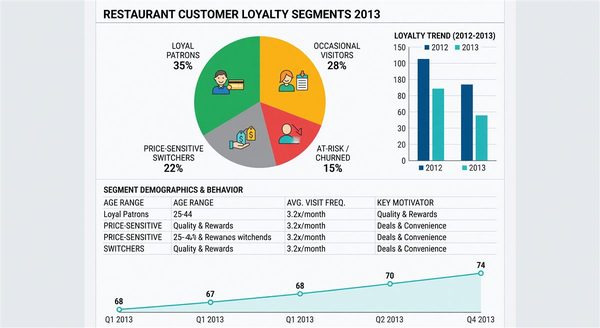
- Champions. Frequent, recent, high-spend. These members already produce most of the program’s revenue contribution. The goal is retention, not acquisition.
- Loyal regulars. Recent and frequent but mid-spend. The goal is gradual expansion of party size or check average through targeted upsell offers.
- Promising newcomers. Recent but low frequency. The goal is to drive a second and third visit quickly before they drift to dormancy.
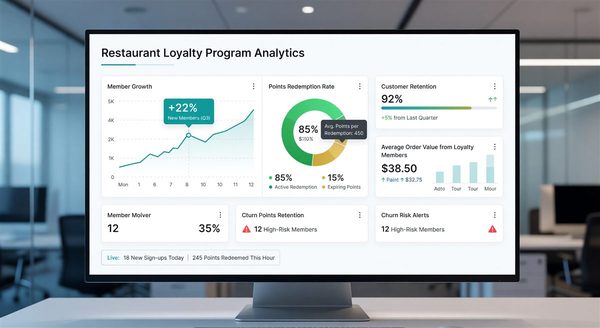
- At-risk members. Previously frequent but recently quiet. The goal is reactivation before the silence becomes structural.
- Lost members. Long-dormant. The goal is a final winback attempt with a high-value offer; if it does not work, deprioritize.
A sixth segment — light users who never engaged — is usually best left alone, since the cost of marketing to them rarely produces enough lift to justify the spend.
What behavioral data reveals
Beyond RFM, behavioral data from loyalty programs reveals patterns that conventional CRM segmentation misses:
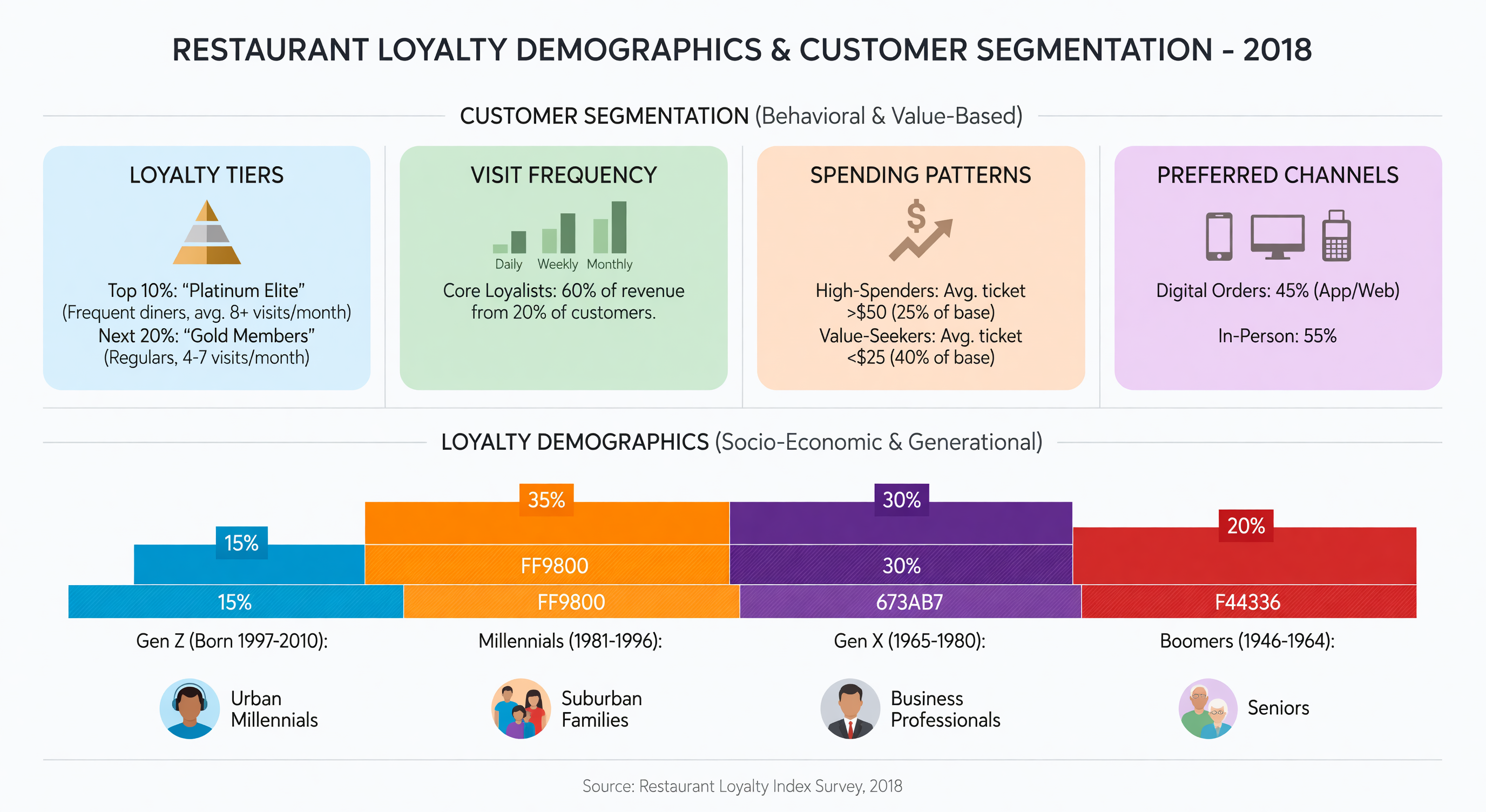
- Daypart preference. Lunch-dominant members behave differently from dinner-dominant members and should receive different offer types.
- Day-of-week pattern. Weekend-only diners and weekday regulars have different elasticities to off-peak promotions.
- Item affinity. Members who consistently order from one menu category respond better to category-specific offers than to brand-wide discounts.
- Channel preference. Members who order online or via app exhibit different visit patterns from members who only transact in-restaurant.
The operators that lead the segment in loyalty performance are typically the ones who have invested in capturing and acting on these behavioral cuts, not just the demographic basics.
Tailoring offers by segment
The core idea behind segment-tailored offers is matching the offer strength and type to the member’s likely response. Champions do not need discount offers — they need recognition. Promising newcomers need fast, easy wins to reinforce the enrollment decision. At-risk members need a meaningful incentive to break the dormancy trend. Loyal regulars respond well to small upsell offers that nudge a slightly larger check without sacrificing margin.
For a complementary view on how operators built their first segmentation approaches several years earlier, see our 2013 piece on early restaurant loyalty segmentation.
The operator implication
Segmentation is one of the highest-leverage investments a mature loyalty program can make. It does not require new platform infrastructure in most cases — the data is already there. What it requires is the discipline to stop sending the same offer to the entire member base and the analytical capacity to measure whether segmented offers actually outperform untargeted ones over time.
FAQ
What is the simplest useful loyalty segmentation model? RFM — recency, frequency, and monetary value — collapses most behavioral variation into a manageable grid that small marketing teams can act on without specialized analytics infrastructure.
How many segments should a restaurant loyalty program use? Four to six segments is the practical sweet spot. More than that and execution becomes unwieldy; fewer than that and the segmentation does not produce enough differentiation to justify the work.
Are there segments not worth marketing to? Long-dormant members who do not respond to a final winback attempt and never-engaged light users are usually best deprioritized. The cost of marketing to them rarely produces enough lift to justify continued investment.
Further Reading from Authoritative Sources
- Association of National Advertisers — ANA publishes standards and research on audience segmentation and behavioral data use in marketing, directly relevant to loyalty program segmentation practices.
- Harvard Business Review — HBR research on customer lifetime value and retention economics underpins the segmentation logic of investing most in Champion members.