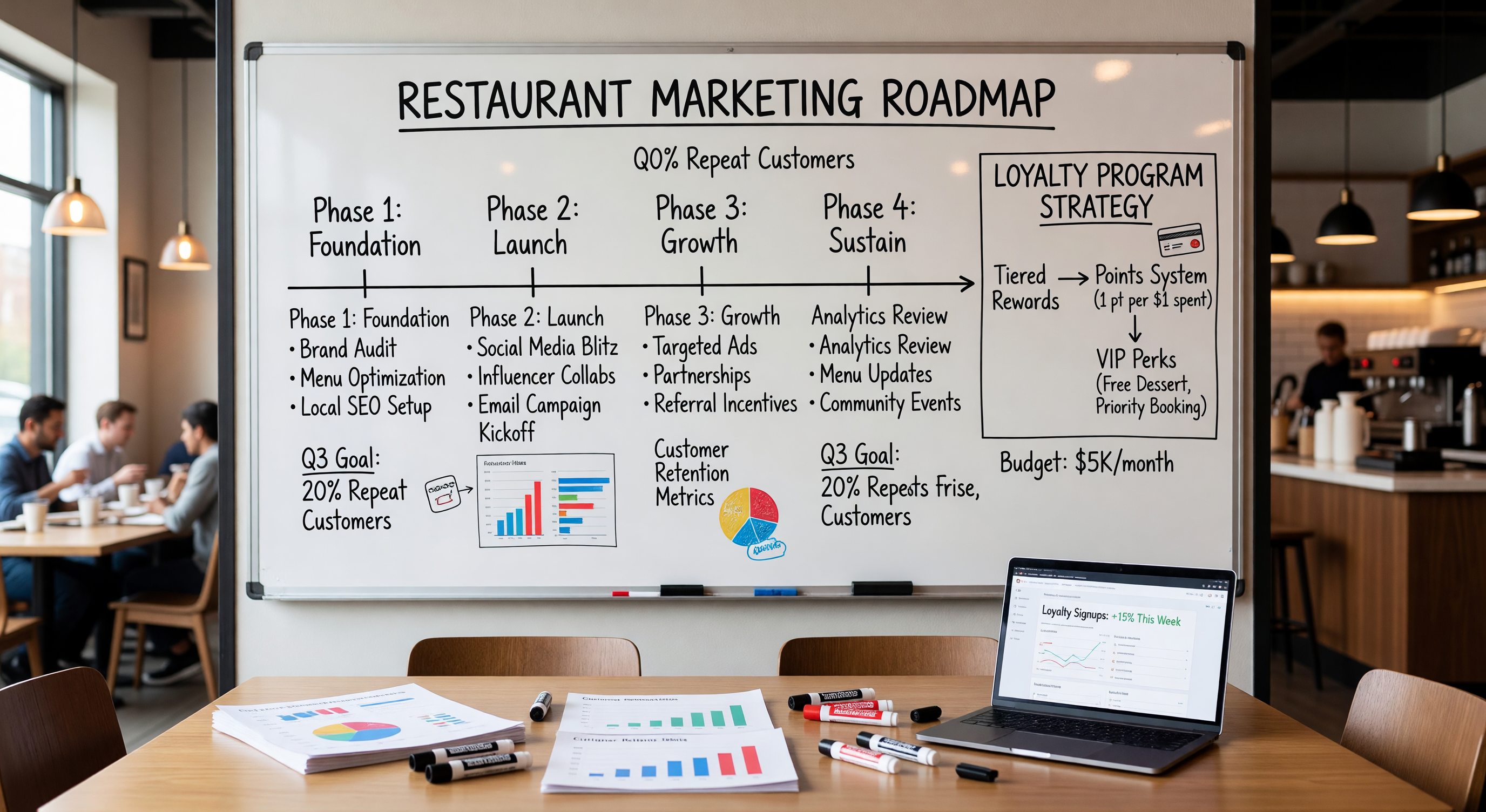
Most restaurant loyalty program launches that disappoint can be traced back to a planning phase that compressed too much work into too little time. Programs launched in a hurry tend to skip the foundational decisions about platform, structure, and measurement that determine whether the program will produce real lift or just sit in the system as a sunk cost. This roadmap lays out a practical phased sequence for operators planning a loyalty program launch, from initial platform selection through the end of the first year.
Phase one: foundation decisions
Before any platform vendor enters the conversation, the operator team needs to align on three foundational questions:
- What is the program’s primary business objective? Frequency lift, check growth, dormant guest reactivation, and data acquisition are all valid goals, but they imply different program designs.
- What is the target member economics? What annual revenue per active member does the program need to produce to clear its cost?
- What is the realistic active member ceiling? Based on current guest count and visit frequency, what is the maximum number of active members the brand can plausibly sustain?
Answering these questions in writing, and getting executive sign-off, prevents the most common launch failure mode: building a program optimized for one objective and then judging it against a different one a year later.
Phase two: platform selection
Platform selection should follow the foundation decisions, not lead them. The shortlist of vendors should be filtered through three criteria: fit with the brand’s POS environment, fit with the operator’s mobile and digital roadmap, and fit with the analytics depth the program will need to manage members after launch.
Operators should resist the temptation to pick the platform with the most features. The platform that gets used well always outperforms the platform with the longer feature list that nobody fully adopts. A useful evaluation tactic is asking each vendor to walk through the day-to-day workflow of a program manager 12 months post-launch, not just the launch capabilities.
Phase three: program design
Program design — the earn rate, the reward structure, the tier mechanics — should be the third decision, not the first. By this point the operator knows what the program needs to accomplish and what platform will support it, which makes design choices much easier. The core design questions are:
- Earn structure: point-based, visit-based, or spend-based?
- Reward catalog: free items, dollar credits, or experiential?
- Tier mechanics: flat program, tiered status, or hybrid?
- Time to first reward: how fast does a new member see value?
For a deeper look at how design choices interact with consumer behavior, see our analysis of restaurant rewards program visit lift.
Phase four: operational readiness
The work that happens between platform contract signing and member-facing launch is where many programs quietly fail. The operational readiness checklist should include:
- POS integration tested at every restaurant, not just the test location
- Staff training rolled out with manager-led role-play, not just an e-learning module
- Enrollment scripts tested with real guests during a pilot window
- Reward redemption process tested end-to-end including kitchen and check-print workflows
- Member service workflows established for the inevitable card and account issues
Programs that skip any of these readiness items typically encounter the corresponding failure mode within the first 90 days.
Phase five: launch and early acquisition
The launch window is the highest-velocity period the program will ever experience. Acquisition tactics should be targeted at guests already in the building during the launch window — table tents, server prompts, and check-print invitations consistently outperform broader marketing pushes for early sign-ups. External marketing can come later, once the program has demonstrated it can convert in-restaurant enrollment to active engagement.
The first 90 days are also when most programs encounter their first hard data: enrollment volume, first-visit return rate, and time-to-first-reward distribution. These early metrics should be reviewed weekly, not monthly, and adjustments to staff prompts or enrollment offers should be made quickly while the launch energy is still high.
Phase six: first-year goals
By the end of year one, a healthy casual dining program should have:
- Active member percentage above 40 percent of total enrollment
- Redemption rate above 50 percent of issued rewards
- Measurable visit frequency lift among engaged members
- Stable monthly enrollment volume after the launch spike subsides
- A working analytics dashboard the program manager actually uses
Programs that hit these benchmarks by year-end are positioned to scale into more sophisticated segmentation and mobile engagement in year two. Programs that miss them need a structured diagnostic — our loyalty program tune-up guide walks through how to do that work.
FAQ
How long does a restaurant loyalty program launch typically take? From foundation decisions to member-facing launch, six to nine months is a realistic timeline. Compressing this further usually means cutting corners on operational readiness, which shows up as problems in the first 90 days post-launch.
What is the most common reason loyalty program launches disappoint? Skipping the foundation phase. Programs that move directly from “we should have a loyalty program” to platform selection rarely end up with a program well-aligned to the business objective.
Should new programs focus on enrollment volume or engagement quality early? Engagement quality. High enrollment volume with poor engagement is a more expensive problem to fix later than slower enrollment with strong engagement habits established from launch.
Further Reading from Authoritative Sources
- Harvard Business Review — HBR’s management and operations research provides the analytical foundation for the article’s phased launch framework — including the argument for disciplined foundation decisions before platform selection, the operational readiness standards that prevent launch-day failures, and the first-year benchmark approach (active member rate, redemption rate, frequency lift) that the article uses to define program health.
- Association of National Advertisers — ANA publishes loyalty marketing launch standards and operator best practices that validate the article’s six-phase roadmap structure — including the primacy of in-restaurant acquisition over external marketing for early enrollment, the operational readiness checklist, and the first-year KPI benchmarks that the article presents as the standard evaluation framework for new restaurant loyalty programs.