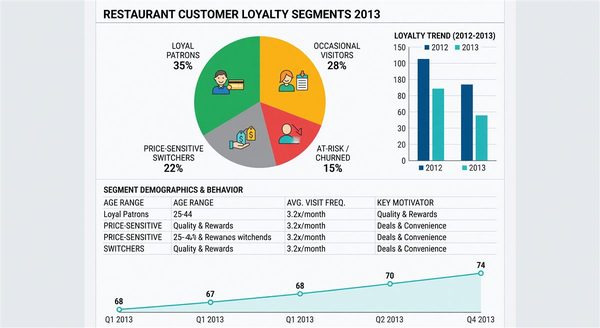
The most repeated statistic in restaurant loyalty conversations is the average number of programs a U.S. consumer belongs to. By late 2013, that number had settled in the two-to-three range across multiple independent studies. What the headline number does not capture, and what matters far more for operators, is the much smaller number of programs the average consumer actively uses. Enrollment is cheap. Active engagement is what produces revenue lift.
The enrollment versus active gap
The pattern shows up consistently across consumer research: enrolled membership counts are roughly double active membership counts. A consumer who belongs to three programs typically engages meaningfully with one or two. The third is in their wallet but rarely opened, with a card that may have been scanned once and forgotten.
This active-to-enrolled ratio matters because it sets a realistic ceiling on how much member behavior an operator can expect to change through better program management. Even an excellently run program will see a meaningful share of enrollments lapse into dormancy within the first year. The goal is not zero dormancy — that is unrealistic — but rather a higher-than-industry-average ratio of active to enrolled members.
What drives active engagement
Looking across 2013 consumer findings, four factors consistently separated the programs a member actively used from the ones that went dormant:
- Visit frequency to the brand. A program at a restaurant the member already visits monthly stays active. A program at a restaurant the member visits twice a year goes dormant regardless of program quality.
- Time to first reward. Members who earn their first reward within the first three visits are dramatically more likely to remain active than members who do not see a reward until their eighth or tenth visit.
- Communication cadence. Members who hear from the brand monthly stay engaged. Members who go silent for a quarter or longer drift toward dormancy.
- Relevance of rewards. Members who earn rewards on items they actually want stay engaged. Members who earn rewards they do not value stop tracking the program.
The first factor — brand visit frequency — is the dominant one. The other three matter, but they cannot rescue a program at a brand the member rarely visits.
Implications for program targeting
The active-to-enrolled gap has a useful implication for acquisition strategy. Mass enrollment campaigns that drag in light users inflate the headline membership number without producing proportional revenue lift. The members added through these campaigns are disproportionately destined for dormancy. A more disciplined approach focuses acquisition on guests who already visit the brand at moderate frequency, where the probability of active engagement is high.
This does not mean operators should turn away light-user sign-ups. It means they should not treat those sign-ups as equivalent in value to mid-tier guest enrollments, and they should not let acquisition tactics that produce mostly light-user enrollment dominate the marketing budget.
For a related view on how visit frequency lift is measured, see our piece on 2014 restaurant rewards consumer findings.
The dormancy recovery question
A persistent question in 2013 loyalty conversations was whether dormant members could be reactivated through targeted communication. The data was mixed. Members who had gone dormant within the past 90 days responded reasonably well to reactivation offers. Members who had been dormant for a year or more rarely came back regardless of offer strength.
This argues for early intervention. Programs that identify members trending toward dormancy and reach out before they fully disengage produce much better reactivation results than programs that wait until the member has been silent for several quarters.
FAQ
How many restaurant loyalty programs does the average U.S. consumer belong to? Roughly two to three programs, based on multiple 2013 consumer studies, with active engagement typically concentrated in one or two of those.
Why do enrolled members go dormant? The dominant cause is low visit frequency at the brand. Even well-designed programs cannot keep members engaged at restaurants they rarely visit.
Can dormant loyalty members be reactivated? Members dormant for less than 90 days respond reasonably well to targeted offers. Members dormant for a year or more rarely return regardless of the reactivation tactic.
Further Reading from Authoritative Sources
- National Retail Federation — NRF publishes industry consumer research on loyalty program participation that provides the enrollment and active-engagement benchmark context for the two-to-three program average analyzed in this article.
- Harvard Business Review — HBR’s behavioral economics and consumer loyalty research underpins the article’s analysis of why time-to-first-reward and visit frequency determine whether enrolled members become active or dormant program participants.