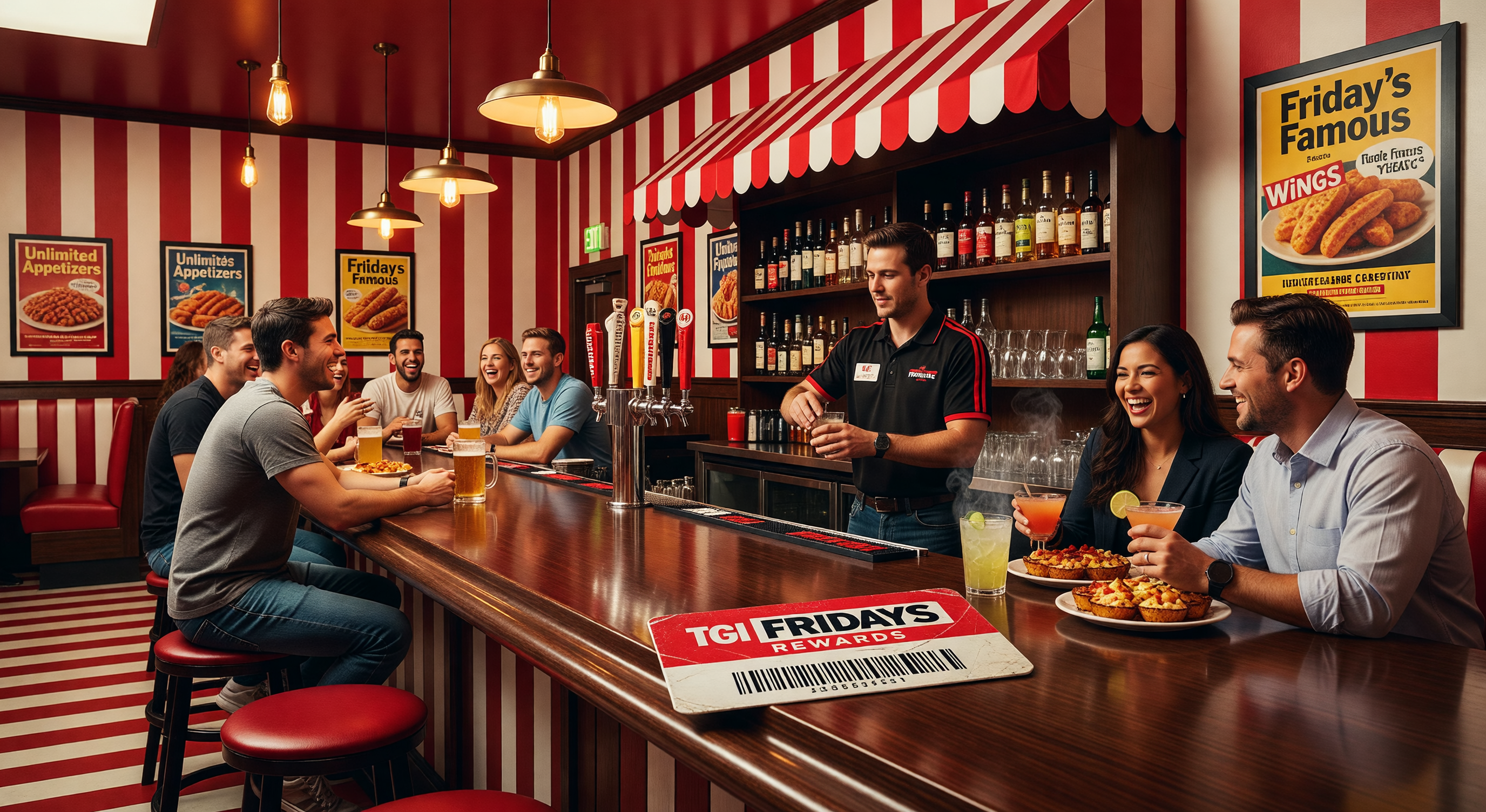
When TGI Friday’s launched Give Me More Stripes, it entered a crowded field of casual dining loyalty programs competing for the same discretionary dining dollars. What distinguished the program — and what ultimately limited it — came down to a design philosophy that prioritized engagement theater over straightforward value delivery.
This review covers how the program actually worked, what members got for their spending, and how it stacked up against the wave of casual dining loyalty programs rolling out during the same period.
How Give Me More Stripes Worked
Give Me More Stripes was a points-based program in which members accumulated “Stripes” with each qualifying purchase, redeeming them for menu rewards once their balance crossed defined thresholds. The base structure was straightforward — roughly one Stripe per dollar spent — with bonus-earn promotions layered on top.
The earn rate tied directly to check totals at participating Friday’s locations. Members presented their card or app at checkout, and Stripes posted automatically to their account within a short processing window. Points could also accumulate through bonus challenges — limited-time promotions that rewarded specific ordering behavior like trying a new menu item or visiting multiple times within a set period.
The program operated primarily through a mobile app, which represented a forward-looking design choice for the period. App-based loyalty was still relatively novel in full-service casual dining in 2012–2013, and Friday’s deserves credit for committing to the mobile-first approach when many competitors were still issuing plastic cards.
Redemption Thresholds and Bonus Mechanics
Give Me More Stripes was organized around redemption thresholds rather than the elaborate multi-level status hierarchies common in hotel and airline loyalty. Members accumulated Stripes and unlocked rewards as their balance grew, with bonus-earn promotions and limited-time challenges providing accelerated paths to the next reward.
That goal-gradient design — a clear, near-term target to work toward — is something behavioral research consistently links to stronger program engagement. Knowing exactly how many Stripes stand between you and the next reward gives members a concrete reason to favor Friday’s over a competitive option when deciding where to eat.
That said, the program also carried a meaningful drawback: Stripes expired, which meant members who weren’t active risked losing their accumulated balance and having to rebuild. For the casual Friday’s visitor — someone who eats there four or five times a year — this expiration mechanic made the larger rewards feel perpetually out of reach.
What Rewards Actually Looked Like
The redemption catalog covered the range you’d expect from a full-service casual dining program: free appetizers, entrée discounts, desserts, and drinks. Members accessed additional redemption options as their balance grew, and had periodic access to exclusive items tied to promotions.
Friday’s also used the program to push trial of new menu items — a smart operator move that turns loyalty infrastructure into a product launch tool. Members received targeted offers tied to menu innovation, which served both the guest (a compelling reason to redeem) and the business (incremental trial of items with higher margin targets).
The actual cents-per-Stripe redemption value placed Give Me More Stripes in the middle of the casual dining field — better than programs that required excessive spend for trivial rewards, but not as compelling as the leaders who were running closer to 3–4% effective return on dining spend.
Mobile App Experience
The Give Me More Stripes app handled account management, Stripe balance tracking, offer delivery, and table booking at select locations. For a casual dining chain of Friday’s scale, building a fully functional loyalty app in this period required meaningful investment, and the execution was generally well-regarded by members.
The app also enabled push notifications for bonus challenges and time-limited offers, which created a direct channel between Friday’s and its loyalty base outside of email. For members who kept notifications enabled, this created genuine incremental visit drivers — a flash offer for double Stripes on a Tuesday afternoon could meaningfully shift visit timing.
One practical limitation: the app required consistent location services to validate in-restaurant visits, which created friction for members who kept location services off or experienced check-in failures in lower-connectivity environments. Account lookup via card swipe remained available as a fallback, but the card-versus-app inconsistency created support overhead.
Competitive Context
Give Me More Stripes launched during a wave of casual dining loyalty investment that included Applebee’s, Chili’s, and a range of smaller chains all standing up similar points-and-rewards infrastructure. The competition for “share of wallet” in casual dining was intense, and loyalty programs became a differentiator — or at minimum, a table-stakes defensive move to prevent defection to chains that offered rewards.
Against that backdrop, Friday’s program had genuine strengths: the mobile-first approach, the goal-gradient redemption design, and the bonus challenge mechanic all put it ahead of more static competitors. The program’s weak point was the earn rate, which required meaningful spend commitment before rewards became visible enough to create a behavioral pull.
For high-frequency Friday’s visitors — people who eat there twenty or more times a year — the program created real accumulated value. For the median Friday’s customer visiting four to six times annually, the value was thinner, and the Stripe expiration risk made the larger rewards feel like a moving target.
Who Got the Most Value
The program rewarded consistent frequency more than it rewarded spend. A member who visited frequently at lower check totals would outpace a member who visited rarely with large groups. That design aligned well with Friday’s bar and beverage business, where frequent bar visits built Stripe balances without generating the per-check totals of a full dinner for four.
Business lunch visitors also found the program favorable — the midday crowd visiting multiple times weekly built Stripe balances quickly, creating a loyalty segment that intersected well with Friday’s bar-adjacent daytime menu positioning.
The program was less well-suited for occasional splurge visitors — families or groups celebrating events who generated large one-time check totals but visited infrequently. Those members accumulated Stripes rapidly on a single visit but then saw them expire before accumulating enough for meaningful redemption.
FAQ
How did you earn Stripes in the Give Me More Stripes program? Members earned Stripes on qualifying purchases at participating TGI Friday’s locations by scanning their app or swiping their program card at checkout. Bonus Stripes were available through limited-time challenges tied to specific ordering behavior.
Did Give Me More Stripes points expire? Yes — Stripes had an expiration policy tied to account activity. Members who didn’t visit within a defined window risked losing accumulated Stripes before reaching a redemption threshold.
How was Give Me More Stripes structured? The program was built around redemption thresholds rather than elaborate status tiers — members accumulated Stripes (roughly one per dollar spent) and unlocked menu rewards as their balance grew, with bonus-earn promotions accelerating the path to the next reward.
Was Give Me More Stripes available as a mobile app? Yes — the program was app-first, with a mobile app handling account management, Stripe tracking, offer delivery, and check-in. A physical card was also available as an alternative.
What kinds of rewards could you redeem Stripes for? Redemption options included free appetizers, entrée discounts, desserts, and drinks, with higher balances unlocking larger rewards. Members also received periodic exclusive offers tied to promotions.
Is Give Me More Stripes still active? TGI Friday’s eventually restructured its loyalty approach after the Give Me More Stripes era, moving through successive program iterations. The specific Give Me More Stripes structure was discontinued as Friday’s refined its loyalty strategy.
Further Reading from Authoritative Sources
- Harvard Business Review — HBR’s behavioral economics research provides the analytical framework for the article’s analysis of Give Me More Stripes — including the goal-gradient effect that made the threshold-based accumulation structure an engagement driver, and the behavioral cost of Stripe expiration for infrequent visitors who cannot maintain the activity cadence required to protect their balance.
- National Retail Federation — NRF publishes restaurant and retail loyalty benchmarks that contextualize Give Me More Stripes’ earn rate, redemption catalog, and mobile-first design choices against the casual dining competitive landscape of 2012 to 2013 — supporting the article’s assessment of where the program led the field and where it fell short against the strongest casual dining loyalty programs of the era.