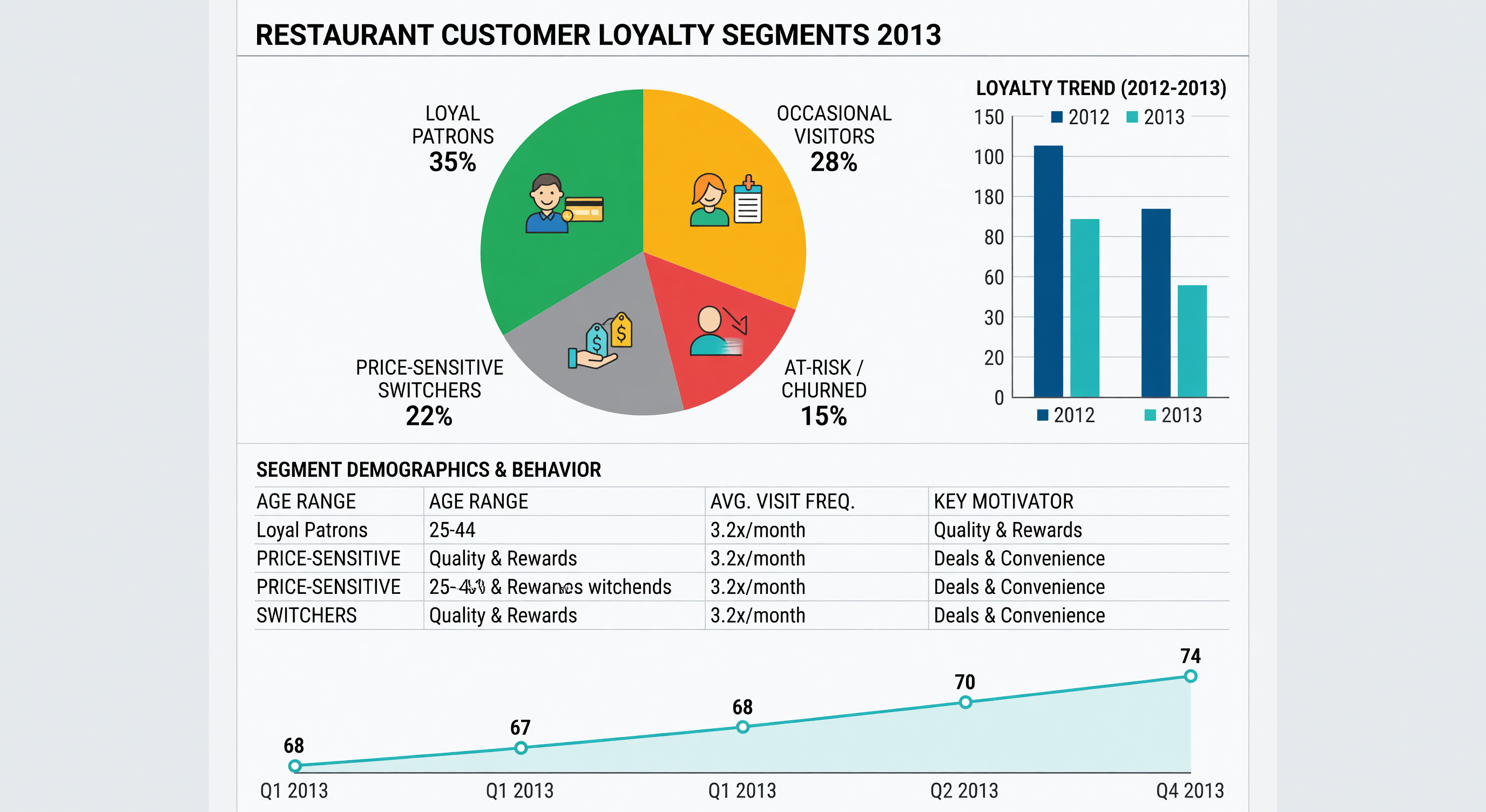
Most restaurant loyalty programs in 2013 still treated their members as a single group. Every enrolled card got the same monthly email, the same point earn rate, the same reward catalog. By the back half of the year, a handful of more sophisticated operators had begun experimenting with simple segmentation, and the early results were good enough that segmentation moved from an “advanced topic” to something the median program owner was at least planning for in their 2014 roadmap.
This piece looks at what early segmentation actually looked like in 2013, what data operators had to work with, and where the first wins came from.
Why segmentation arrived when it did
Three things converged in 2013 to make segmentation practical. First, most loyalty programs that had launched in 2010 or 2011 now had enough longitudinal member data to identify visit patterns rather than just snapshot transactions. Second, email service providers had improved their dynamic content capabilities to the point that sending different offers to different segments was no longer a technical project. Third, the limitations of one-size-fits-all programs had become visible in the form of stagnant active member percentages and rising dormancy rates.
The combination meant that operators who had data, tools, and a clear problem to solve all converged on the same answer at roughly the same time.
What 2013 segmentation looked like
Early segmentation efforts were modest. Most operators started with two or three buckets, not four to six. The typical starting cuts were:
- Active versus inactive. The single most useful initial cut, separating members who had visited in the past 90 days from members who had not.
- High versus low frequency. Within the active group, distinguishing weekly-or-better visitors from monthly-or-less.
- New versus established. Members in their first 90 days received different communication than members who had been enrolled for a year or more.
Even these simple cuts produced measurable improvement in email engagement metrics and modest but real lift in redemption rates. Operators who reported the strongest early results were the ones who paired segmentation with reward differentiation, sending genuinely different offers to each segment rather than the same offer with different subject lines.
The data operators had to work with
In 2013, most restaurant loyalty platforms exposed a basic set of member-level data: enrollment date, last visit date, total visits, total spend, and reward redemption history. A handful of more advanced platforms exposed additional fields like preferred location, daypart pattern, and party size. That was the working material for early segmentation.
Operators who tried to build segments based on data they did not reliably capture — survey-based preferences, demographic appends, predictive modeling — generally found the effort outweighed the benefit at this stage. The wins came from acting on the data that was already in the platform, not from importing external enrichment.
Where the first wins came from
Across 2013 segmentation experiments, three tactics produced disproportionate early returns:
- At-risk reactivation. Members trending toward dormancy who received a targeted offer in the 60-to-90-day post-visit window reactivated at meaningfully higher rates than members who received generic monthly emails.
- New member acceleration. Members in their first 30 days who received a structured welcome sequence with progressive earn opportunities reached their first reward faster and showed higher long-term active rates.
- High-value recognition. Members in the top frequency tier who received recognition-based communication — early access, exclusive previews, status acknowledgment — showed measurably higher retention.
These three tactics formed the core of the segmentation playbook that most casual dining programs would build on through 2014 and beyond. For a later view of how this thinking matured, see our 2018 segmentation overview.
FAQ
What was the simplest useful loyalty segmentation in 2013? Active versus inactive, followed by high-frequency versus low-frequency within the active group. Two-to-three-bucket segmentation outperformed undifferentiated communication immediately.
Did 2013 segmentation require new platform investment? For most operators, no. The data needed for basic segmentation was already in the loyalty platform; what was new was the discipline to act on it.
Why did segmentation arrive in 2013 rather than earlier? Several factors converged: programs had accumulated enough longitudinal data, email tools could deliver dynamic content easily, and the limits of one-size-fits-all programs had become visible in stagnant active-member metrics.
Further Reading from Authoritative Sources
- Harvard Business Review — HBR’s research on customer segmentation and behavioral marketing provides the academic and practitioner context for the article’s analysis of why simple active/inactive and frequency-based segmentation produced immediate lift in redemption and email metrics for restaurant loyalty operators in 2013.
- Association of National Advertisers — ANA publishes loyalty program marketing best practices that validate the article’s core finding that segmented reward differentiation — not just segmented messaging — was the structural breakthrough that produced early measurable returns for 2013 restaurant loyalty operators.