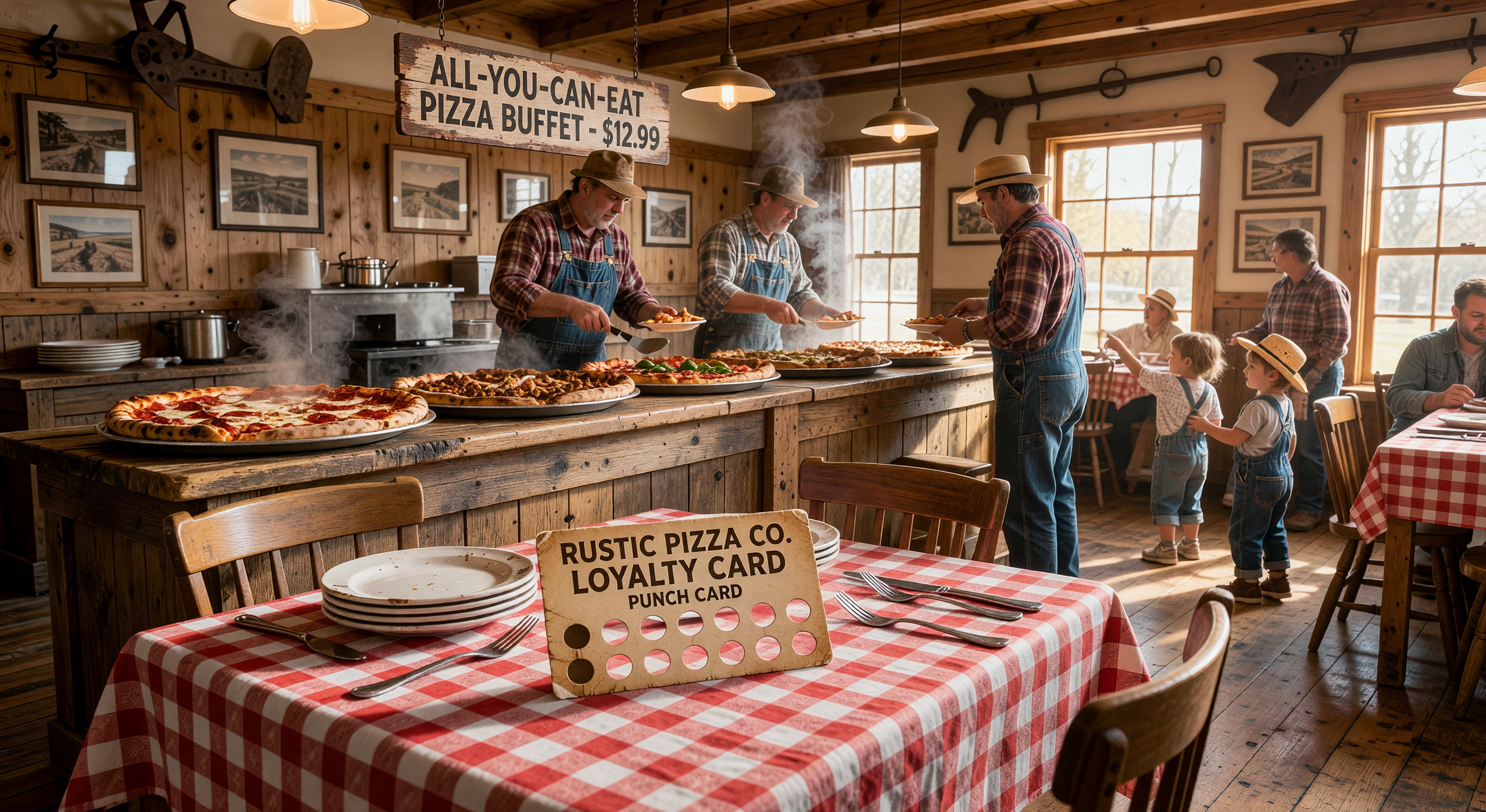
Pizza Ranch operates more than 200 locations — roughly 220 across about 15 states as of early 2026 — concentrated in Iowa (its single largest market), Minnesota, the Dakotas, Nebraska, and adjacent Midwest states. Its customer base is defined by a specific ritual: the all-you-can-eat buffet, usually on a weeknight or Sunday after church, typically with kids. The Ranch Rewards program was built for exactly that customer — and that clarity of purpose is both its strength and its ceiling.
How the program works
Enrollment is free. Members sign up online, in-restaurant, or through the Pizza Ranch Rewards app (iOS and Android, built on Paytronix). The core mechanic is simple: earn one point for every dollar spent on qualifying food and beverage purchases, rounded up to the nearest dollar. Spend $11.50, earn 12 points.
When a member reaches 100 points, the balance automatically converts to a $5 Ranch Rewards credit — no action required, no redemption button to push. That credit lands on the account and is available for the next visit, redeemable in-restaurant or on the Pizza Ranch website for direct orders.
The return rate is 5% on eligible spend, which is competitive for a casual dining loyalty program. For context: a family running $40 in buffet spend per visit earns a $5 reward roughly every 2.5 visits.
What the math actually looks like
The 5% headline is real, but the expiration policy introduces friction. Once points convert to a $5 reward, that reward expires 60 days from the date it was earned. The birthday bonus — a flat $5 added automatically the Monday before your birthday — expires in 30 days. Unregistered points or points that haven’t yet hit the 100-point threshold do not expire, which protects casual members from losing accumulated credit between visits.
The $50 maximum redemption per transaction is a ceiling most members will never approach, but it’s worth knowing for group events where a single check might run high.
What members actually receive
Welcome experience: No sign-up bonus in the standard program, though the app does reward the first check-in with 25 bonus points — a quarter of the way to a $5 reward with no spend required. It’s a small incentive but a clean onboarding nudge.
Birthday reward: A $5 credit, automatically loaded the Monday before your birthday (or on the day itself if your birthday falls on a Monday). For a family that uses Pizza Ranch as a birthday dinner destination — and a notable portion of the chain’s regulars do — this delivers real value. The 30-day expiration is tight; members should note it immediately.
Double Points Wednesdays: Points earned on Wednesday purchases count double, up to $100 in spend. This is the single most useful feature for regulars with flexibility in their weekly schedule. A $40 Wednesday buffet earns 80 points — most of a reward — versus 40 on any other night.
App check-in: Members can tap the gold check-in button in the app, give the cashier a short code, and skip the physical card entirely. The 25-point first-check-in bonus applies once per account.
Gift card earning: Points accrue on purchases made with Pizza Ranch gift cards, including cards bought through RaiseRight (the fundraising platform many Midwestern youth groups use). For families who route discretionary dining through RaiseRight for the fundraising benefit, this stacking opportunity is meaningful.
Where the program delivers
The structural simplicity is genuinely appropriate for the audience. Families at a buffet counter don’t want to think about category multipliers or points that behave differently on beverages than on food. One point per dollar, automatic conversion, done — the program works without requiring members to optimize anything.
The Wednesday double-points promotion is the standout mechanic. Unlike promotions that require a specific trigger offer or a coupon code, it’s a standing weekly benefit that regulars can build into their schedule. Pizza Ranch has publicly cited the double-points program as generating strong ROI; for members, it means the effective return on a Wednesday visit is closer to 10%.
The gift card earning policy is more forward-thinking than it looks. Many Pizza Ranch regulars already participate in RaiseRight for youth group fundraising, and earning points on those redemptions adds loyalty value to a purchase channel that most chains ignore entirely.
Where the program falls short
There is no tier structure. A household visiting twice a week and spending $200 a month accrues no status, earns no accelerated baseline, and receives no recognition beyond the same point accumulation available to someone who visits once a quarter. At a chain where a small core of regulars almost certainly drives a disproportionate share of revenue, the absence of even a modest VIP tier is a gap.
The 60-day expiration on converted rewards will catch members who have irregular visit patterns — travel, a busy stretch, an illness. The math is relatively forgiving during normal life, but there’s no grace mechanism. The reward simply lapses.
Third-party delivery earns nothing. DoorDash and Uber Eats purchases are explicitly excluded. Given the growth of delivery even among casual dining chains, this exclusion limits the program’s ability to reward members across their full spending pattern with the brand.
The Paytronix app infrastructure is functional but not distinctive. Account management, balance checks, and check-in work reliably. What’s absent is the kind of push notification personalization, streak mechanics, or gamified engagement that would give members a reason to open the app on off days. The app is a utility, not an engagement layer.
Compared to pizza loyalty programs
The major delivery-oriented chains — Domino’s Piece of the Pie Rewards, Pizza Hut Hut Rewards, Papa Johns’ Papa Rewards — operate programs built around order frequency and average check size, with carryout and delivery as primary channels. The comparison is imperfect because Pizza Ranch is fundamentally a dine-in buffet business.
A more apt comparison is the loyalty programs at Cici’s or Golden Corral, where the buffet pricing model creates a similar spend-tracking structure. In that peer group, Ranch Rewards’ clear earn rate and automatic conversion hold up well. The $5 birthday bonus is stronger than most comparable programs offer.
Bottom line
Ranch Rewards is a well-fitted program for a well-defined customer. If you’re a Pizza Ranch regular — dine-in, at least twice a month, somewhere in the Midwest — you should be enrolled. The 5% return is genuine, the birthday bonus is useful, and Double Points Wednesdays are an easy win. The absence of tiers and the 60-day reward expiration are real limitations, but neither undermines the core value for consistent members. Occasional visitors or those who primarily order through third-party delivery will find the program thinner.
Frequently asked questions
Is there a fee to join Ranch Rewards? No. Enrollment is free online, in-restaurant, or through the app.
What’s the earn rate? 1 point per dollar spent on eligible food and beverage purchases, rounded up to the nearest dollar.
When do points convert to rewards? Automatically at 100 points — a $5 credit is added to your account with no action required.
How long do rewards last once converted? 60 days from the date the $5 reward was earned. The birthday bonus expires in 30 days.
Does delivery earn points? No. Purchases through DoorDash, Uber Eats, or other third-party delivery services are excluded.
What’s the birthday reward? A $5 credit loaded the Monday before your birthday (or on your birthday if it falls on a Monday), expiring 30 days after issuance.
Is there a sign-up bonus? No cash sign-up bonus, but downloading the app and completing your first app check-in earns 25 bonus points.
Does the buffet count toward points? Yes. All in-restaurant food and beverage purchases, including buffet pricing, earn points.
Further Reading from Authoritative Sources
- National Retail Federation — NRF industry data provides the peer benchmarks for casual dining loyalty earn rates against which Pizza Ranch’s 5% return is evaluated.
- Pizza Ranch — Wikipedia provides context on the Pizza Ranch brand and its geographic concentration in Iowa, Minnesota, and the Dakotas that shapes the program’s design and audience.