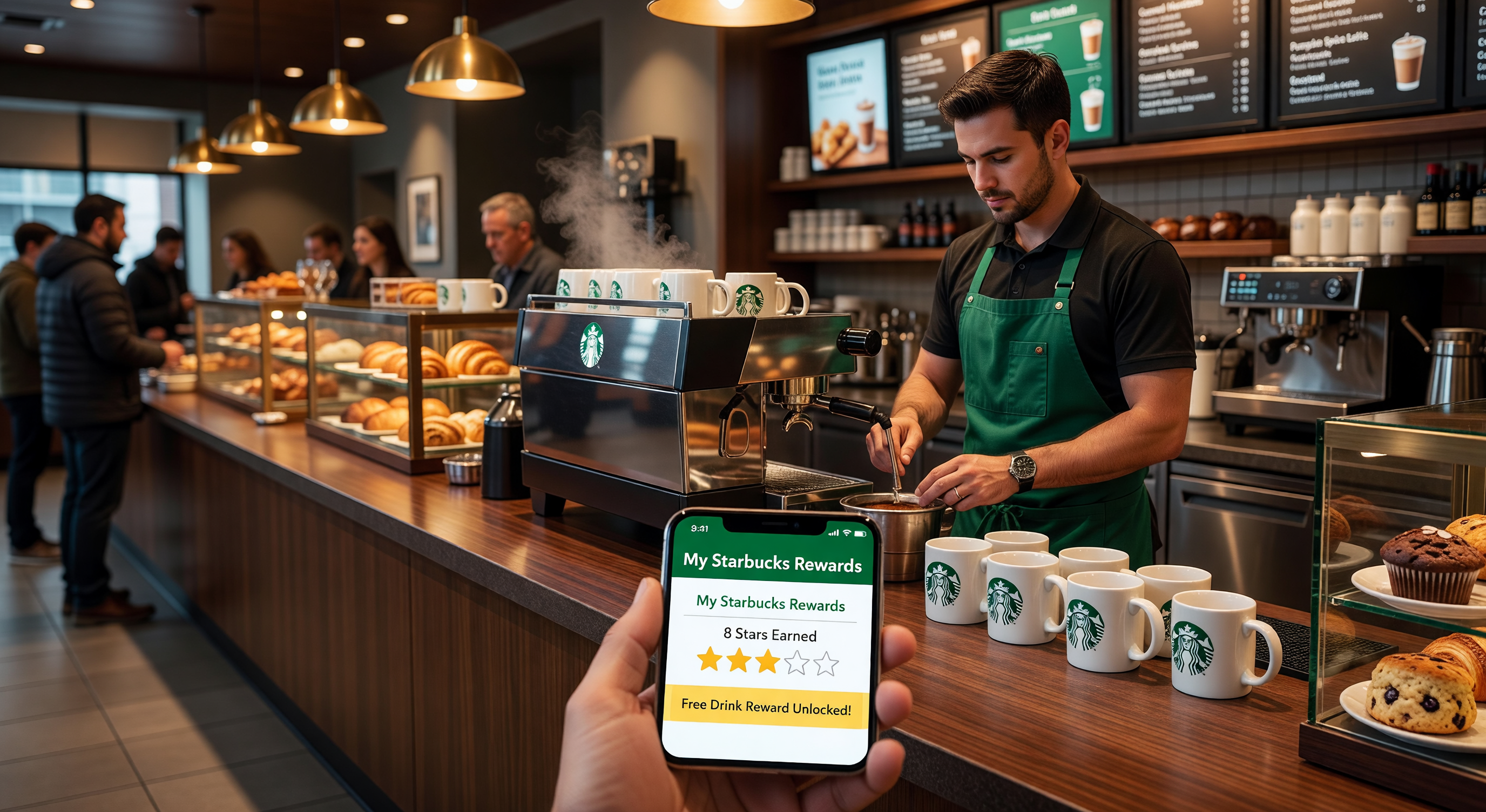
My Starbucks Rewards is the loyalty program that every restaurant operator benchmarks against. After more than a decade as the dominant model in the category, Starbucks overhauled it on March 10, 2026 — adding a third tier, restructuring the earning rates, and introducing new perks designed to deepen engagement with high-frequency visitors. The result is a more sophisticated program that clearly rewards its best customers, while quietly reducing value for the occasional guest.
Here is how it actually works now.
How the program works
Enrollment is free. Create an account through the Starbucks app or website, and you are automatically placed in the Green tier. Stars accumulate on qualifying purchases made through the app or a registered Starbucks Card.
The earning rate is where the 2026 overhaul made its biggest structural change. Previously, members could earn 2 Stars per dollar — 1 from purchase and 1 from card reload. The new program separates earnings by tier:
- Green: 1 Star per $1 spent, with bonus Stars available on card reloads ($30+ reload earns 10 bonus Stars; $50+ earns 25)
- Gold: 1.2 Stars per $1 spent (12 Stars per $10), reached by earning 500 Stars in a 12-month window
- Reserve: 1.7 Stars per $1 spent (17 Stars per $10), reached by earning 2,500 Stars in a 12-month window
The math is straightforward: a Green member spending $100 earns 100 Stars. A Reserve member spending the same $100 earns 170 Stars — 70% more acceleration toward the next reward.
The redemption ladder
One genuine improvement in the redesigned program is the redemption structure. Stars can now be spent at six levels rather than a cruder two- or three-tier system:
| Stars | What you get |
|---|---|
| 25 | Free drink customization (max $1 value) — extra shot, syrup, cold foam |
| 60 | $2 off any purchase |
| 100 | Brewed coffee, tea, or bakery item (max $6 value) |
| 200 | Handcrafted beverage or breakfast item (max $10 value) |
| 300 | Sandwich, protein box, or packaged coffee (max $16 value) |
| 400 | Select merchandise (max $20 value) |
The 25-Star customization tier is genuinely useful — a free syrup add or cold foam costs you nothing when you have a small Stars balance, and it drives engagement between bigger redemptions. The 60-Star/$2-off tier is less compelling; the math doesn’t favor it against simply saving toward a 100-Star free item.
The new dollar caps on the 100-Star and 200-Star tiers are worth flagging. Previously these redemptions were uncapped, meaning a Reserve member could redeem a 200-Star reward against a $12 specialty drink and receive full value. The $10 cap on the 200-Star tier means a $12 drink costs you some out-of-pocket even on a Stars redemption. It is a meaningful devaluation for anyone who regularly orders premium handcrafted beverages.
What each tier actually delivers
Green is the functional minimum. You earn Stars, you get a birthday reward (7-day redemption window), and you get access to Free Mod Monday — one complimentary drink customization, up to $2 value, on a Monday each month. Your Stars expire after six months unless you extend them through qualifying activity. It is a functional entry-level program, but the earning rate of 1 Star per dollar makes the path to any meaningful reward slow for occasional visitors.
Gold is where the program becomes genuinely worthwhile. Stars never expire. You earn at 1.2x the Green rate, receive a minimum of four Double Star Days per year, and your birthday reward extends to a 7-day window. Reaching Gold requires 500 Stars — at 1 Star per dollar for a Green member working toward the threshold, that is $500 in spend before the multiplier kicks in. For a daily coffee drinker spending $6 per visit, roughly 83 visits to qualify.
Reserve is the elite tier and unambiguously the best value in the program — for the narrow slice of customers who can hit it. At 2,500 Stars annually with 1.7 Stars per dollar, a Reserve member is spending roughly $1,470 per year at Starbucks to maintain status. At that volume, the benefits are substantial: non-expiring Stars, a 30-day birthday reward window, at least six Double Star Days annually, access to exclusive merchandise, and invitations to curated global events. This is a tier designed for people who are already committed Starbucks customers at a high frequency; it does not create that commitment, it rewards it.
Where the program leads
Three things My Starbucks Rewards does better than any peer program.
Technology integration. The app remains the standard. Ordering, payment, Stars tracking, offer management, and reload are all handled in a single interface with no friction at the point of sale. Members don’t encounter a loyalty prompt separate from a payment prompt — the program is invisible during use, which is the correct design. Competitors have spent years trying to replicate this and most haven’t closed the gap.
Earning flexibility. The tiered earning rate, bonus reload Stars, Double Star Days, and promotional events mean there are multiple paths to acceleration. A motivated Green member can accumulate Stars faster than the base rate suggests; a Reserve member compounds value quickly. The program rewards engagement with the app beyond simple purchase.
Non-expiring Stars for higher tiers. The old program’s Star expiration policy was the single most consistent member complaint. Solving it at Gold and Reserve — the tiers where loyalty is highest and churn is most costly — is the right fix. Green expiration is still a friction point, but the new structure makes it extendable through app activity, which is a reasonable compromise.
Where the program has deteriorated
The 2026 redesign is a devaluation for anyone outside Gold or Reserve, and the program’s marketing obscures this. The baseline earning rate dropped from an effective 2 Stars per dollar (purchase + reload) to 1 Star per dollar for Green members. Even Gold members, at 1.2 Stars per dollar, earn less than the old system’s baseline. The headline benefits — Free Mod Mondays, expanded redemption tiers, no-expiry Stars for upper tiers — are genuine additions, but they do not offset the earn-rate reduction for the majority of enrolled members who will never reach Reserve.
The Reserve threshold deserves specific scrutiny. At 2,500 Stars and 1.7 Stars per dollar, a member earning from the Gold tier spends approximately $1,470 annually to qualify. That is a high bar. Most loyalty programs define their elite tiers at points reachable by moderately frequent customers; Starbucks has defined Reserve at a level accessible only to habitual daily visitors or people making regular large orders. The aspirational tier structure works — it creates visible status and meaningful perks — but the threshold should be understood as genuinely exclusive, not merely aspirational.
Compared to peer programs
Few programs match My Starbucks Rewards on technology and earn-rate breadth. MyPanera Rewards takes a fully opaque, surprise-and-delight approach that is interesting but impossible to value in advance. Jamba Insider Rewards is a competent fast-casual implementation that shows clear Starbucks influence. Casual-dining programs like TGI Friday’s Give Me More Stripes operate on different mechanics and frequency assumptions. What distinguishes My Starbucks Rewards in every comparison is the completeness of the technology stack — the program and the app are the same thing.
The Delta SkyMiles and Marriott Bonvoy linking is a newer dimension worth noting. Members who travel frequently can earn SkyMiles on Starbucks purchases and Bonvoy points through linked activity. This cross-program earning is rare in restaurant loyalty and adds genuine value for the right customer profile.
Bottom line
My Starbucks Rewards is still the reference implementation for restaurant loyalty — the best mobile integration in the category, a thoughtful multi-level redemption structure, and a tier system that creates real incentives for frequency. For any regular Starbucks customer, enrollment is mandatory; the program is built into the ordering experience and delivers clear value at every engagement level.
But the March 2026 overhaul should be understood plainly: it is a better program for high-frequency visitors and a worse program for occasional guests. Green-tier members now earn at half the effective rate of the old system. The value is real at Gold and spectacular at Reserve — the question is whether you visit often enough to reach those tiers.
Enroll. Aim for Gold. Be clear-eyed about whether Reserve is achievable for your actual usage pattern before counting on those benefits.
Frequently asked questions
Is there a fee to join My Starbucks Rewards? No. Enrollment is free through the Starbucks app or website.
How many Stars do I earn per dollar spent? Green members earn 1 Star per $1. Gold members earn 1.2 Stars per $1. Reserve members earn 1.7 Stars per $1. Bonus Stars are available on card reloads.
Do Stars expire? Gold and Reserve members’ Stars never expire. Green members’ Stars expire after six months but can be extended through qualifying app activity.
What are the tier thresholds? Green is the default entry tier. Gold requires 500 Stars earned within 12 months. Reserve requires 2,500 Stars earned within 12 months.
What changed in March 2026? Starbucks added a third tier (Reserve), restructured earn rates by tier, introduced Free Mod Mondays, added a 60-Star redemption option, added dollar caps to some redemption levels, and eliminated Star expiration for Gold and Reserve members.
How do I redeem Stars? Through the app at order time, or by telling your barista at the register. Redemptions apply at the time of order against eligible items.
Further Reading from Authoritative Sources
- Starbucks — Wikipedia documents the Starbucks loyalty program history that contextualizes the March 2026 overhaul the review analyzes — including the program’s role as the restaurant loyalty reference implementation that every operator benchmarks against, and the structural context of successive redesigns since the program launched.
- Harvard Business Review — HBR’s behavioral economics and marketing research provides the analytical foundation for the article’s assessment of the Reserve tier threshold — including the goal-gradient research that explains why multi-level Stars structures drive engagement, and the behavioral argument for why the Reserve 2,500-Star threshold is exclusive rather than merely aspirational for most enrolled members.