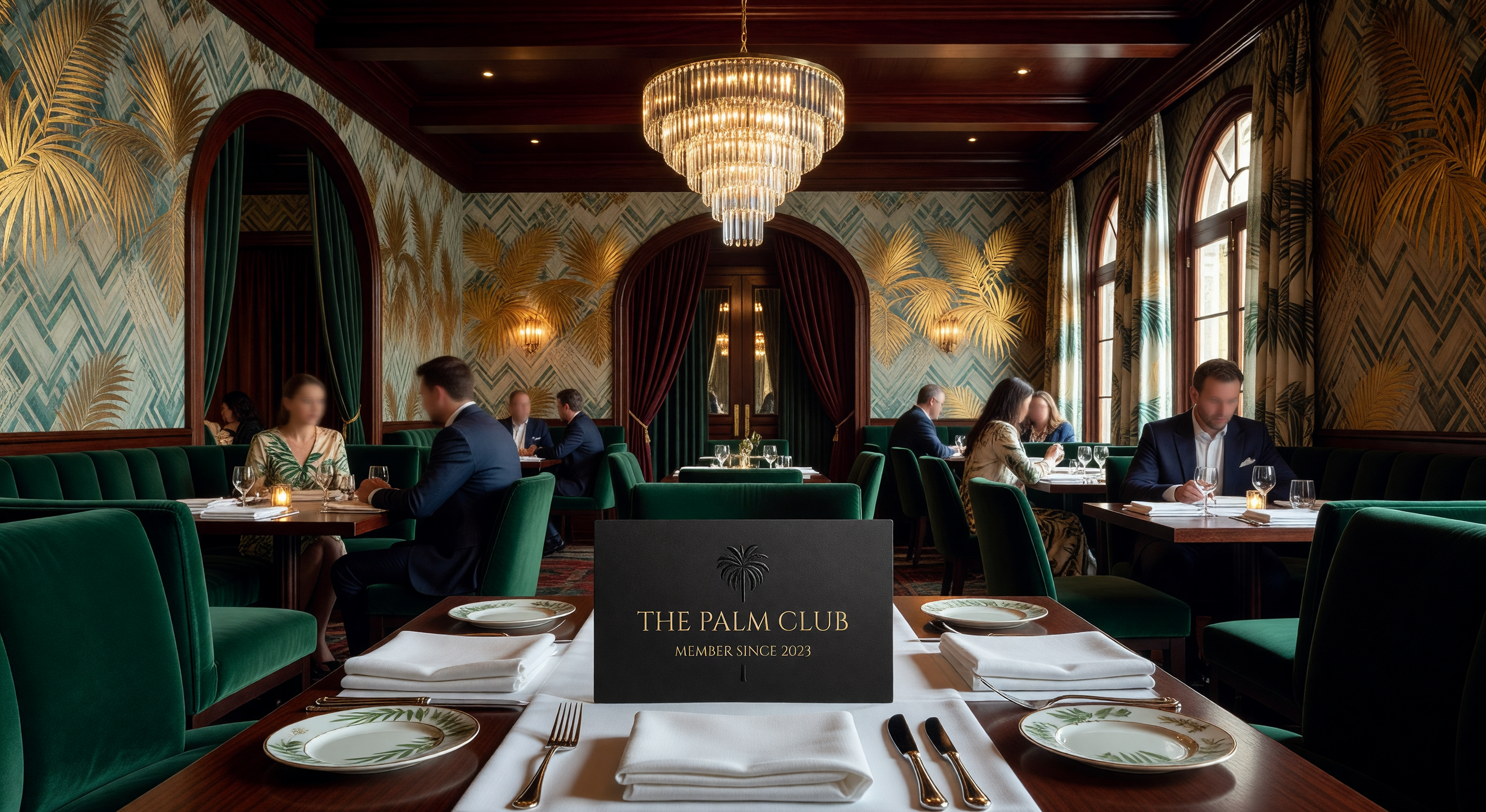
The 837 Club is dead. That sentence requires saying plainly before anything else, because the original article that appeared here in 2013 reviewed a program that no longer exists in any meaningful form. What The Palm now calls the 837 Club on its website is the Landry’s Select Club — the same generic multi-brand loyalty program that runs across Golden Nugget casinos, Bubba Gump Shrimp, and roughly 600 other properties in Tilman Fertitta’s hospitality empire. The name 837 appears in the URL. The substance behind it does not.
Here is what happened, and what the program looks like today.
The acquisition that changed everything
The Palm filed for Chapter 11 bankruptcy in 2019. In February 2020, Landry’s, Inc. — the Houston-based conglomerate controlled by Fertitta — closed its acquisition of the chain for approximately $45 million. Along with the caricature-covered walls and the USDA Prime beef, Landry’s inherited The Palm’s most brand-specific asset: a loyalty program named for the restaurant’s founding address at 837 Second Avenue, where Pio Bozzi and John Ganzi opened the first Palm in 1926.
That program did not survive the integration. The original 837 Club had been positioned as a single-brand program with a genuine tier structure — one that scaled recognition with cumulative spend and offered benefits that made sense specifically for a fine-dining steakhouse regular. Top-tier members received 3-pound birthday lobsters, invitations to caricature unveiling parties (a signature Palm tradition since the 1940s), and access to invitation-only events. The rewards catalog reportedly reached as far as a week-long stay at Baron Eric de Rothschild’s private chateau in France for members who accumulated 150,000 points.
Those benefits are gone. The replacement is structurally different in every way that matters.
What the current program actually delivers
The Landry’s Select Club operates on a flat-rate points model: members earn 1 point per dollar spent across participating Landry’s locations, with 250 points redeeming for a $25 reward — an effective 10% cash-back rate. Enrollment carries a one-time $25 fee, offset immediately by a $25 welcome reward credited to the new account within 24 hours.
The annual birthday benefit is $25, applied during the member’s birthday month. Priority seating is available at participating locations seven days a week. Members can track balances and redemptions through an online account portal at landrysselect.com; notably, restaurant staff cannot process point redemptions directly — members must handle that through the portal themselves.
There is no published tier structure. No accelerated earning at higher spend levels. No recognition that scales with frequency or loyalty to The Palm specifically. A guest who has dined at The Palm monthly for a decade accumulates points on the same terms as someone who visited once after joining.
The scope has also inverted. The original 837 Club’s single-brand focus was a feature — it meant recognition was Palm-specific, not diluted across a portfolio. The Landry’s Select Club turns that inside out. Benefits now extend across 600+ locations, which broadens portability but eliminates the thing that made fine-dining loyalty meaningful: being known as a regular at the restaurant you actually care about.
What remains worth noting
The math still works at the base level. The $25 enrollment fee is recovered on the first visit via the welcome reward. The 10% effective return on spend — if you accumulate and redeem consistently — is competitive with other casual-to-upscale dining programs. The birthday reward is reliable. If you are already a Landry’s portfolio diner, this card makes practical sense as a consolidation tool.
The priority seating claim is harder to evaluate without testing it location by location. At the original Palm locations — New York Midtown, Washington D.C. (a location reportedly encouraged by then-Ambassador George H.W. Bush in 1972), Chicago, Beverly Hills — reservation access during peak periods has historically been the most practical benefit a loyalty program can offer. Whether the Landry’s Select Club delivers on that specifically at Palm properties is unverified.
What is lost and why it matters
The original 837 Club belonged to a small category of fine-dining loyalty programs that understood their audience. A Palm regular is not a casual diner optimizing cents-per-dollar. They are a repeat business entertainer, a long-tenure client dinner host, or a genuine devotee of a specific dining institution. The program that served them recognized this: tier structure rewarded cumulative investment, benefits were brand-specific, and the top-tier perks (the lobster, the caricature ceremony, the Rothschild chateau) were genuinely memorable in a way that $25 reward credits are not.
The Landry’s Select Club is a competent loyalty program for a mass-market portfolio. It is not a fine-dining loyalty program. The Palm now runs in the same rewards infrastructure as a waterfront seafood chain and a casino buffet. For a brand that has traded on power-dining heritage since 1926, the mismatch is not minor.
The bottom line
If you dine at The Palm regularly and have not yet enrolled, the current program is worth joining for the welcome and birthday rewards alone — the economics are straightforward. But anyone who remembers the original 837 Club, or who is evaluating The Palm’s loyalty program as a reason to increase visit frequency, should understand what they are actually getting: a generic points card with brand-specific branding applied over it.
The 837 Club that warranted a dedicated review in 2013 no longer exists. What replaced it is functional. It is not the same thing.
Frequently asked questions
Is the 837 Club still active? The name persists on thepalm.com, but the program it describes is the Landry’s Select Club — a multi-brand program across Landry’s 600+ properties. The original single-brand 837 Club with its tier structure and brand-specific benefits was discontinued after Landry’s acquired The Palm in 2020.
What does enrollment cost? A one-time $25 fee, which is immediately offset by a $25 welcome reward credited to the new account.
Are there membership tiers? No published tier structure exists in the current Landry’s Select Club. All members earn at the same flat rate: 1 point per dollar spent, with 250 points redeeming as a $25 reward.
Can I redeem rewards at the restaurant? No. Redemptions must be processed through the member portal at landrysselect.com. Restaurant staff cannot handle point redemptions directly.
Does the program work at other restaurants? Yes — and that is a change from the original program. The Landry’s Select Club is valid across the full Landry’s portfolio including other steakhouse brands, seafood chains, Golden Nugget casinos, and affiliated hotels.
Further Reading from Authoritative Sources
- The Palm restaurant — Wikipedia documents The Palm’s corporate history including the bankruptcy and Landry’s acquisition that eliminated the original 837 Club tier structure.
- Landry’s, Inc. — Wikipedia provides context on the scope of Landry’s hospitality portfolio, which is essential to understanding why the Select Club’s multi-brand design fundamentally changed The Palm’s loyalty positioning.