Cafe de Boston is the kind of single-location downtown lunch spot that exists in every major city — a counter-service cafe in the financial district, busy at lunch with office workers, quieter the rest of the day. Its loyalty handling is built around LevelUp, the Boston-headquartered mobile payment and loyalty platform that powers similar programs at independent and small-chain restaurants. This review looks at how the LevelUp integration works for Cafe de Boston’s guests and where it sits as a model for small-format restaurant loyalty.
How the LevelUp integration works
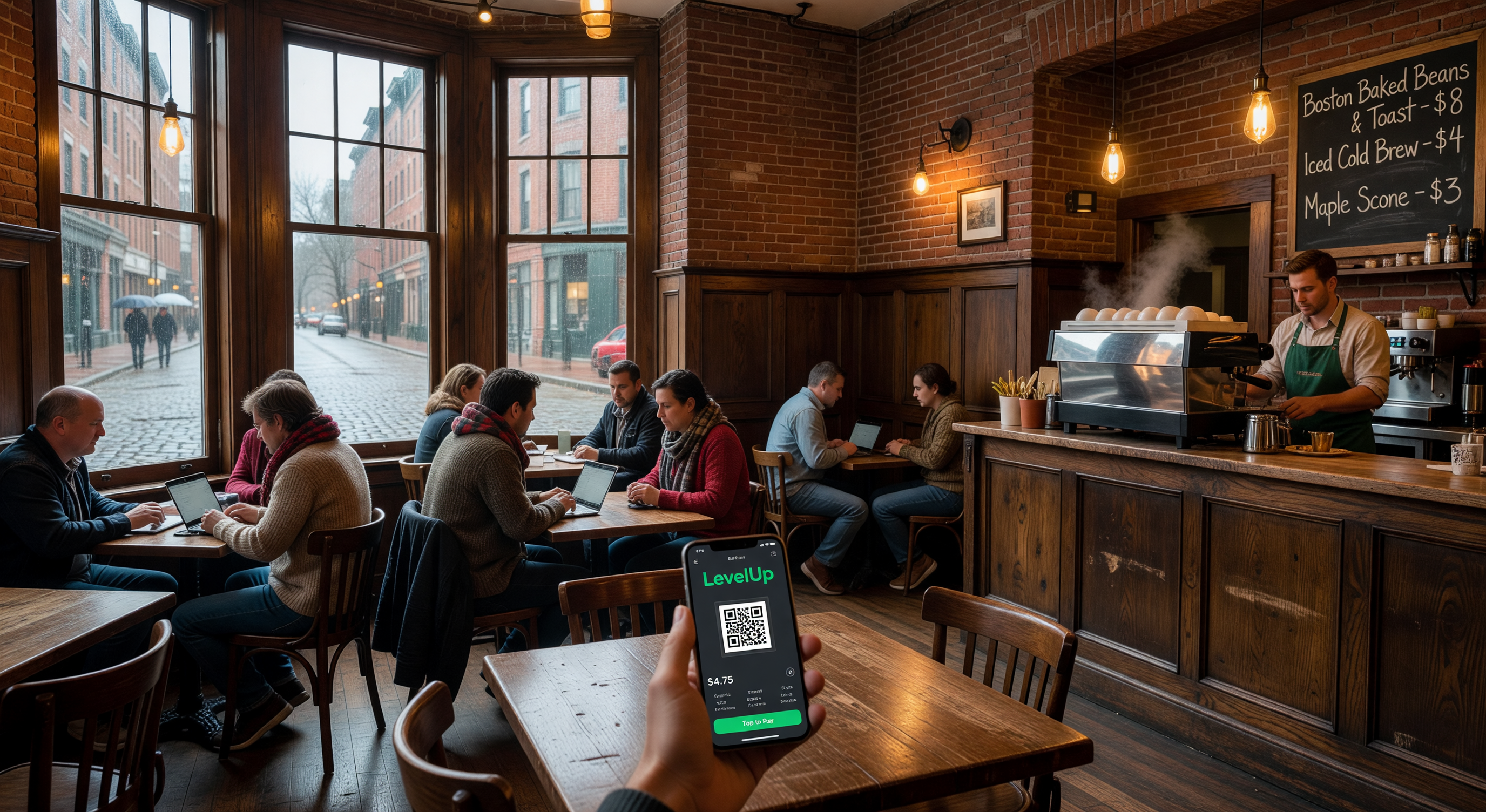
LevelUp is a mobile payment platform that doubles as a loyalty layer. Guests download the LevelUp app, link a payment method (typically a credit card), and use a QR code at the register to pay. The app handles the payment, the loyalty earning, and the redemption in a single transaction — no separate card to swipe, no points to track manually, no paper coupons to remember.
For participating restaurants like Cafe de Boston, the program delivers loyalty benefits without requiring the restaurant to build its own infrastructure. LevelUp handles the technology stack; the restaurant calibrates the benefit structure. Members earn credit toward future purchases based on their spend, with the credit usually delivered as a percentage-back on each visit that accumulates until the member chooses to redeem.
What members actually receive
The standard LevelUp benefit at participating restaurants is a percentage-back credit on each qualifying purchase. For a guest spending $12 on lunch, the program might credit back $0.60 to $1.20 (the percentage varies by restaurant). Credit accumulates until the member reaches a threshold or chooses to redeem, at which point it’s applied to a future purchase.
The mechanic is invisible. Members don’t have to think about points balances, redemption thresholds, or expiration dates the way they do with traditional loyalty programs. They just pay with the app and notice, over time, that meals get periodically discounted by the accumulated credit. That simplicity is the program’s defining feature.
Where the integration works
For Cafe de Boston specifically, LevelUp suits the use case extraordinarily well. The chain’s audience — office workers grabbing lunch on workday rotations — is exactly the demographic for whom mobile-payment loyalty makes most sense. App adoption is high, payment friction at a counter-service register is meaningful, and the percentage-back model delivers reliable, accumulating value without requiring members to actively manage a loyalty account.
The integrated payment-and-loyalty mechanic is also a model for how small-format restaurants can offer competitive loyalty without building bespoke technology. The major chain loyalty programs — My Starbucks Rewards, MyPanera, Jamba Insider — represent investments that no single-location independent could match. LevelUp gives a small operator access to comparable mechanics at a fraction of the cost.
The percentage-back model is also a good fit for the price points and frequency patterns of downtown lunch traffic. A guest visiting Cafe de Boston three times a week sees credit accumulate quickly enough to feel meaningful; the redemption cycle aligns with the visit cycle.
Where the model has limits
LevelUp’s reach is the main constraint. The platform works only at participating restaurants, and the network — while substantial in some markets, particularly Boston — is meaningfully smaller than the open mobile-payment ecosystem (Apple Pay, Google Pay) members may already be using elsewhere. A guest who has already standardized on a different payment app may resist installing LevelUp for a single restaurant.
The percentage-back model, while simple, lacks the surprise-and-delight elements that some chain loyalty programs offer. There are no surprise bonuses, no tier upgrades, no birthday recognition with the same fanfare a chain like Starbucks brings to the same moment. Members who want loyalty to feel like more than a quiet discount may find LevelUp insufficiently engaging.
Restaurant-specific calibration also means members carry mental models of multiple separate restaurants’ LevelUp settings. The standardization the platform provides at the infrastructure level doesn’t extend to the benefit structure each restaurant sets, which means a guest using LevelUp at five different restaurants may face five different percentage-back rates and redemption thresholds.
Compared to chain loyalty programs
LevelUp’s value proposition is structurally different from chain loyalty programs. Where TGI Friday’s Give Me More Stripes and BJ’s Premier Rewards are built around brand-specific recognition and chain-scale infrastructure, LevelUp provides a horizontal layer that powers loyalty across many independent restaurants. Neither approach is universally better; they serve different operator needs and different guest patterns. For a small-format urban lunch spot like Cafe de Boston, LevelUp is probably the right choice; for a national chain with substantial brand equity and marketing resources, a dedicated program is probably better.
Bottom line
The LevelUp integration is a sensible choice for Cafe de Boston’s positioning and audience. Members who already use LevelUp at other Boston-area restaurants get a seamless extension of the program; new members face installation friction that may or may not be justified by the program’s value to a single restaurant. The percentage-back model delivers reliable value without complexity. For small operators considering loyalty infrastructure, LevelUp remains one of the more credible turnkey options.
Frequently asked questions
Is there a fee to use LevelUp? No. The app is free to download for guests; restaurants pay platform fees.
How do I earn rewards at Cafe de Boston? By paying with the LevelUp app at the register. The app handles payment and loyalty earning in a single transaction.
Where else can I use LevelUp? At any participating restaurant in the LevelUp network. Coverage is meaningful in Boston and varies by market elsewhere.
Do I have to manually redeem credit? Accumulated credit is typically applied automatically when you reach a threshold, with some restaurants allowing manual redemption choice.
Is my payment information secure? LevelUp stores payment credentials according to industry-standard practices; consult the app’s privacy and security documentation for specifics.
Further Reading from Authoritative Sources
- Harvard Business Review — HBR’s research on consumer friction reduction and loyalty program mechanics provides the analytical context for evaluating LevelUp’s invisible percentage-back model — including the behavioral argument that payment-integrated loyalty reduces cognitive load and drives higher participation than programs requiring separate card swipes or manual balance tracking.
- National Retail Federation — NRF publishes retail and restaurant technology adoption research that provides industry context for the LevelUp platform’s role in the 2013 small-operator loyalty ecosystem — relevant to evaluating whether mobile-payment-integrated loyalty delivered competitive mechanics to independent restaurants that would otherwise lack the resources for dedicated program infrastructure.