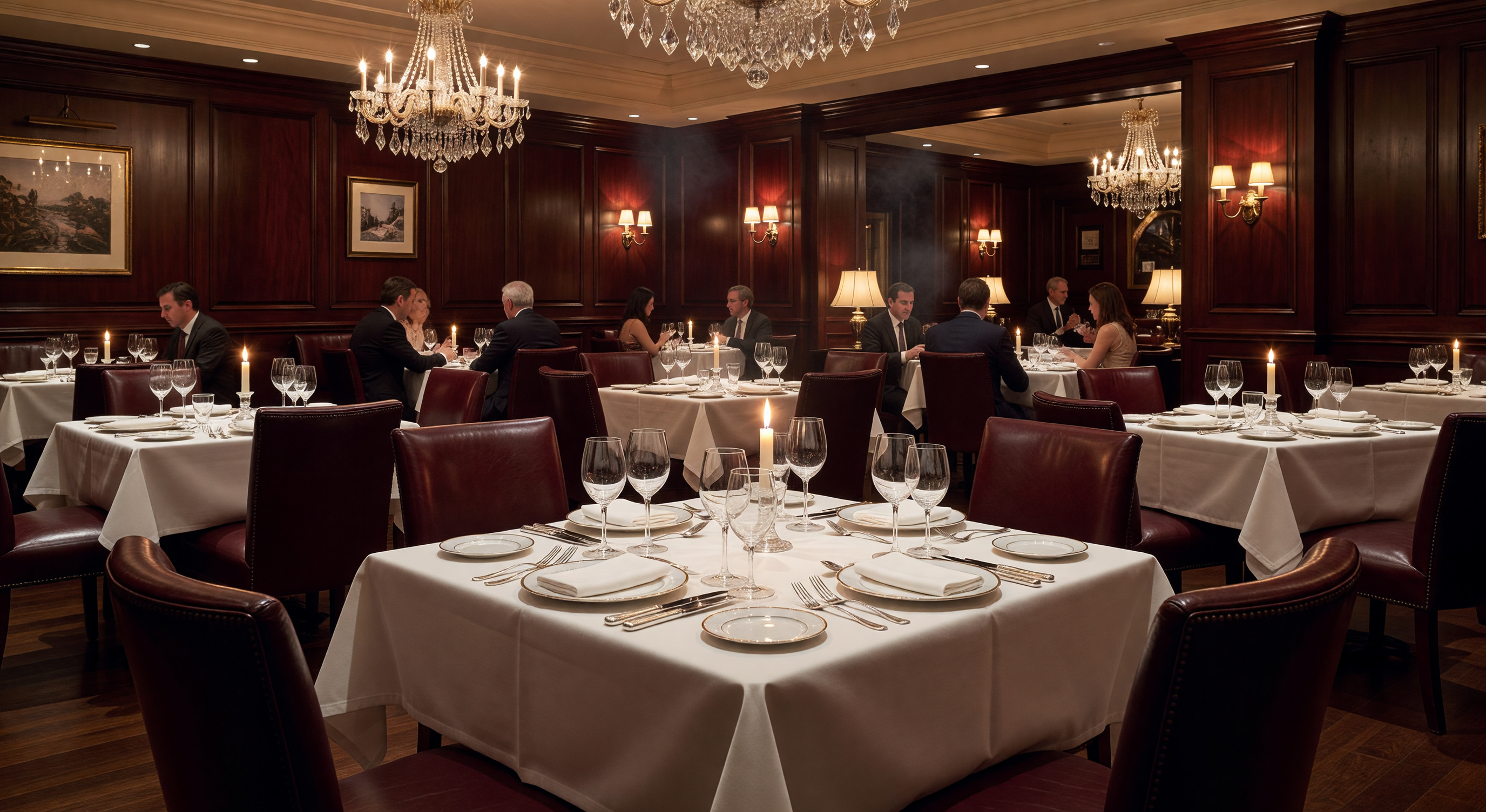
Morton’s The Steakhouse — founded in Chicago in 1978, built on USDA Prime beef, tableside service rituals, and the kind of check average that makes expense-account diners think twice — has been part of the Landry’s portfolio since 2011. With that acquisition came a structural change that still defines the loyalty experience for frequent Morton’s guests: there is no Morton’s-specific rewards program. Guests earn and redeem through the multi-brand Landry’s Select Club, the same card used at Bubba Gump Shrimp, Rainforest Cafe, and roughly 600 other Landry’s-owned concepts.
Understanding what that means in practice — and whether it serves a fine-dining diner well — is what this review is about.
How the program is structured
The Landry’s Select Club charges a one-time, non-refundable $25 membership fee. Within 24 hours of registration, a $25 Welcome Reward is credited to the account, making the effective first-year cost zero. The fee is never charged again; there is no annual renewal.
From that point forward, the earn mechanic is straightforward: one point for every dollar spent on food, beverage, retail, and gift card purchases at participating locations. Every 250 points converts to a $25 reward, automatically deposited into the member’s digital account. That math gives a flat 10% effective return at the point of redemption — a $25 reward on $250 in spend.
One reward lands automatically every year regardless of spend: the $25 Birthday Reward, credited on the first day of the member’s birthday month. It expires on the 15th of the following month, so there’s a roughly six-week window to use it.
Points and earned rewards expire 12 months from the date of issue. There is no tier system, no elite status, and no carry-forward for high-volume spenders.
What members actually get at Morton’s
At a real-world Morton’s dinner — call it a $280 check for two with cocktails — a Select Club member earns 280 points. After roughly four such dinners ($1,120 in spend), a $25 reward certificate unlocks. That is a 2.2% cash-back equivalent, which is the sustainable earn rate members should expect between birthday windfalls.
The birthday reward is where the program generates disproportionate value for a Morton’s diner. A $25 comp against a Morton’s entrée — which can run $60 to $85 for a prime cut — is a genuine 30-40% discount on that line item. Used strategically during a birthday dinner, it is the most meaningful single benefit the program delivers.
The priority seating benefit — available for parties of six or fewer, seven days a week, at participating locations — is the other understated advantage. At a busy Morton’s on a Friday night, a member who walks up without a reservation and receives a table within a reasonable wait has received something genuinely useful that does not show up in a points calculation.
Where the structure frustrates fine-dining expectations
The flat earn rate is the program’s defining tension at Morton’s. Fine-dining loyalty programs at comparable steakhouses typically offer either a percentage-back structure calibrated to the price tier, a multiplier on high-check spend, or a dedicated recognition layer for frequent guests. The Select Club offers none of these.
A Morton’s regular who spends $5,000 a year at the brand is recognized identically to a guest spending $500 at Bubba Gump. There is no tier reward for that loyalty, no table recognition, no accelerated earning. The program’s architecture was designed around a casual-to-polished casual portfolio, and Morton’s — acquired into that portfolio — participates without a carve-out for its price tier.
The certificate denomination creates a second friction point. A $25 reward is a meaningful discount at a $40 casual lunch. Against a $300 Morton’s dinner, it is a line item that registers, but barely. Percentage-back programs or higher-threshold certificates ($50, $100) would suit the price point better.
Points and rewards expiring at 12 months is another pressure point for the occasional fine-dining visitor. A guest who dines at Morton’s three or four times a year — but rarely visits other Landry’s brands — may find their earn rate outpaced by the expiration clock before a reward fully matures.
Finally, a small but notable asterisk: certain Morton’s locations are excluded from the program. Morton’s Saratoga, NY and Morton’s Grille Niagara Falls do not participate. Members traveling to those markets earn nothing.
Who gets the most from this program
The Select Club is structurally designed for breadth, not depth. A member who stays at a Golden Nugget hotel, eats at McCormick & Schmick’s on Tuesday, and dines at Morton’s for a special occasion will accumulate points across all three touchpoints and redeem them anywhere in the network. The cross-brand portability is the program’s genuine competitive advantage.
For that traveler and multi-brand Landry’s diner, the Select Club is straightforwardly worth the $25 entry. The Welcome Reward erases the fee. The annual birthday reward pays for itself. Priority seating across 600+ locations is a consistent operational benefit.
For a guest who dines exclusively or primarily at Morton’s, the math is thinner. The 2.2% sustainable earn rate is below what credit-card dining categories often provide, and there is no recognition premium for choosing one of Landry’s most expensive brands repeatedly. A Morton’s loyalist who dines at no other Landry’s concept would be better served by a premium dining rewards card and the comfort of reservations.
Compared to peer programs
The Palm 837 Club at The Palm Restaurant operates as a single-brand structure with table recognition and a more visible status layer for frequent guests — a better fit for guests whose loyalty is brand-specific. Del Frisco’s Double Eagle represents a third model. Each reflects different assumptions about who the loyal diner is and what they want recognized.
The Select Club wins on network scale and portability. It loses on fine-dining specificity. Which matters more depends entirely on whether the guest eats across the Landry’s portfolio or treats Morton’s as a standalone destination.
Bottom line
Landry’s Select Club is a well-constructed casual dining loyalty program that Morton’s participates in without modification. The $25 entry cost is trivially offset by the Welcome Reward, the birthday benefit generates genuine annual value, and priority seating is a real operational perk. But the program does not differentiate Morton’s guests from the rest of the Landry’s network in any meaningful way, and the flat earn rate with no premium for fine-dining spend is a structural mismatch with the brand’s price tier.
Join if you eat across the Landry’s portfolio. Join if you want the birthday comp and priority seating for a cost that pays for itself on the first visit. Skip or supplement with a premium credit card if Morton’s is your only Landry’s destination and you expect your loyalty to be recognized as such.
Frequently asked questions
Does Morton’s have its own loyalty program? No. Morton’s participates in the multi-brand Landry’s Select Club. There is no Morton’s-specific program.
What does membership cost? A one-time, non-refundable $25 fee. A $25 Welcome Reward is credited within 24 hours, making effective first-year cost zero. No annual renewal fee.
What is the earn rate at Morton’s? One point per dollar on qualifying food, beverage, retail, and gift card spend. No multiplier or premium for higher check averages.
How do points convert to rewards? Every 250 points earns a $25 reward, deposited automatically to the member’s digital account.
What is the birthday reward? A $25 reward credited on the first day of the member’s birthday month, expiring on the 15th of the following month.
Do points expire? Yes. Points and earned rewards expire 12 months from the date of issue. There is no extension or reinstatement for expired balances.
Are all Morton’s locations included? No. Morton’s Saratoga, NY and Morton’s Grille Niagara Falls are excluded from the program.
What is the priority seating benefit? Select Club members receive priority seating privileges at participating locations, seven days a week, for parties of six or fewer. Availability is not guaranteed during peak periods.
Further Reading from Authoritative Sources
- Morton’s The Steakhouse — Wikipedia provides documented background on Morton’s history, ownership, and brand positioning that contextualizes why the Landry’s Select Club’s flat earn rate is a structural mismatch with Morton’s fine-dining price tier.
- Landry’s Inc. — Wikipedia documents Landry’s Inc.’s portfolio scale — 80-plus brands across 600-plus locations — that is the basis of the cross-brand portability advantage the review identifies as the Select Club’s strongest differentiator for guests who dine across the Landry’s network.